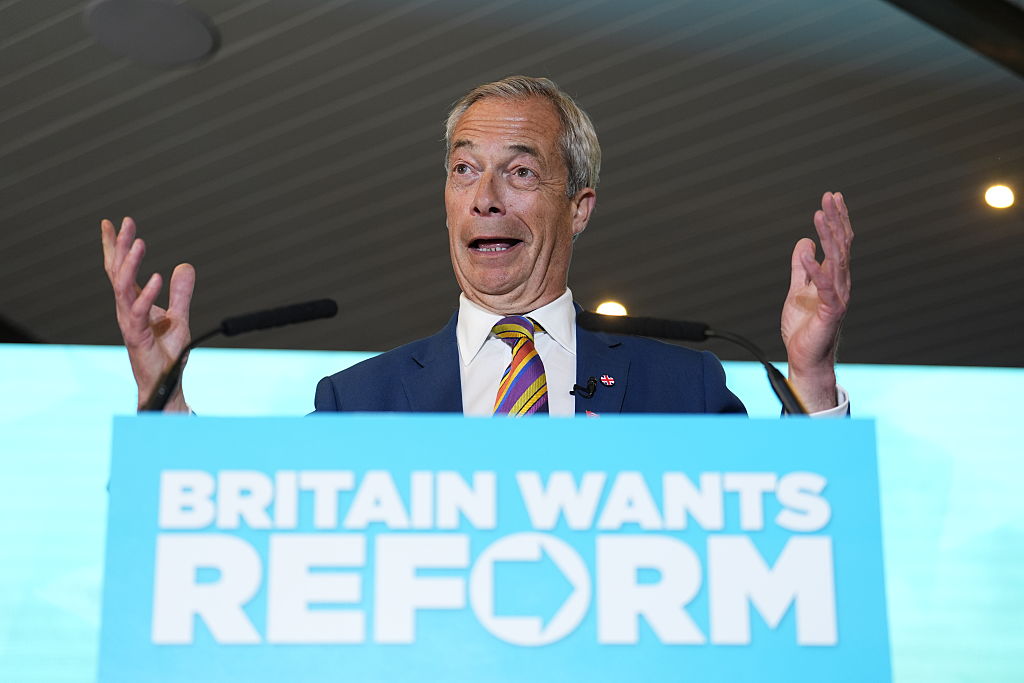
Britain’s local elections saw many left-wing votes shift to Zack Polanski’s Greens. But while the Labour Party’s support is plummeting, the big winners were Reform UK, as Nigel Farage conquers former Labour heartlands.
Speaking to the press early on Friday morning, the chairman of Nigel Farage’s Reform UK, David Bull, described the incoming results — delivering a sweeping victory for his party — as a “referendum on the Labour Party.” Farage concurred, adding that the unprecedented collapse of Labour majorities across the country represented a “truly historic shift.”
As the dust settles, it’s hard to disagree. In Wales, First Minister Eluned Morgan became the first leader of a British administration to lose her seat while in office. Welsh Labour fought a lackluster campaign under her leadership after her Starmerite predecessor resigned following revelations that he had lobbied environmental regulators to ease restrictions on a company owned by a businessman convicted of dumping waste into Welsh waters — from whom he also happened to have accepted £200,000.
A similar disaster unfolded in Scotland, where Labour leader Anas Sarwar returned the party’s worst result since the creation of the Scottish Parliament in 1999. In northern England, Labour fared little better. In Culture Secretary Lisa Nandy’s Wigan, twenty-four of twenty-five seats went to Reform UK. Elsewhere the Reform insurgency cost Labour control of Tameside, Redditch, and Halton. In Hartlepool, too, Reform became the largest party, while extreme fragmentation between the Greens and Reform in Newcastle left Labour with just two seats.
The Mandelson Referendum
In nearly every part of Britain, the historic collapse was reflected in Labour’s ground operation. Prime Minister Keir Starmer’s unashamed hollowing out of the party has created a level of disenfranchisement unseen even in Tony Blair’s worst days. Most local branches struggled to attract any volunteers whose salaries weren’t related to campaigning, while a social media strategy focused entirely on extreme personal nastiness toward rivals — the Labour right’s one trick — was enough to put off even the most loyal Labour members.
Those that dragged themselves door knocking were lucky to only encounter hissing antipathy, with many experiencing physical confrontation. A Tribune reader in Manchester reports being threatened with an industrial-strength water-pressure gun and getting called a “pedo lover,” while another canvasser in Newcastle described an “active hatred” that “made [Labour’s defeat in] 2019 seem like [Blair’s landslide in] 1997.”
Labour’s leadership, meanwhile, seemed largely oblivious. One member tells Tribune that Deputy Prime Minister David Lammy arrived to canvass in a London borough and was told his presence may negatively impact the vote. “If you know anyone who wants to shake David Lammy’s hand,” he replied, speaking in the third person, “they know where to find him.”
As the scale of the defeat became apparent, Jeremy Corbyn–era Shadow Chancellor John McDonnell called for broad discussion over how the party’s “worst nightmare” had come to pass. Many others delivered a harsh judgement on the leader.
Alongside the more than fifty MPs reportedly demanding Starmer’s resignation, former party chair Ian Lavery warned that “as Keir Hardie founded the Labour Party, another Keir may end it forever.” Leeds council chief whip Luke Farley remarked that “clearly, this leadership of the party is now coming to an end,” while MP Catherine West threatened to challenge Starmer for the leadership if no cabinet ministers moved against him by this Monday.
It would take a considerable craftsman to chisel the smile off the face of left-leaning voters contemplating Starmer’s difficulties. But beyond the schadenfreude that many will feel, these results are not pointing anywhere progressive.
In Lancashire, Preston’s socialist council fell to no overall control, weakening — though certainly not defeating — the redistributive radicalism of the “Preston Model.” In Salford, a council that has set no-cuts budgets, insourced social care services, pursued one of Britain’s most ambitious council house building schemes, and created one of the most hostile environments for rogue landlords, Labour shed thirteen of twenty-one seats, losing principled socialists such as deputy mayor and Unite union militant Jack Youd.
Yet the worst blow was in Wandsworth. In the London borough long considered a policy laboratory of Thatcherism, a dedicated Labour branch of socialists and community activists seized control in 2022 after a surprise Tory defeat. Once elected, they engaged in an ambitious program of council house building, neighborhood beautification, higher wages for local workers, expanded free school meals, and divestment from companies connected to Israeli war crimes. Despite the national picture, Wandsworth Labour defied expectations and won the popular vote. But though it held on to twenty-eight seats, the decisive twenty-ninth was lost by just sixteen votes.
The Greens, who doubled their vote share to 17.3 percent, deprived Labour of its majority and denied one of London’s most progressive councils another term in office. Now the socialist ambitions of councilors like Aydin Dikerdem have been voided for no gain.
But if Wandsworth was the base of Thatcherism’s cadre, then Lambeth occupies the same position in the Blairite imagination. The council Blair hailed as a “beacon of light” under Steve Reed’s stewardship is now dominated by the Greens. In Lewisham, where Labour bullied Councilor Liam Shrivastava out of the party for opposing genocide in Gaza, he returned as the Green mayor. In Manchester, where a developer-friendly council has treated local people with contempt for decades, eighteen of thirty-two seats went Green, knocking out senior Labour figures at town hall.
After Starmer
Bloodied noses are in abundance in the Labour camp. And yet the results still do not bode particularly well for the Left. Despite Zack Polanski claiming that “it’s very clear that the new politics is the Green Party versus Reform,” the overall picture inspires less confidence.
In London, downwardly mobile graduates and ethnic minority workers who have — with the exception of the Corbyn years — been treated contemptuously by Labour for much of this century have gone elsewhere in droves. The Greens’ willingness to run campaigns rooted in enthusiasm, idealism, and political conviction, rather than smears and fearmongering, contrasts sharply with Starmer’s Labour — and clearly inspired thousands of activists and voters. But outside the major cities, there are still too many places where the Greens’ impact has been minimal at best — or where, at worst, a split left-of-center vote has helped the Right advance.
Despite the obvious strengths of voting Labour and Green in different places, it’s hard to imagine any successful attempt to create an electoral pact. Any successor to Starmer will face pressures to appeal to the “Labour family,” while Manchester mayor Andy Burnham’s upcoming appearance alongside Greens at an event later this month has already provoked fury among Starmerite officials who have corroded Labour’s base while retaining institutional control over the party. By the same stroke, many decent people who were shown the door by the Labour leadership have now found a welcome political home in the Greens and have little interest in returning to a party that treats them with open contempt.
As a sleep-deprived Dikerdem said in a video mourning the end of the progressive gains he and his comrades made in Wandsworth, this council is the “canary in the coal mine.” Is every Labour council as good as Wandsworth? Obviously not. But equally, no Labour administration could be as aggressively reactionary as a Reform one — whether at the local level or in Westminster.
Facts Only
Reform UK secured sweeping victories in local elections, described as a "referendum on the Labour Party."
Welsh First Minister Eluned Morgan lost her seat, marking the first time a sitting British administration leader lost while in office.
Labour suffered significant losses in Scotland, with leader Anas Sarwar delivering the party’s worst result since 1999.
In Wigan, Reform UK won 24 of 25 seats, including Culture Secretary Lisa Nandy’s constituency.
Labour lost control of councils in Tameside, Redditch, Halton, and Hartlepool, where Reform UK became the largest party.
In Wandsworth, Labour lost a decisive seat by 16 votes, allowing the Greens to deprive them of a majority.
Greens doubled their vote share in Wandsworth to 17.3%, ending Labour’s control of the council.
In Lambeth, the Greens became the dominant party, displacing Labour.
Manchester saw 18 of 32 seats go to the Greens, unseating senior Labour figures.
Labour’s campaign faced internal strife, with volunteers reporting hostility and physical confrontations while canvassing.
Over 50 Labour MPs reportedly called for Keir Starmer’s resignation following the election results.
Former Labour chair Ian Lavery warned that Starmer’s leadership could end the party, echoing founder Keir Hardie’s legacy.
Executive Summary
Full Take
The local election results reveal a fractured political landscape, where Labour’s collapse has benefited both Reform UK and the Greens, but with starkly different implications. The strongest version of this narrative highlights Labour’s self-inflicted wounds—Starmer’s alienation of the party’s base, a campaign strategy rooted in personal attacks, and a failure to inspire volunteers—while acknowledging Reform UK’s effective exploitation of discontent in former Labour heartlands. The Greens’ gains, particularly in urban areas, reflect a hunger for progressive alternatives, but their limited reach outside cities raises questions about scalability.
Patterns detected: ARC-0024 Ambiguity (framing Labour’s losses as solely due to internal failures without deeper systemic analysis), ARC-0043 Motte-and-Bailey (implying Reform UK’s rise is a direct repudiation of Labour without addressing broader voter disillusionment).
The root cause appears to be a paradigm shift in voter trust, where traditional party loyalties are eroding. Labour’s embrace of centrist, technocratic leadership has alienated both its left-wing base and working-class voters, who now see Reform UK as a protest vehicle. Meanwhile, the Greens’ idealism contrasts sharply with Labour’s perceived cynicism, but their inability to consolidate left-of-center votes risks ceding ground to the right.
Implications for human agency are profound: voters are rejecting established political frameworks, but the alternatives—Reform UK’s nationalism and the Greens’ urban progressivism—offer divergent futures. The second-order consequences include further polarization, with Reform UK’s gains potentially normalizing far-right rhetoric, while the Greens’ rise could pressure Labour to recommit to progressive policies—or double down on centrist triangulation.
Bridge questions: How might Labour rebuild trust without reverting to Blairite or Corbynite extremes? Could an electoral pact between Labour and the Greens emerge, or is the rift too deep? What would it take for Reform UK’s support to translate into national electoral success?
Counterstrike scan: A coordinated influence campaign would amplify Labour’s failures while downplaying systemic discontent, framing Reform UK as the sole beneficiary of voter anger. The actual content aligns partially—highlighting Labour’s collapse but also noting the Greens’ role—suggesting a nuanced rather than manipulated narrative.
Sentinel — Human
This analysis appears to be a human-written piece characterized by narrative storytelling and localized, specific examples, rather than purely synthetic, generalized reporting.