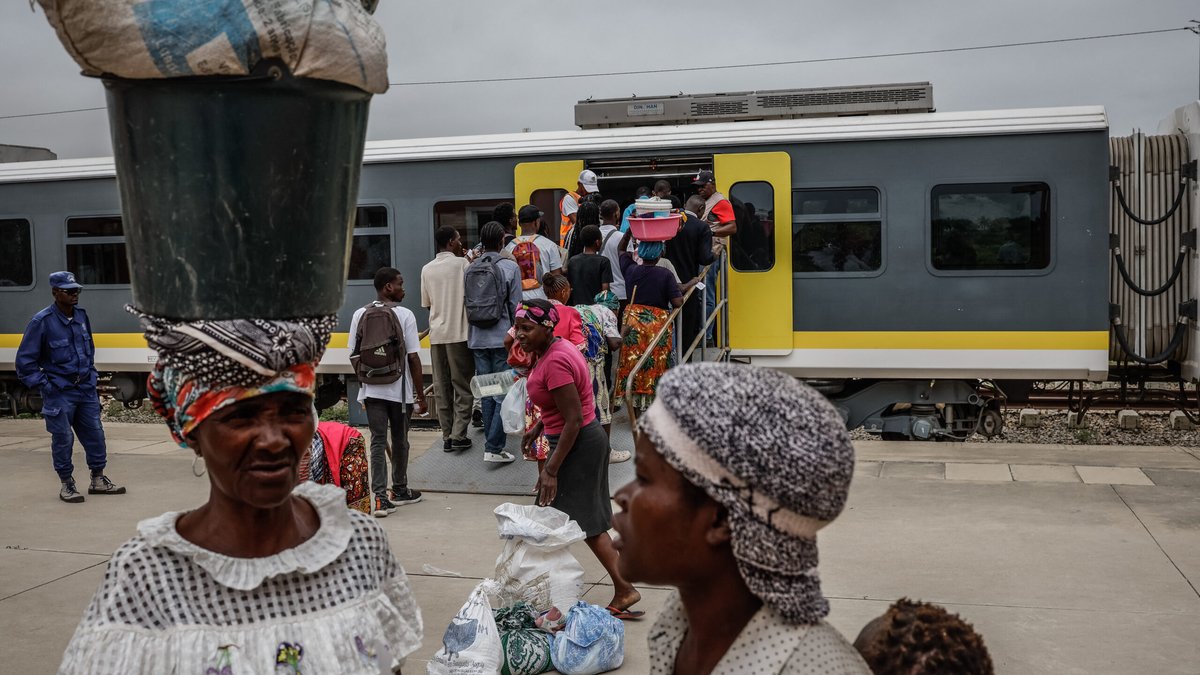
The region of the Southern African Development Community (SADC) is witnessing substantial developments in its crucial railway corridors, emphasising the increasing role of railways in boosting regional trade, reducing logistics costs and promoting cross-border connectivity.
South Africa, SADC’s biggest economy, has opened its freight rail network to private train operators in the country’s biggest rail reform in decades. The development has been mooted for almost a year, but in mid May 2026 Pretoria finally confirmed it.
The move is significant because South Africa controls Africa’s largest freight rail network, with more than 20,000 km of rail routes. The network is central to exports from some of the country’s biggest industries, including mining, automotive manufacturing and agriculture.
South Africa has, like SADC’s other 15 member states, long largely relied on road transportation, but recent investments in rail infrastructure indicate a strong momentum that sees railways as a cost-effective and sustainable alternative. This highlights the commitment to boosting regional trade and creating more interconnected economies. As rail corridors become more reliable and cost-effective they are set to play an increasingly vital role in SADC’s logistics landscape, supporting the region’s goals for economic integration and sustainable development.
Aligned with the objectives of the African Continental Free Trade Area (AfCFTA), these corridors represent significant progress towards regional economic integration.
North-South Corridor
Perhaps the most ambitious and vital infrastructure proposal is the North-South Corridor, which links the DRC and Zambia in the north with the economic powerhouse of South Africa in the south. In recent years, the corridor has seen significant upgrades aimed at enhancing capacity, reducing delays and minimising wear on rail infrastructure. The Zambian and Zimbabwean governments have prioritised upgrades on their portions of the corridor, including new rolling stock and track repairs.
In South Africa, state transport company Transnet is involved in an initiative to expand the rail freight capacity on its northern routes.
The planned upgrades include additional signalling systems, increased cargo handling capabilities and the establishment of dedicated freight lines.
Lobito Corridor railway
The Lobito Corridor, stretching from the port of Lobito in Angola to the DRC and Zambia, is another rail corridor undergoing transformative changes. Its development may offer other corridors an example of how public-private partnerships can facilitate progress. Angola has invested heavily, with assistance from private-sector partners, in modernising this route for the transport of copper, cobalt and other valuable minerals from the DRC and Zambia to the Atlantic coast.
The recent concession of the Lobito rail corridor to a private consortium – the Lobito Atlantic Railway, backed by Trafigura, Mota-Engil and Vecturis – is expected to bring in nearly $500m in investments to upgrade and maintain the rail network, signalling Angola’s commitment to developing itself as a logistics hub for the region. The Africa Finance Corporation (AFC) – the Lagos-based lead developer of the rail corridor – called for proposals from contractors for the Zambia leg of the railway by the end of May, having undertaken a feasibility study earlier. “This is the most exciting thing I’ve seen happen in Africa in years,” enthused Mahesh Kotecha, the president of a New York-based financial advisory firm Structured Credit International Corporation.
Amadou Wadda, the AFC’s senior director of portfolio management, told the Africa We Build summit in Nairobi in April that the AFC is seeking financial close for the project, and possible exit in the fourth quarter of 2027, by crowding-in private capital in keeping with the Corporation’s “exit discipline”.
In 2023 the Kamoa-Kakula mine – the largest and highest-grade copper mine in the DRC, a joint venture between Canada’s Ivanhoe Mines, China’s Zijin Mining and the DRC government – became the first industrial user of the Lobito Corridor’s railway infrastructure.
By 2024 the mine had both negotiated a $150m loan from the AFC to expand the mine itself and signed an agreement to use the Lobito Corridor to transport up to 240,000 tonnes of “blister-anode” copper and ore concentrate per year. Although seismic activity in May 2025 resulted in flooding and a drop in copper production, the impact on the use of the rail link is expected to be minimal.
Before utilising the Lobito Corridor, the Kamoa-Kakula mine relied on trucks to haul copper concentrate across sub-Saharan Africa to the ports of Durban in South Africa, Dar es Salaam in Tanzania, Veria in Mozambique and Walvis Bay in Namibia. The port of Lobito is approximately half the distance of that between Durban and the Kamoa-Kakula mine.
Chicualacuala – Dabuka Corridor
The Chicualacuala rail line is a section of the Limpopo Railway, which connects the cities of Maputo in Mozambique and Somabhula in Zimbabwe. The line is part of a larger project to develop both railway and port infrastructure across the region. The line is soon to be upgraded at a cost of $10m, with rehabilitation work involving 614 km of track aimed at improving the movement of coal from Botswana into Zimbabwe and then on to Maputo
The National Railways of Zimbabwe has made significant progress in refurbishing wagons and locomotives through its ongoing public-private partnership (PPP) with mining firm Zimasco, a move aimed at improving operational efficiency and reinforcing rail as a preferred mode of bulk cargo transport.
Mmamabula – Lephalale
The corridor proposal to connect Botswana and South Africa focuses initially on coal as the “anchor mineral”. Anura Partners, which is advising on the project, says that the firm “developed a unique and comprehensive understanding of how and why this Botswana-South Africa Rail Corridor project could be instrumental in the economic growth and social development of both countries and the region”.
The firm goes on to say that the corridor “will unlock Botswana’s mineral potential, support South Africa’s bulk commodity export needs and bolster regional trade connectivity,” reaching Zambia and the DRC along the North-South Corridor. The company says that the project is essential for meeting South Africa’s growing energy needs as the country’s coal reserves decline, while facilitating Botswana’s freight and petroleum imports and diversified mineral exports.
South Africa’s 41.1 GW fleet of coal-fired plants accounts for the vast majority (86%) of the continent’s total. Botswana (400 MW) and Zambia (300 MW) also have notable installed coal-fired capacity, according to African Energy Live Data figures.
Nacala Corridor
The Nacala Corridor connects the interior regions of Mozambique, Malawi and Zambia to the Indian Ocean port of Nacala, and its railway line has recently undergone major upgrades, transforming it into a viable route for agricultural exports and mining products.
This corridor is a joint project between Mozambique, Malawi and Zambia, with backing from international investors and development banks. The corridor’s extensive upgrades include the construction of a deep-water port at Nacala and the rehabilitation of existing rail infrastructure, enhancing capacity and reducing costs.
The corridor, which has been in operation since 2016, is a $4.5bn investment that was initially backed by the Brazilian multinational Vale, which exited the project, transferring various assets to the Japanese conglomerate Mitsui and the state-owned company Portos e Caminhos de Ferro de Moçambique (ports and railways).
The project includes a deep-water port in Nacala in northern Mozambique, linked to a 912 km railway line, which transports coal mined in the inland province of Tete. Nacala is the deepest Indian Ocean port on the African coastline.
The Japanese ambassador to Mozambique estimated that approximately 30 Japanese companies had an interest in the Nacala Corridor, and the development of the Port of Nacala in particular could serve as a gateway for new business creation and regional growth.
During the Ninth Tokyo International Conference on African Development (TICAD9), in August 2025, Mozambique’s president, Daniel Chapo, highlighted the “enormous potential” of the route, which connects Mozambique to landlocked neighbours, calling for an investment from Japan to ensure its rapid, large-scale implementation – and an alternative (alongside TAZARA; see below) for central Africa to export its mineral resources to Asia.
TAZARA
This iconic rail line, running for 1,860 km between Dar es Salaam in Tanzania and New Kapiri Mposhi in Zambia’s copper-belt, is one of China’s earliest and most ambitious infrastructure projects in Africa. Completed in 1975, it features 320 bridges and 22 tunnels. The rationale for building the line, employing 50,000 Africans and 25,000 Chinese workers, was to provide Zambia with an alternative route to export its copper, avoiding South Africa, then under a hostile apartheid regime, and neighbouring white-minority controlled territories.
Following South Africa’s democratisation, TAZARA fell into relative decline, until a tripartite agreement reached between Zambia, Tanzania and China in 2025 saw a $1.4bn capital investment programme take shape to revitalise the railway.
The three-year rehabilitation programme is already under way, and it is envisioned that within four years freight volumes will grow from the current 400,000 tonnes to over 2.4m tonnes while the transit time for freight between Dar es Salaam and New Kapiri Mposhi will be reduced from its current 7 to 10 days to under five days, while passengers should be able to travel the route in less than 72 hours.
Upgraded track infrastructure, new rolling stock, renovated workshops and quarries and improved operational efficiency will position TAZARA as a competitive, reliable backbone corridor for regional trade between SADC countries and East Africa. It may in the future form part of the Trans-Africa Railway, a proposed 7,800 km, $13bn project linking Dar es Salaam to Djibouti via inland countries.
TAZARA is calling for investments along the corridor to maximise the railway’s impact, including manufacturing zones near key stations; agro-processing facilities to support exports; inland container depots along the route; and the transportation of minerals to reduce logistics costs, create jobs and transform the railway corridor into a thriving competitive economic belt.
Tanzania’s standard gauge railway
Tanzania is constructing a high-speed electric 1,219 km standard gauge railway (SGR) line from the port of Dar es Salaam to Mwanza, with a target speed for passenger trains of up to 160 kilometres per hour and freight trains of up to 120 kilometres per hour. A 371 km branch from Isaka to Rusumo is planned to connect onwards to Kigali in Rwanda. The SGR will be Africa’s first long-distance electric railway. It is designed to connect Dar es Salaam’s port with Tanzania’s interior and onward to Rwanda, Burundi, the DRC and Uganda.
The first phase, from Dar es Salaam to Dodoma, is already operational – and said to be regularly used by Tanzania President Samia Suluhu Hassan to travel between Dar es Salaam, the country’s economic capital, and Dodoma, its political capital.
Further phases are under construction. The lead contractor is the Turkish construction company Yapi Merkezi. In addition to the single-track railway project in Tanzania, Yapi Merkezi has also constructed three stations between Tabora and Isaka, a maintenance workshop and depot area; a building for student training; an administration building; and all signalling, telecommunications and electrification works. This $900m project is planned to be completed in 42 months.
Yapi Merkezi is also contracted to renovate the line from Malaba, on the Kenya-Uganda border, to Kampala, a 227 km main line route that has been out of service for decades. This project will provide a rail link from the DRC, Uganda, Rwanda and Burundi to Kenya’s port city of Mombasa.