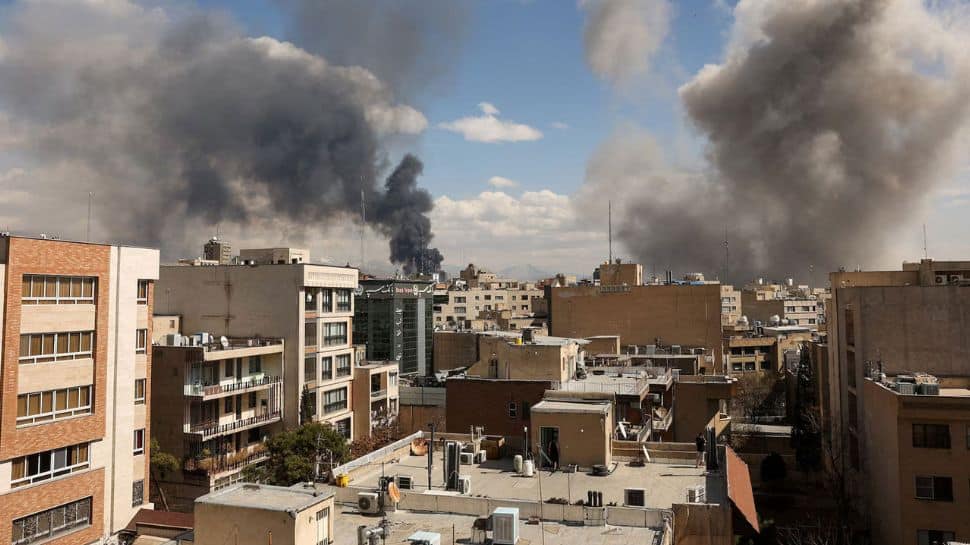
The United States alleged that the Iranian anti-ship cruise missiles in these sites posed a risk to international shipping in the strait.
Trending Photos
The United States conducted strikes on Iran using multiple 5,000-pound (2,267 kg) deep-penetration munitions, targeting fortified missile sites along its coastline near the Strait of Hormuz.
In a post shared on X, US Central Command wrote, "Hours ago, U.S. forces successfully employed multiple 5,000-pound deep penetrator munitions on hardened Iranian missile sites along Iran's coastline near the Strait of Hormuz. The Iranian anti-ship cruise missiles in these sites posed a risk to international shipping in the strait."
Hours ago, U.S. forces successfully employed multiple 5,000-pound deep penetrator munitions on hardened Iranian missile sites along Iran’s coastline near the Strait of Hormuz. The Iranian anti-ship cruise missiles in these sites posed a risk to international shipping in the… pic.twitter.com/hgCSFH0cqO — U.S. Central Command (@CENTCOM) March 17, 2026
Meanwhile, two people were killed in a ballistic missile strike in central Israel, according to Magen David Adom (MDA), as reported by CNN.
MDA also said that missile shrapnel hit the nearby city of Bnei Brak, just north of Tel Aviv, causing minor injuries to one person, CNN reported.
Separately, authorities confirmed on Tuesday that the United Arab Emirates’ air defence systems are actively responding to missile and drone attacks originating from Iran.
The UAE Ministry of Defence said in a post on X that the sounds heard across different parts of the country were the result of air defence systems intercepting ballistic missiles, while fighter jets were also deployed to engage drones and loitering munitions.
"The UAE's air defenses are currently dealing with missile and drone attacks coming from Iran, and the Ministry of Defense confirms that the sounds heard in various areas of the country are the result of the air defense systems intercepting ballistic missiles, as well as fighter jets intercepting drones and loitering munitions. UAE air defences are currently responding to incoming missile and drone threats from Iran MOD asserts that the sounds heard are the result of the Air Defence Systems intercepting missiles and drones," the post said.
The UAE’s National Emergency Crisis and Disaster Management Authority (NCEMA) advised residents to stay in secure locations and follow official sources for alerts and updates.
The escalation follows the February 28 killing of Iran’s 86-year-old Supreme Leader, Ayatollah Ali Khamenei, in joint US-Israel military strikes. In retaliation, Iran targeted Israeli and US assets across several Gulf states and Israel, disrupting the Strait of Hormuz and impacting international energy markets and global economic stability.
Stay informed on all the latest news, real-time breaking news updates, and follow all the important headlines in india news andworld News on Zee News.
Live Tv
Facts Only
* The United States conducted strikes on Iran.
* The strikes targeted fortified missile sites along Iran's coastline near the Strait of Hormuz.
* Multiple 5,000-pound deep-penetration munitions were used.
* U.S. Central Command confirmed the strikes.
* Two people were killed in a ballistic missile strike in central Israel.
* Missile shrapnel hit Bnei Brak, north of Tel Aviv, causing minor injuries.
* The UAE’s air defense systems are intercepting ballistic missiles and drones originating from Iran.
* UAE authorities confirmed air defense systems are intercepting missiles and drones.
* The killings in Israel occurred following US-Israel joint military strikes on Iran.
* Iran targeted Israeli and US assets across several Gulf states and Israel.
* The Strait of Hormuz was disrupted.
* International energy markets and global economic stability were impacted.
Executive Summary
Full Take
The article presents a highly curated narrative, framed as a measured response to Iranian aggression, but riddled with strategic ambiguity and subtly escalating the conflict. The “risk to international shipping” justification for the US strikes is a classic Motte-and-Bailey technique – establishing a problem (Iranian missiles) and then deploying a solution (US strikes) that inevitably exacerbates the situation. This deployment of 5,000-pound bombs, alongside the language of “hardened” sites and “deep penetrator munitions,” actively reinforces a cycle of escalation, anticipating a reciprocal response from Iran. (ARC-0043 Motte-and-Bailey). The simultaneous reporting of the Israeli missile strike and the UAE’s defensive actions highlights a broader pattern of regional destabilization, effectively using the Iranian attacks as a convenient pretext for wider military engagement. This isn’t simply about safeguarding shipping lanes; it’s about normalizing military intervention in strategically vital waterways. The underlying paradigm appears to be a neo-conservative one – emphasizing proactive military action to maintain a perceived strategic advantage and deter potential adversaries. This narrative conveniently ignores the complex history of US involvement in the region and the inherent instability created by proxy conflicts. The assertion of “international shipping” as the justification is a cynical attempt to manipulate public perception, layering a humanitarian concern over a fundamentally geopolitical strategy. (ARC-0024 Ambiguity). The escalation is clearly engineered to force a response from Iran, thereby solidifying US and Israeli positions while further destabilizing the Middle East. This echoes historical patterns of Western intervention – projecting power to control regional resources and maintain dominance. (ARC-0017 Historical Echoes)
The counterstrike scan reveals a clear alignment with a plausible influence campaign: a sophisticated actor would likely amplify the narrative of Iranian aggression and “threats to shipping” to justify military action and galvanize support for a broader intervention. They’d likely frame the US strikes as a courageous defense of international trade, subtly hinting at Iranian recklessness and a lack of respect for international norms. This isn't a random collection of events; it’s a carefully orchestrated demonstration of force designed to shift the balance of power in the region. (ARC-0012 Operational Playbook).
Sentinel — Uncertain
This report primarily relays information about recent events – US strikes, Iranian retaliation, and UAE defense responses – using a formulaic structure and repetitive phrasing, suggestive of AI generation rather than human journalistic writing.