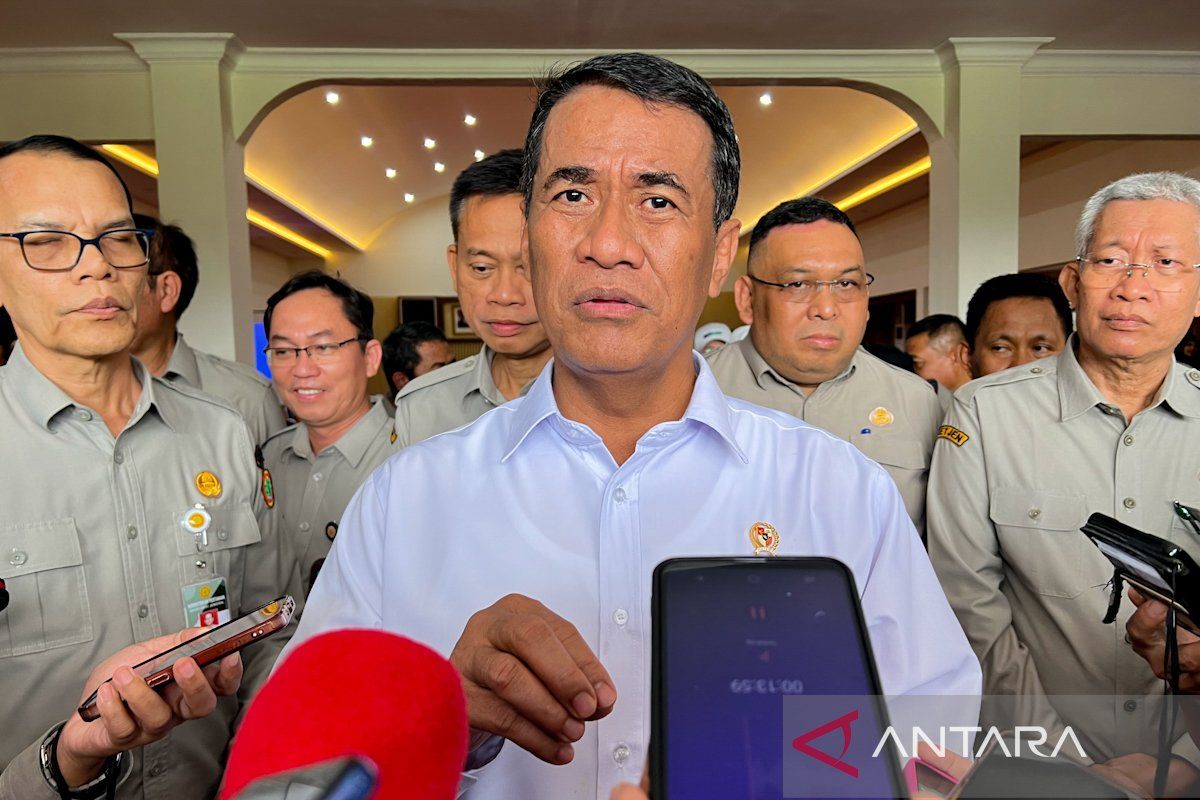
Indonesia’s Minister of Agriculture Andi Amran Sulaiman said downstream processing is key to strengthening the economy, boosting energy independence, and securing food resilience amid global uncertainty.
Speaking in Jakarta on Saturday, the minister said Indonesia must stop exporting raw commodities and instead expand downstream industries to capture higher added value domestically.
He highlighted key commodities such as coconut, crude palm oil (CPO), and gambier, saying their derivatives—ranging from processed oils to industrial products—could significantly increase economic returns compared with raw exports.
Indonesia is the world’s top coconut producer, but much of its output is exported unprocessed, he said, noting products like virgin coconut oil, coconut milk, and coconut water could multiply value by tens to hundreds of times.
“If coconut is processed into virgin coconut oil, coconut milk, and coconut water, the value can increase tens to hundreds of times,” he said.
He added that Indonesia supplies about 80 percent of global gambier demand, yet exports it mostly in semi-processed form, allowing other countries to capture higher value.
Amran also pointed to palm oil, saying Indonesia controls more than 60 percent of global CPO production, which could be transformed into higher-value goods such as margarine and cosmetics.
He said downstreaming would not only strengthen the national economy but also improve farmers’ welfare, create jobs, and enhance Indonesia’s global economic position. However, he acknowledged challenges, including resistance from parties opposed to Indonesia reducing imports and becoming more self-reliant in food and energy.
The government remains committed to advancing downstreaming, food self-sufficiency, and energy independence in line with President Prabowo Subianto’s directives, he said.
Amran said Indonesia’s reduced rice imports—cut by up to 7 million tons, equivalent to about Rp100 trillion—had contributed to a drop in global rice prices from US$660 per ton to US$340 per ton, or around 44 percent.
He added that Indonesia’s food sector gains had earned international recognition, including global food security awards from the Food and Agriculture Organization (FAO) in 2024 and 2025.
The achievements have attracted interest from countries such as Japan, Canada, Chile, and Belarus, which have visited Indonesia to study its food system.
Amran warned that food security is critical aspect, noting that a food crisis could trigger political instability and social conflict, making it a top national priority.
Related news: Indonesia to review more mining export bans : Minister
Related news: RI Govt to break ground on six downstream projects by January end
Related news: Danantara breaks ground on US$7 bln Indonesia downstream projects
Translator: Muhammad Harianto, Martha Herlinawati Simanjuntak
Editor: M Razi Rahman
Copyright © ANTARA 2026
Facts Only
Indonesia’s Minister of Agriculture, Andi Amran Sulaiman, spoke in Jakarta on Saturday.
He stated that downstream processing is key to strengthening the economy, boosting energy independence, and securing food resilience.
Indonesia is the world’s top coconut producer, but much of its output is exported unprocessed.
Products like virgin coconut oil, coconut milk, and coconut water can increase value by tens to hundreds of times compared to raw exports.
Indonesia supplies about 80% of global gambier demand, mostly in semi-processed form.
Indonesia controls over 60% of global crude palm oil (CPO) production.
Downstream processing of palm oil could produce higher-value goods like margarine and cosmetics.
The minister acknowledged challenges, including resistance from parties opposed to reducing imports.
The government is committed to advancing downstreaming, food self-sufficiency, and energy independence.
Indonesia’s rice imports have been reduced by up to 7 million tons, contributing to a drop in global rice prices from US$660 to US$340 per ton.
Indonesia has received global food security awards from the FAO in 2024 and 2025.
Countries such as Japan, Canada, Chile, and Belarus have visited Indonesia to study its food system.
Executive Summary
Indonesia’s Minister of Agriculture, Andi Amran Sulaiman, emphasized the importance of downstream processing to strengthen the economy, enhance energy independence, and secure food resilience amid global uncertainty. Speaking in Jakarta, he argued that Indonesia must shift from exporting raw commodities to developing downstream industries to capture higher added value domestically. Key commodities like coconut, crude palm oil (CPO), and gambier were highlighted, with processed derivatives such as virgin coconut oil, margarine, and industrial products offering significantly higher economic returns than raw exports. Indonesia, as the world’s top coconut producer and a major supplier of gambier and palm oil, currently exports much of these commodities unprocessed or semi-processed, allowing other countries to benefit from higher-value production.
The minister noted that downstream processing would not only boost the national economy but also improve farmers' welfare, create jobs, and elevate Indonesia’s global economic standing. However, he acknowledged challenges, including resistance from parties opposed to reduced imports and increased self-reliance. The government remains committed to advancing downstreaming, food self-sufficiency, and energy independence, aligning with President Prabowo Subianto’s directives. Indonesia’s reduced rice imports, cut by up to 7 million tons, have contributed to a 44% drop in global rice prices, earning international recognition, including food security awards from the FAO. The country’s food sector achievements have attracted interest from nations like Japan, Canada, Chile, and Belarus, which have studied Indonesia’s food system. Amran warned that food security is critical to preventing political instability and social conflict, making it a national priority.
Full Take
The strongest version of this narrative presents Indonesia’s push for downstream processing as a strategic move to enhance economic resilience, reduce dependency on raw commodity exports, and secure food and energy independence. The minister’s arguments are grounded in tangible examples—coconut, palm oil, and gambier—where value addition could significantly boost economic returns. The claim that Indonesia’s reduced rice imports have lowered global prices by 44% lends credibility to the policy’s impact, while international recognition from the FAO and interest from other nations reinforce the narrative of success.
However, the narrative also contains elements of **ARC-0024 Ambiguity** and **ARC-0043 Motte-and-Bailey**. The minister acknowledges resistance to downstreaming but does not specify who opposes it or why, leaving room for unanswered questions about potential trade-offs, such as short-term economic disruptions or geopolitical tensions with trading partners. The framing of food security as a critical national priority to prevent instability is valid but could also be leveraged to justify centralized control over agricultural policies, raising questions about transparency and accountability.
The root cause of this narrative is a paradigm of economic nationalism, where self-reliance and domestic value capture are prioritized over global trade integration. This echoes historical patterns of import substitution industrialization, which have had mixed results in other developing economies. The implications for human agency are dual: farmers and local industries may benefit from higher-value production, but consumers could face higher prices if imports are restricted. The second-order consequences include potential trade disputes if Indonesia’s export bans or import reductions disrupt global supply chains.
Bridge questions to consider: What are the specific risks of resistance to downstreaming, and who stands to lose from this policy shift? How might Indonesia balance domestic processing with maintaining its role as a global commodity supplier? What safeguards are in place to ensure that smallholder farmers, not just large corporations, benefit from downstream industries?
Counterstrike scan: If this were part of a coordinated influence campaign, the playbook would emphasize economic nationalism, frame opposition as unpatriotic, and use selective data (e.g., FAO awards) to bolster credibility while downplaying challenges. The actual content aligns with this pattern to some extent but does not exhibit overt manipulation. The focus on tangible economic benefits and international recognition suggests a genuine policy push rather than a deceptive narrative.