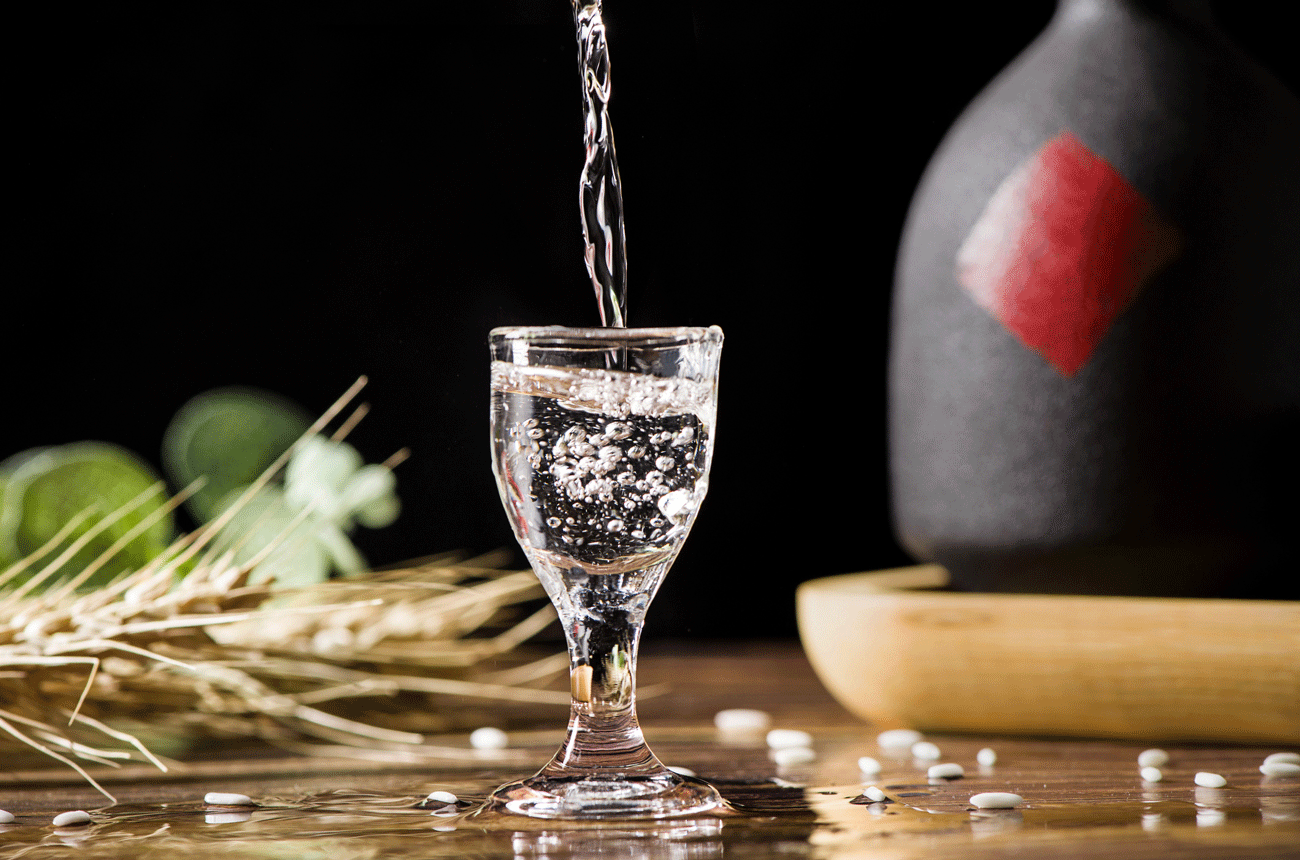
Never heard of baijiu? You’re not alone. Adele Irimiea meets Ben Salguero, who is on a mission to bring China’s national spirit into the Western mainstream.
Get our daily fine wine reviews, latest wine ratings, news and travel guides delivered straight to your inbox.
You are now subscribed
Your newsletter sign-up was successful
You’d be forgiven for not knowing that the world’s most valuable spirits brand is the Chinese baijiu producer Moutai. In fact, according to the Brand Finance report Alcoholic Drinks 2025, Moutai’s brand value is roughly equal to that of the top 10 spirits brands combined – a list that includes only four non-baijiu brands: Hennessy, Jack Daniel’s, Bacardi and Johnnie Walker.
In 2025, Moutai’s brand value alone was estimated at $58.4 billion, placing it 20th in the Global 500 rankings alongside companies such as Apple, Microsoft and Google, as listed in the Global 500 2025 report by Brand Finance.
Defined as a white spirit, baijiu is a category that remains remarkably underexamined and widely misunderstood. It is among the earliest distilled alcohols in the world, dating to the Ming Dynasty of 1368-1644; making China home to the world’s oldest continuously operating distillery – Luzhou Laojiao – founded in 1573. Yet despite these facts, baijiu remains little known outside China.
The baijiu champion
To understand why baijiu has remained so obscure internationally, it’s necessary to grasp the complexity of the category itself. Few people understand this better than Ben Salguero, a UK baijiu specialist and owner of Jaded Dragon bar in Bristol, home to Europe’s largest collection of baijiu.
Salguero has dedicated his career to bringing baijiu to Western consumers and educating them about the spirit, which he describes as ‘unlike anything else’ and predicts is ‘heading towards its heyday’, much as rum and tequila have over the past decade.
‘It’s bizarre that it’s 2026 and there’s this whole category of alcohol that is still unknown to most of the world,’ he says.
Understanding baijiu
Baijiu, commonly distilled from a cereal grain called sorghum, is the national drink of China and has 12 recognised styles, each distinct in production and character. The four principal ‘aroma’ categories are strong, light, rice and sauce.
Get our daily fine wine reviews, latest wine ratings, news and travel guides delivered straight to your inbox.
Strong-aroma baijiu is associated with tropical fruit notes such as guava and pineapple, alongside unexpected flavours like bubble-gum. Sauce-aroma baijiu is deeply savoury and food-driven, with characteristics reminiscent of dark chocolate, Marmite and soy sauce.
Light-aroma baijiu commonly displays flavours of sesame, white chocolate, bell pepper and even Brussels sprouts. Rice-aroma baijiu, by contrast, can be likened to distilled sake, offering notes of seaweed, melon and gentle salinity.
For drinkers familiar with high-ester rum, baijiu can be understood through a similar lens. Rum contains a complex range of volatile compounds, with up to 184 distinct compounds identified. Sauce-aroma baijiu, by comparison, contains more than 500.
A matter of taste
‘That’s the intensity of flavour, the tasting is exciting. You’re tasting a memory, in a very romantic sense,’ says Salguero. ‘When we taste distilled alcohol – not whisky, where wood plays a role, but white spirits – we are tasting the esters carried through distillation,’ he explains.
‘Fundamentally, they come from fatty acids created during the fermentation of the original food source. Those acids themselves don’t have flavour, but when they hit your tongue, your brain recognises them. It recalls something you’ve tasted before. In that way, you are quite literally tasting memory at its core.’
Salguero says his customers’ reactions to baijiu have been largely positive, with the greatest resistance surprisingly coming from bartenders, many of whom express a ‘fear’ towards the category.
Meanwhile the general public are more open-minded. ‘Even if they decide they don’t like it, they’re still willing to try,’ says Salguero.
Brands and bottles
In the UK, more accessible baijiu brands include Ming River, known for its approachable and fruity profile, and Moutai, characterised by its intense savoury and nutty flavour. One persistent challenge, however, is labelling.
‘If you can’t read Chinese, you often don’t know what you’re buying,’ Salguero explains. ‘The bottles are very traditional. I’ll pick up a bottle I’ve never seen before and won’t know anything about it.’
This is why specialist bars such as Jaded Dragon play a crucial role. Traditionally, baijiu is drunk neat in small 15ml ganbei cups. However, Salguero believes cocktails are key to its Western adoption.
In this sense, baijiu occupies a unique position in the global spirits landscape. ‘It is simultaneously an ancient and a new spirit,’ says Salguero. Although obscure outside China, the category may now be entering a new phase of global recognition.
One to try: Ming River Sichuan Baijiu
Ming River is a fresh-floral Sichuan (referring to the strong aroma style associated with highly aromatic and fruity flavours) from Luzhou, crafted in China’s oldest distillery. It has strong aromas of ripe tropical fruit with notes of green apple, pear, pineapple, melon, guava and pink peppercorn. On the palate, it is tangy, funky and tropical. Serve neat at room temperature in 15ml shot glasses or try it in a cocktail (see below). Alcohol 45%
Make a baijiu cocktail
Ming River Sichuan Baijiu also works well as a rum alternative. Using it in a Daiquiri is a great first-time drinking experience.
Baijiu Daiquiri
Glass: Coupe
Garnish: Lime wedge
Method: Put the baijiu, lime juice and sugar syrup into a cocktail shaker. Half fill with ice and shake until your hands are cold. Strain into a chilled coupe, garnished with a lime wedge on the rim.
40ml Ming River Sichuan Baijiu
30ml freshly squeezed lime juice
20ml sugar syrup
Understanding soju: The world’s best-selling spirit and its craft evolution
Sake: A beginner’s guide and top recommendations
The rise of Indian single malts
Content written and compiled by the Decanter Team
Facts Only
Moutai is the world's most valuable spirits brand (Brand Finance report Alcoholic Drinks 2025)
Baijiu is a white spirit distilled from cereal grain sorghum and is the national drink of China
Defined as a category, baijiu has 12 recognized styles with four principal 'aroma' categories: strong, light, rice, and sauce
Ben Salguero is a UK baijiu specialist and owner of Jaded Dragon bar in Bristol
Ming River Sichuan Baijiu has strong aromas of ripe tropical fruit with notes of green apple, pear, pineapple, melon, guava, and pink peppercorn
Executive Summary
In this article, Adele Irimiea interviews Ben Salguero, a UK baijiu specialist who is working to bring Chinese national spirit into the Western mainstream. The article highlights that Moutai, a baijiu producer, holds the world's most valuable spirits brand title with an estimated brand value of $58.4 billion in 2025 (Brand Finance report Alcoholic Drinks 2025). Baijiu, a white spirit distilled from cereal grain sorghum, is among the earliest distilled alcohols dating back to the Ming Dynasty and is the national drink of China. It has 12 recognized styles with four principal 'aroma' categories: strong, light, rice, and sauce.
The article discusses the complexity of baijiu category, with many people misunderstanding it due to its underexamination. The UK baijiu champion Ben Salguero is dedicated to educating Western consumers about this spirit which he considers 'unlike anything else' and predicts its rise in popularity similar to rum and tequila over the past decade.
The article also mentions that the lack of English labels on bottles makes it difficult for those who cannot read Chinese to understand what they are buying. The author recommends trying Ming River Sichuan Baijiu, known for its fresh-floral profile with strong aromas of ripe tropical fruit, as a starting point.
Full Take
The article presents the increasing popularity of baijiu, a lesser-known Chinese spirit, in the Western world. Ben Salguero, the UK baijiu specialist, aims to educate consumers about this 'unlike anything else' spirit and predicts its growth similar to rum and tequila. The complexity of the category, lack of English labels on bottles, and cultural differences pose challenges for its global recognition. However, the author recommends trying Ming River Sichuan Baijiu as a starting point.
Patterns detected: ARC-0024 Ambiguity (The article does not provide information about why baijiu remains little known outside China)
Root Cause: The article highlights the lack of understanding and awareness of baijiu in Western cultures due to its underexamination and complex nature.
Implications: Increased recognition of baijiu could lead to a broader cultural exchange between Eastern and Western societies, promoting global unity and mutual understanding. However, it may also expose consumers to new tastes, potentially challenging their preferences.
Bridge Questions: What motivates people to try new spirits? How can the complexity of baijiu be communicated effectively to Western audiences? Can understanding baijiu foster better cross-cultural connections?