The Art Detective
After Championing Other Artists for Decades, Tony Bechara Finally Lands in the Spotlight
He promoted Carmen Herrera and boosted El Museo. Now his pixelated paintings delight at the Parrish Art Museum.
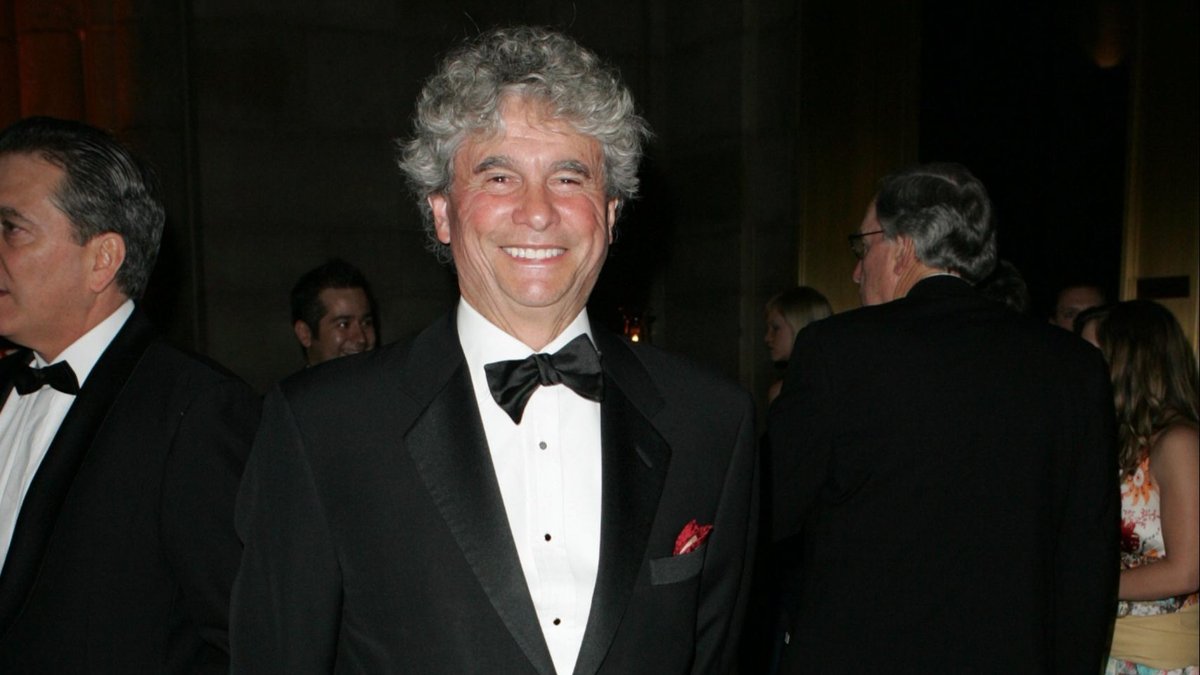
Many people in the New York art world knew Tony Bechara as a champion of institutions and artists. They saw him at board meetings, museum galas, and gallery openings. Far fewer were aware that, for decades, Bechara was also making his own art in his Flatiron loft.
That lesser-known part of his life is the subject of a new exhibition, “Tony Bechara: An Artist of Many Worlds,” at the Parrish Art Museum in Water Mill, out in the Hamptons. The first museum survey dedicated to Bechara, who died last year, it includes 84 works spanning more than 60 years, from an early landscape to pixelated abstractions, shaped canvases, sculptures, notebooks, and color charts.
“It’s an enormous body of work of tremendous quality,” Monica Ramírez-Montagut, the Parrish’s director, said. “He was a very public figure, but then he would go home and stand in front of an easel.”
Bechara spent his mornings painting thousands of little squares to build meticulously structured acrylic paintings. He devoted his afternoons to advancing the interests of cultural organizations such as El Museo del Barrio, where he served as a board chairman, and the careers of fellow artists, most notably his friend, the Cuban-born painter Carmen Herrera.
Bechara’s public life made him a beloved and influential figure in the Latino community. It also put him in close contact with billionaire philanthropists, museum directors, and New York mayors. Yet he remained hesitant to use these relationships to promote his own work, according to several people close to him.
“He was not looking for recognition,” Ramírez-Montagut said. “He was making art because he had to make art. There’s no other option.”
The Grid
Born in San Juan, Puerto Rico, in 1942, Bechara studied philosophy, international relations, and law before becoming a full-time painter. The Parrish show begins with a muted landscape from 1968, but his work quickly became abstract, colorful, and methodical.
Bechara started each canvas by covering it with masking tape to create a precise grid. He then painted thousands of quarter-inch squares—what today might be called pixels—by hand, gradually building shimmering, lava-like compositions.
“He would say, ‘Now I’m going to explore reds, but I’m going to do 20 shades of red in one single painting,’” Ramírez-Montagut said. “Always with a strategy, but always leaving that strategy a little bit of a breathing space to be able to improvise, to be able to be a little bit random, always a little playful thing.”
Attesting to this are three square monochrome paintings—20 Magentas, 20 Yellows, and 20 Cobalts.
An element of surprise was always present in his work because large areas of the canvas were concealed by masking tape as he worked across them. “The work wasn’t revealed even to its maker, Tony, until after he stripped all the tape away,” said Alex Logsdail, whose Lisson Gallery represents the estates of both Herrera and Bechara.
The Boardroom Leader
Becoming a respected cultural leader is a highly unusual path for a practicing artist, especially in New York, where trustees are often recruited in part for their wealth and ability to raise money. Yet Bechara was repeatedly asked to help lead some of the city’s most important nonprofits.
Along with serving as trustee, co-chair and chair of El Museo, he sat on the boards of the Brooklyn Academy of Music and Studio in a School, which provides arts education in public schools, and supported the Metropolitan Opera and the Metropolitan Museum of Art.
“The reason people wanted Tony on the board is because he was very well educated, not just in art but also in economics and international relations,” said lawyer Stanley Stairs, a friend who served on some of the same boards and is now an executor of Bechara’s will. “He was also pretty articulate. That sort of person makes a good trustee.”
The two men met in the 1980s, when Stairs, then a trustee of the Latino theater company INTAR, was looking for an artist to join its board. By then, Bechara was already a full-time artist, whose résumé included an appearance in the 1975 Whitney Biennial.
“He had the voice of the artist,” said curator and collector Estrellita Brodsky, who served with Bechara as a co-chairman of El Museo’s board. “He was very much a catalyst.”
Julián Zugazagoitia got to know Bechara while serving as El Museo’s executive director from 2002 to 2010. Together, they led the museum through a $44 million capital campaign and a renovation.
“He was the best chair I’ve ever had,” said Zugazagoitia, who has spent the past 15 years as the director and CEO of the Nelson-Atkins Museum of Art in Kansas City, Missouri.
Bechara chaired the board as El Museo expanded from being a museum primarily identified with Puerto Rican culture into an institution with a broader Latin American and Caribbean mission.
Brodsky said that Bechara “had this wonderful ability of not telling you what to do but suggesting. And he was always right.”
She said he “encouraged” Brodsky to join El Museo, first as an assistant curator and then as a trustee. He “suggested” to her husband, real-estate mogul Daniel Brodsky, that he give rent-free office space to Studio in a School, an arrangement that has endured for decades, beyond the deaths of Bechara and its founder, philanthropist Agnes Gund.
“With MoMA, Aggie, and myself, he encouraged us to buy Carmen’s works when no one else was,” she said, referring to Gund, longtime president emerita of the Museum of Modern Art.
Business Manager
Along with supporting El Museo, reviving the artistic career of Carmen Herrera (1915–2022) was Bechara’s most lasting achievement.
“He was her neighbor, friend, confidant, business manager, surrogate son,” Logsdail, the Lisson dealer, said. “Their legacies are completely intertwined. One doesn’t exist without the other.”
Although Herrera moved in the same postwar circles in New York as artists like Barnett Newman and Mark Rothko, she remained largely overlooked for decades.
Bechara “always felt that Carmen didn’t receive the recognition she deserved,” Stairs told me. “He would say, ‘Look, this is unfair.’”
Herrera and Bechara met in 1972, when they participated in a group show, “Contemporary Latino Americano Art Exhibition,” at New York University’s Loeb Student Center, according to Brodsky.
Herrera, already in her late 50s, was having a hard time hanging her paintings, and “Tony, ever the gentleman, offered to help her,” she recalled last week.
Bechara devoted an extraordinary amount of time to advancing Herrera’s career. He had lunch with her every day, cultivated collectors, secured exhibitions and loans, placed works in museums, and managed much of the infrastructure that helped turn her into one of the art world’s greatest late-career success stories.
Starting in 1998, he parlayed his connections in the art world to advance her work, with show at El Museo and a New York gallery, Latin Collector, that had shown his works. In 2009, he brought her paintings to the Pinta art fair in London as part of a fundraising effort for El Museo, Logsdail said. Nothing sold. As Bechara prepared to pack up the booth, Nicholas Logsdail, Lisson’s founder (and Alex’s father), stopped by. He asked Bechara to leave the paintings on consignment to him. The rest is history. Within 10 years, Herrera had a Whitney Museum retrospective and her paintings were trading for as much as $2.9 million at auction.
“That success story is really thanks to Tony,” Brodsky said.
“Tony set aside his career for hers,” Stairs said. “He didn’t cut back completely but he cut back substantially.” He then recalled Bechara’s words: “You have only that many hours in a day. I can’t let Carmen down.”
He didn’t. Herrera, who died in 2022 at the age of 106, named Bechara as her sole heir, Alex Logsdail said. Now, their foundations are on track to be merged into one. “That was their wish,” the dealer said. “Both of them.”
Recognition, at Last
For Bechara, the choice was never between painting and not painting. It was between advancing his own career and helping someone else.
He may have devoted fewer hours a day to his art, but he never stopped making it, according to Zugazagoitia, the former El Museo director. Zugazagoitia refrained from calling Bechara in the mornings, he said. “We had this implicit understanding that mornings were for his art.”
While maintaining his studio practice, Bechara was shy about advertising it, even to people close to him. Logsdail said that it took Lisson at least five years after that fateful meeting at Pinta to do a proper studio visit, even though they were in constant touch about Herrera’s matters. “He was very modest about showing his work,” he said.
It wasn’t until after Herrera’s death that Bechara began thinking seriously about his own artistic legacy, friends said. But a setback soon followed. A botched surgery left the avid cyclist, tennis player, and ballroom dancer permanently in a wheelchair.
“It was like slamming on the brakes,” Logsdail said.
Bechara finally felt a sense of urgency to focus on his own art, according to his friends. He also continued painting, and three works in the Parrish show were made in 2025.
Ramírez-Montagut had been trying to persuade Bechara to mount a museum exhibition. “I thought his work was extraordinary and it matched our collection of abstract painting and hard-edged painting,” she said.
In 2023, when the Parrish was celebrating its 125th anniversary, artists with ties to the East End were asked to show their work in the context of its permanent collection. Ramírez-Montagut invited Bechara. He chose to display his tondo near one by Ilya Bolotowsky and an oval canvas by Leon Polk Smith, another artist he had championed.
In the winter of 2024, at its gallery in West Chelsea, Lisson staged its first solo exhibition of Bechara’s work. “He had an enormous network of supporters in New York, and they all came,” Logsdail said. The gallery sold pieces to new collectors and museums. Most prices were in the range of $20,000 to $60,000, and they went as high as $150,000 for large, historic works.
“It was critically well-received,” Logsdail said. “Then we started working on the show at the Parrish.”
Bechara didn’t live to see the exhibition. He died on April 23, 2025, his 83rd birthday.
“The timing was very unfortunate,” Logsdail said. “I expected Tony to be around for a very long time.”
When the Parrish exhibition opened last last month, even some of Bechara’s closest friends were surprised by the breadth of work that had been assembled in one place.
“Tony would have loved it,” Stairs said.
Bechara understood better than most what it takes to help artists get their due. Finally, the time had come for others to step up for him.
Sentinel — Human
The text reads as high-quality narrative journalism that successfully integrates biographical facts with thematic exploration, strongly suggesting human authorship.