From Imperial Collections to the Market: Exceptional European Silver Masterworks by Jean-Charles Cahier and Pavel Ovchinnikov
Paris – The Classics auction series returns to Bonhams Cornette de Saint Cyr in Paris on 22 April with a live sale spanning over four centuries of art and antiques. This season's edition is headlined by an exceptional collection of early Meissen porcelain assembled in East Asia, including remarkable pieces from the personal collection of Augustus the Strong, Elector of Saxony, and King of Poland.
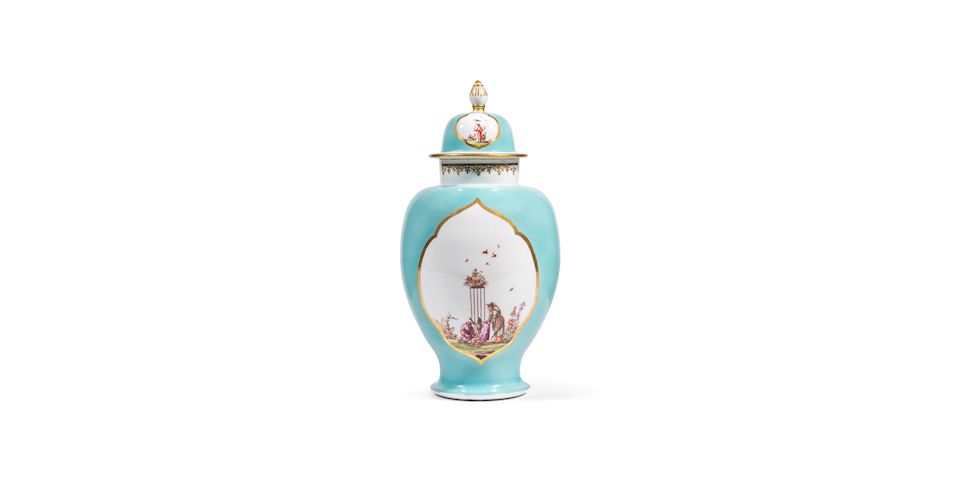
Marking a major milestone for Bonhams, this sale is the first auction of a private Asian collection of European porcelain and the latest milestone in the long history of cultural exchange between the Far East and Europe. Among the highlights of this collection are a rare Meissen Augustus Rex celadon-ground baluster vase and cover, circa 1727-30 (estimate: €50,000-80,000) and two examples of black-glazed Böttger stoneware, imitating Japanese lacquer.
Raphael Machiels, Head of Sale, Classics, commented: "This collection, which will be offered on 22 April at our Classics sale in Paris, embodies the enduring passion shared by Asia and Europe for the art of porcelain. More than three centuries after the first Chinese porcelain arrived on European shores, some very rare pieces will attract the attention of collectors."
Exhibited in Münster and in Schloss Favorite bei Rastatt in 2004, a Meissen Böttger stoneware octagonal coffee pot and cover, circa 1711-13 is a nice example of "Schwartz Porcelain". Decorated in Dresden in the workshop of Martin Schnell, an octagonal, black-glazed vessel decorated with gold and enamel chinoiserie scenes, flowers, birds, and a crane, with a scroll handle, curved spout, domed lid, and gilt details, is estimated at €20,000-30,000.
A rare Meissen Augustus Rex celadon-ground baluster vase and cover, circa 1730, from the personal collection of Augustus the Strong, Elector of Saxony, and King of Poland (estimate: €50,000-80,000).
Other highlights of the sale will include:
From the Pavlovsk Palace, in the former collection of The Grand Duke Michael Pavlovich (1798-1849), a pair of large silver five-light candelabra with a broad torus of leaves alternating with acanthus by one of the leading Parisian silversmiths Jean-Charles Cahier, Paris, 1819-1838 (estimate: €150,000-200,000).
The monogram belongs to Grand Duke Michael Pavlovitch, youngest son of Czar Paul I and brother of Czars Alexander I and Nicholas I. After arriving in Paris with the Allied forces in 1814, he returned to Russia, where he commanded the Guards' Infantry Brigade and helped establish the High School of Artillery in St. Petersburg. He later distinguished himself in the war against Turkey, receiving the Order of St. George, and in 1831 was appointed overseer of all Russian military schools. He married Princess Helen of Württemberg, with whom he had six daughters.
Michael Pavlovitch and Tsar Nicholas I were notable patrons of leading Parisian silversmiths, including Martin-Guillaume Biennais, Jean-Baptiste-Claude Odiot, and Jean-Charles Cahier. Cahier produced an extensive silver service for Pavlovsk Palace, eventually numbering over a thousand pieces. Part of this service was dispersed by the Soviet government between the World Wars, with many pieces later entering the Taïgou collection.
Also included is an impressive silver-gilt and champlevé enamel wine set by Pavel Ovchinnikov, Moscow, 1873 (estimate: €30,000-40,000). Executed in the Russian Revival style, the set is decorated with bead ornament and formal geometric and linear borders. The stylistic language of the set reflects designs created in 1861 by the architect and designer Ippolit Monighetti (1819 – 1878), preserved today in the State Hermitage Museum in St. Petersburg. It is believed that this service was commissioned to represent Russian artistic craftsmanship at the Vienna World Exhibition of 1873. The set stands as a refined example of Russian Revival silver and enamel work of the 1870s, and may represent a surviving element of the celebrated Russo-Byzantine service associated with the Vienna exhibition.
Furthermore, an exceptional pair of Greek-style mahogany and mahogany-veneered commodes, stamped J.F. Oeben and dating circa 1760, of rectangular form with a slight central projection, each opening with three drawers in the upper frieze above two drawers without a central rail and two cupboard doors, and decorated with finely chased gilt-bronze mounts including ring handles and sabots (estimate: €100,000–200,000).
Concluding the highlights, a large 15th-century Hispano-Moresque armorial basin, likely made in Manises (Valencia), features a deep, slightly flared shape with an outward-turned rim. It is decorated in copper lustre and dark blue. The centre shows an armorial shield surrounded by blue flowers and leaves set against lustre foliate arabesques. The sides and rim continue with alternating blue floral motifs and lustre foliage, while the exterior repeats similar decoration. Beneath the rim is a trellis border, and the base displays concentric circles around a floral motif. A similarly large basin is in the collection of the Getty Museum, Los Angeles (estimate: €80,000-120,000).
Facts Only
* The Bonhams Cornette de Saint Cyr auction will take place on April 22nd in Paris.
* The sale includes a collection of early Meissen porcelain.
* A rare Meissen Augustus Rex celadon-ground baluster vase and cover is estimated at €50,000-80,000.
* Two examples of black-glazed Böttger stoneware are estimated at €20,000-30,000.
* A Meissen Böttger stoneware octagonal coffee pot and cover is estimated at €20,000-30,000.
* A silver-gilt and champlevé enamel wine set by Pavel Ovchinnikov is estimated at €30,000-40,000.
* A pair of Greek-style mahogany and mahogany-veneered commodes are valued at €100,000-200,000.
* A 15th-century Hispano-Moresque armorial basin is valued at €80,000-120,000.
* Jean-Charles Cahier produced a silver service for Pavlovsk Palace.
* Michael Pavlovitch was a patron of Parisian silversmiths.