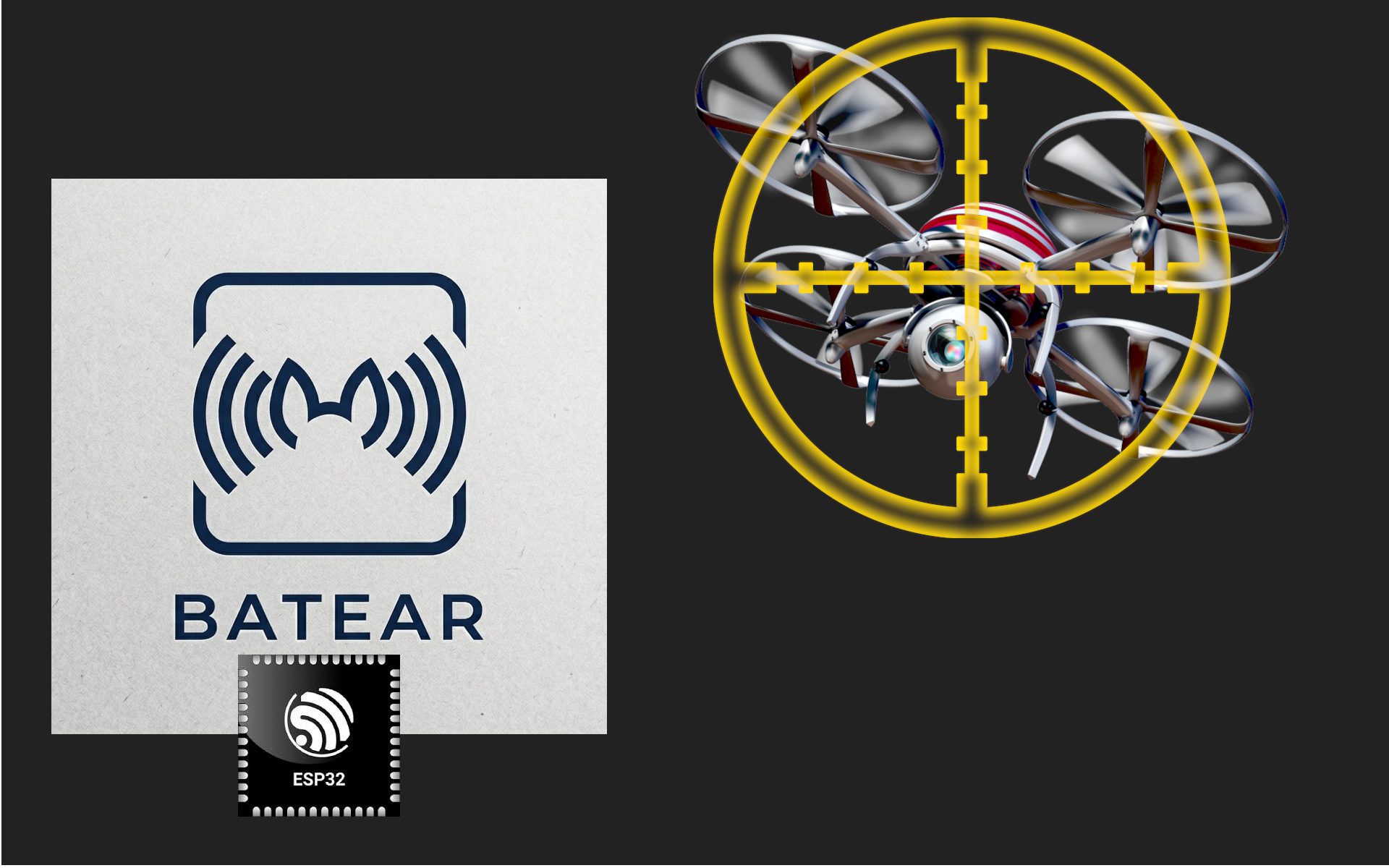
We don’t usually speculate on the true identity of the hackers behind these projects, but when [TN666]’s accoustic drone-detector crossed our desk with the name “Batear”, we couldn’t help but wonder– is that you, Bruce? On the other hand, with a BOM consisting entirely of one ESP32-S3 and an ICS-43434 I2S microphone, this isn’t exactly going to require the Wayne fortune to pull off. Indeed, [TN666] estimates a project cost of only 15 USD, which really democratizes drone detection.
The key is what you might call ‘retrovation’– innovation by looking backwards. Most drone detection schema are looking to the ways we search for larger aircraft, and use RADAR. Before RADAR there were acoustic detectors, like the famous Japanese “war tubas” that went viral many years ago. RADAR modules aren’t cheap, but MEMS microphones are– and drones, especially quad-copters, aren’t exactly quiet. [TN666] thus made the choice to use acoustic detection in order to democratize drone detection.
Of course that’s not much good if the ESP32 is phoning home to some Azure or AWS server to get the acoustic data processed by some giant machine learning model. That would be the easy thing to do with an ESP32, but if you’re under drone attack or surveillance it’s not likely you want to rely on the cloud. There are always privacy concerns with using other people’s hardware, too. [TN666] again reached backwards to a more traditional algorithmic approach– specifically Goertzel filters to detect the acoustic frequencies used by drones. For analyzing specific frequency buckets, the Goertzel algorithm is as light as they come– which means everything can run local on the ESP32. They call that “edge computing” these days, but we just call it common sense.
The downside is that, since we’re just listening at specific frequencies, environmental noise can be an issue. Calibration for a given environment is suggested, as is a foam sock on the microphone to avoid false positives due to wind noise. It occurs to us the sort physical amplifier used in those ‘war tubas’ would both shelter the microphone from wind, as well as increase range and directionality.
[TN] does intend to explore machine learning models for this hardware as well; he seems to think that an ESP32-NN or small TensorFlow Lite model might outdo the Goertzel algorithm. He might be onto something, but we’re cheering for Goertzel on that one, simply on the basis that it’s a more elegant solution, one we’ve dived into before. It even works on the ATtiny85, which isn’t something you can say about even the lightest TensorFlow model.
Thanks to [TN] for the tip. Playboy billionaire or not, you can send your projects into the tips line to see them some bat-time on this bat-channel.
I wonder how this fairs at detecting the figure 8 style drone propellers.
Perhaps the edge geometry could be adjusted to add other frequencies to confuse an automated detection system.
Facts Only
A developer named [TN666] designed an acoustic drone-detection system.
The system uses an ESP32-S3 microcontroller and an ICS-43434 I2S microphone.
The estimated project cost is $15.
The system employs Goertzel filters to detect drone-specific acoustic frequencies.
The design avoids cloud processing, relying on local edge computing.
Historical acoustic detection methods, like Japan's "war tubas," inspired the approach.
Environmental noise and wind can interfere with detection, requiring calibration and wind protection.
[TN666] plans to test machine learning models, such as ESP32-NN or TensorFlow Lite, for potential improvements.
The Goertzel algorithm is lightweight and can run on minimal hardware, including an ATtiny85.
The system aims to make drone detection accessible without expensive radar or cloud services.
The developer suggests that modified drone propeller designs could evade detection.
The project was shared via a tips line for potential feature coverage.
Executive Summary
A developer known as [TN666] has created an affordable acoustic drone-detection system using an ESP32-S3 microcontroller and an ICS-43434 I2S microphone, with an estimated cost of $15. The system leverages Goertzel filters to detect drone-specific acoustic frequencies locally, avoiding cloud dependency and privacy concerns. This approach draws inspiration from historical acoustic detection methods, such as Japan's "war tubas," rather than modern radar-based systems. While effective, the system may face challenges with environmental noise, requiring calibration and wind protection. [TN666] plans to explore machine learning models for potential improvements but currently favors the lightweight, edge-computing Goertzel algorithm for its simplicity and efficiency. The project aims to democratize drone detection, making it accessible without expensive hardware or cloud services.
The design prioritizes local processing to ensure privacy and reliability, particularly in scenarios where cloud connectivity might be compromised or undesirable. The use of Goertzel filters allows the system to run on minimal hardware, including even an ATtiny85, highlighting its efficiency. However, the system's reliance on specific frequency detection could be vulnerable to false positives or evasion tactics, such as modified drone propeller designs. Future iterations may incorporate machine learning to enhance accuracy, though this could increase computational demands.
Full Take
The strongest version of this narrative highlights a clever, low-cost solution to drone detection that prioritizes privacy and accessibility. By leveraging historical acoustic detection methods and lightweight algorithms, [TN666] avoids the pitfalls of cloud dependency and high costs, making the technology democratized and resilient. The Goertzel filter approach is elegant, efficient, and aligns with the principle of edge computing—processing data locally rather than relying on external servers. This not only enhances privacy but also ensures functionality in scenarios where connectivity might be compromised or undesirable.
However, the narrative also reveals potential vulnerabilities. The system's reliance on specific frequency detection could be exploited by adversaries modifying drone propeller designs to emit different acoustic signatures. Additionally, environmental noise and wind interference pose practical challenges, requiring calibration and physical modifications like foam socks or acoustic amplifiers. The mention of future machine learning models introduces a tension between simplicity and accuracy—while ML might improve detection, it could also increase computational demands and reduce the system's accessibility.
Root cause: The paradigm here is one of retro-innovation—looking to the past for solutions to modern problems. The assumption is that simpler, localized technologies can outperform complex, centralized systems in certain contexts. This echoes historical patterns where low-tech solutions prove resilient against high-tech threats, such as the use of acoustic mirrors before radar.
Implications: For human agency, this project empowers individuals and communities to detect drones without relying on costly infrastructure or corporate cloud services. The benefits accrue to privacy-conscious users, hobbyists, and those in remote or contested environments. However, the costs include potential false positives, limited range, and susceptibility to evasion tactics. Second-order consequences might include an arms race in drone propeller designs to evade detection or the proliferation of countermeasures like acoustic jamming.
Bridge questions: How might adversaries adapt drone designs to evade acoustic detection, and what countermeasures could be developed? What trade-offs exist between simplicity and accuracy in edge-computing solutions? How does this project challenge the assumption that advanced technology always requires cloud dependency?
Counterstrike scan: If this were part of a coordinated influence campaign, the playbook might emphasize the vulnerabilities of cloud-dependent systems while promoting low-tech, localized alternatives as inherently superior. The actual content aligns with this to some extent but does so by presenting a genuine technical solution rather than manipulating fears. No overt patterns of distortion or bad faith are detected.
Patterns detected: none
Sentinel — Human
Strong human signals: idiosyncratic humor, technical passion, and organic digressions suggest authentic authorship.