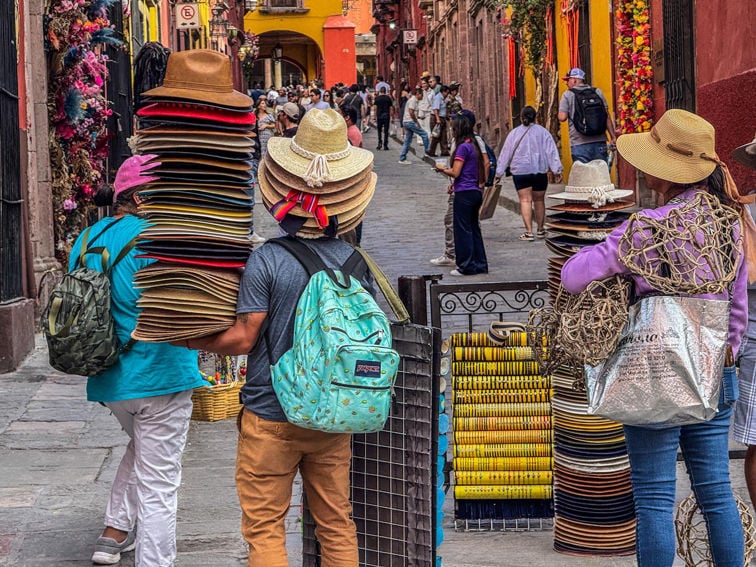
Spring in San Miguel de Allende is a time of warmer weather, purple jacaranda blossoms, preparations for Semana Santa (Holy Week) and, later, school graduations.
Art displays, live music concerts and literary activities continue this month in San Miguel, along with special benefit events and performances, including one event celebrating the spring equinox. More on those below after a look at a couple of local NGOs focused on education and networking.
Jóvenes Adelante reviewing 314 local applicants
Jóvenes Adelante’s (JA) student applicant pool for university enrollment this fall totals 314, according to Don Krim, the nonprofit’s president. JA is reviewing and evaluating applicants now and should have selection decisions by July, he said.
“Our internal goal would be to support between 45 and 50 new undergraduate students and eight master’s students,” Krim said.
Students in the JA program from San Miguel, Dolores Hidalgo and Comonfort receive funding from donations to cover housing and food, along with a laptop computer, mentoring and English-language tutoring.
JA began in 2001 in San Miguel as a community-based organization to help high school students with potential continue on to university. The organization became a Mexican nonprofit in 2007 and a U.S. nonprofit in 2009. Fast-forward to 2026, and JA has graduated 338 total students, helping them finish university degrees and, for some, continue to master’s programs.
JA’s graduation rate is 83%, but Mexico’s is only 26% nationwide, Krim said.
“Only 45% of kids graduate from high school in Mexico, and only 22% of those who graduate go on to apply to university,” he said.
Currently, 138 university students are enrolled through JA, plus 10 master’s students who have graduated from the program and moved on to the next level, Krim said. JA-supported students can choose from a range of Mexican universities, and their choice of majors is also broad, he said.
“A lot of them are studying medicine, nursing, physical therapy, dentistry and engineering,” Krim said. “Those are the largest categories.”
Others are studying law or are focused on agribusiness, tourism or architecture, he said.
JA has U.S. donors but could use more, Krim said. The organization is also funded by a grant from JA U.S. and partners with Amistad Canada. A large grant from the state of Guanajuato for two consecutive years has helped pay for staffing and space, he said.
Krim called educating young Mexicans who otherwise wouldn’t be able to attend university essential for the country’s future.
“We are impacting the course of the future of students and potentially the whole country,” he said. “You have to have an educated population.”
Ladies of San Miguel formed through group chat
A group of mainly African American women that gets together for monthly luncheons in San Miguel started as an online community looking for information and connection, said Kim Lee, who helps coordinate their activities.
“I just wanted to create a group to communicate on WhatsApp,” she said. “I think we’re up to 82 ladies. The group chat has been really good at communicating certain events.”
Besides the monthly luncheon events, members of the group gather each month at Don Lupe’s Grill for dinner and dance to rhythm and blues music. Some live in San Miguel, and others travel back and forth to their home countries, Lee said. Some are retired, and some aren’t, she added.
Anyone wanting to get involved in the group can contact her through Facebook Messenger, and she’ll do the rest, she said.
“All I need is a phone number and a name, and we’ll add them to our chat group,” Lee said.
Cruz Roja benefit on tap March 19
A benefit event for Cruz Roja Mexicana (the Mexican Red Cross in San Miguel) will be held March 19 at 5 p.m. at the Cleviá hotel at Josefina Orozco 6, next to the Luna de Queso restaurant.
The theme is Mardi Gras, and participants are encouraged to bring a mask since a prize will be awarded for the best one.
Admission is a 1,200-peso donation, which can be made here. Music, cocktails and canapés will be served. More information is available at 415 122 0944.
World Music Festival runs March 19–22
Live concerts, art exhibitions and workshops will be part of this year’s World Music Festival in San Miguel de Allende.
The festival schedule, available here, includes:
- The Samadhi Ensemble on March 19, 6:30 p.m., at the Teatro Ángela Peralta, Mesones 82
- A musical tribute to Santana on March 20, 6:30 p.m., at the Peralta
- A jazz trio performance with Claude Bolling at 6:30 p.m. on March 21 at the Peralta
- A closing party at Cent’Anni Restaurant, Canal 34, at 6 p.m. on March 22.
Tickets are available at the Peralta theater box office or by calling 415 161 9551.
Benefit golf tournament tees up March 20
The local nonprofit organization So Others May Eat (SOME) is having a benefit at 9 a.m. on March 20 at Zirándaro Golf, with all proceeds assisting the group’s dining program for hundreds of elders with limited means.
The entrance fee, which includes full-day participation, is a 2,500-peso donation per player. Registration and other tournament details can be found here.
El Charco spring equinox concert on March 21
El Charco del Ingenio Botanical Garden will be holding its 25th annual spring equinox concert at 5:30 p.m. on March 21 in the canyon, which was not affected by the recent fire.
Performing will be Mujeres del Viento Florido (Women of the Flowering Wind), an all-female band from Indigenous communities in Oaxaca.
Tickets are 500 pesos for general admission and 100 pesos for children. Tickets must be bought in advance. Purchase them either at El Charco, or arrange them via email.
Feed the Hungry SMA benefit gala on March 24
A Murals of Dreams gala event to benefit Feed the Hungry SMA will be held March 24, 6–11 p.m., at the Institute Allende, Ancha de San Antonio 22. Feed the Hungry SMA is a nonprofit organization providing 5,000 nutritious meals every school day in 39 educational institutions across San Miguel.
The gala event will feature cocktails, dinner, live music and dancing.
Registration ends March 19. More information is available here.
Cuba and danzón on stage at the Peralta on March 28
The musical tradition of danzón, considered Cuba’s national dance, will be presented at the Teatro Ángela Peralta, Mesones 82, at 7 p.m. on March 28.
Featured musicians include Ricardo Benítez, flute; Pedro Cartas, violin; Alfred Thompson, piano; David Barrera, double bass; Victor Miranda, percussion; and Dairon Vazquez, percussion and vocals. More information and tickets are available here.
Cathy Siegner is an independent journalist based in San Miguel and Montana. She has journalism degrees from the University of Oregon and Northwestern University.
Facts Only
Jóvenes Adelante is reviewing 314 applicants for university enrollment, aiming to support 45-50 new undergraduates and eight master’s students by July.
The nonprofit has graduated 338 students since 2001, with an 83% graduation rate, compared to Mexico’s national rate of 26%.
Currently, 138 university students and 10 master’s students are enrolled through Jóvenes Adelante.
Students receive funding for housing, food, laptops, mentoring, and English tutoring.
The Ladies of San Miguel, a group of primarily African American women, started as a WhatsApp chat and now hosts monthly luncheons and social events.
A Mardi Gras-themed benefit for Cruz Roja Mexicana will be held on March 19 at the Cleviá hotel.
The World Music Festival runs from March 19–22, featuring performances at the Teatro Ángela Peralta and a closing party at Cent’Anni Restaurant.
A benefit golf tournament for SOME will take place on March 20 at Zirándaro Golf.
El Charco del Ingenio Botanical Garden will host its 25th annual spring equinox concert on March 21, featuring Mujeres del Viento Florido.
A gala for Feed the Hungry SMA will be held on March 24 at the Institute Allende.
A danzón performance, Cuba’s national dance, will be presented at the Teatro Ángela Peralta on March 28.
Executive Summary
San Miguel de Allende is bustling with cultural and charitable activities this spring, from educational initiatives to music festivals and benefit events. Jóvenes Adelante, a nonprofit supporting higher education for local students, is reviewing 314 applicants for university enrollment, aiming to fund 45-50 undergraduates and eight master’s students. The organization has a strong track record, with 338 graduates since 2001 and an 83% graduation rate, significantly higher than Mexico’s national average of 26%. Meanwhile, the Ladies of San Miguel, a group of primarily African American women, has grown from a WhatsApp chat into a vibrant community hosting monthly luncheons and social events. The city also hosts several benefit events, including a Mardi Gras-themed fundraiser for Cruz Roja Mexicana, a World Music Festival featuring diverse performances, and a spring equinox concert at El Charco del Ingenio Botanical Garden. Other highlights include a golf tournament supporting SOME’s elder dining program and a gala for Feed the Hungry SMA, which provides thousands of daily meals to schoolchildren. These events reflect San Miguel’s blend of cultural richness, community engagement, and philanthropic efforts.
The article also underscores the challenges and successes of local NGOs, particularly in education. Jóvenes Adelante’s work highlights the stark disparities in Mexico’s education system, where only 45% of students graduate high school and just 22% of those apply to university. The organization’s focus on mentoring, financial support, and English tutoring aims to bridge this gap, with students pursuing degrees in fields like medicine, engineering, and law. Funding comes from U.S. donors, grants, and partnerships, but the need for more support remains. Meanwhile, cultural events like the danzón performance and the World Music Festival showcase the city’s artistic diversity, drawing both locals and visitors. These initiatives, whether educational or cultural, collectively contribute to San Miguel’s dynamic social fabric.
Full Take
This article presents a snapshot of San Miguel de Allende’s vibrant community life, blending cultural events with philanthropic efforts. The strongest version of this narrative highlights the city’s commitment to education, social cohesion, and artistic expression. Jóvenes Adelante’s work is particularly noteworthy, addressing systemic barriers in Mexico’s education system where university enrollment and graduation rates are alarmingly low. The organization’s success—graduating 338 students with an 83% completion rate—underscores the impact of targeted support, including financial aid, mentoring, and language tutoring. This aligns with broader patterns of grassroots NGOs filling gaps left by underfunded public systems, a recurring theme in global education disparities.
However, the article’s focus on positive outcomes and community events may inadvertently downplay structural challenges. For instance, while Jóvenes Adelante’s achievements are commendable, the underlying issue of Mexico’s 26% university graduation rate remains unaddressed at a systemic level. The narrative also leans heavily on celebratory events, which, while valuable for community building, could obscure deeper questions about equity and access. For example, the benefit events—though philanthropic—primarily serve those who can afford to participate, potentially reinforcing social divides rather than bridging them.
The pattern of highlighting local initiatives without critiquing broader systemic failures is common in feel-good journalism. This isn’t necessarily manipulative but risks creating a "sanewashing" effect (ARC-0045), where isolated successes are framed as solutions to systemic problems. The root cause here is the tension between grassroots efforts and institutional change: while NGOs like Jóvenes Adelante provide critical support, they cannot alone fix Mexico’s education crisis. The implications for human agency are significant—individuals and small groups can drive change, but lasting impact requires systemic reform.
Bridge questions: How might the success of Jóvenes Adelante be scaled or replicated to address Mexico’s broader education challenges? What role do cultural events play in fostering social cohesion versus reinforcing existing inequalities? How could the city’s philanthropic efforts be structured to ensure more equitable participation?
Counterstrike scan: If this were part of a coordinated campaign, it might emphasize local solutions to distract from systemic failures, framing NGOs as sufficient substitutes for government action. However, the article does not exhibit this pattern; it simply reports on community efforts without overtly dismissing broader issues.
Sentinel — Human
The article exhibits strong human-written characteristics, including natural variability in sentence structure, personal voice, and specific, verifiable details. No significant synthetic signals detected.