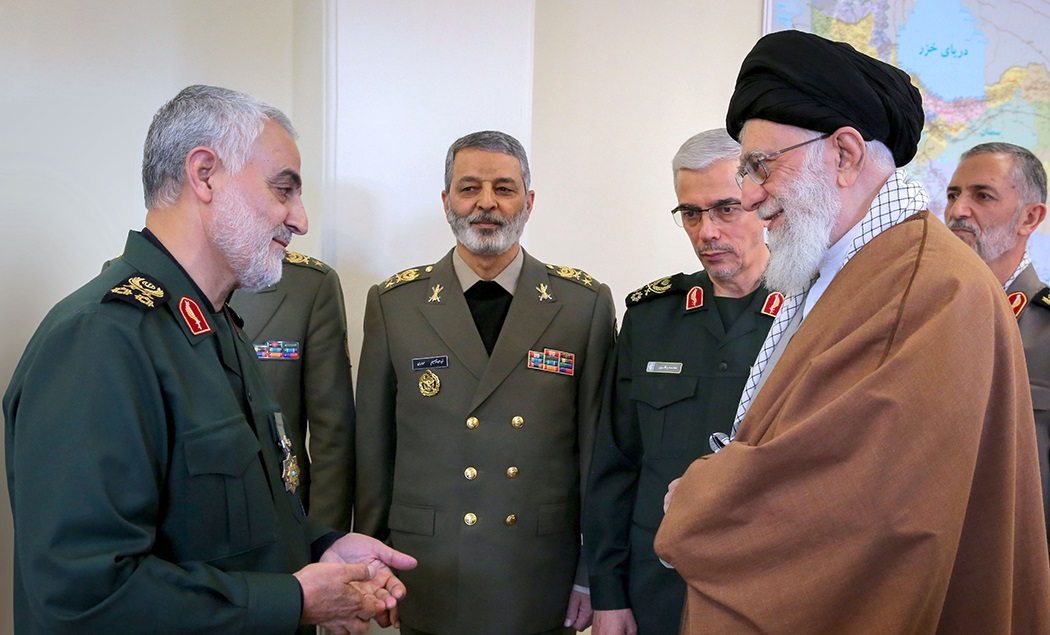
Qasem Soleimani received the Zolfaghar Order from Ali Khamenei, the 87-year-old Supreme Leader who was assassinated in the US and Israeli strikes against Iran. Photo: khamenei.ir
As the US and Israeli strikes against Iran violate the foundations of international law, the economic and human costs will soar.
After three weeks of effective war, the hostilities have caused severe regional spillovers, thousands of deaths, the displacement of millions and a massive global energy crisis that continues to expand. If the implications are global, what is the status of the US and Israeli strikes from the standpoint of international law?
The modern legal order is based on the United Nations Charter (1945), the Geneva Conventions, the Rome Statute (1998) and customary law derived from the Nuremberg trials. The key rules include the prohibition of aggressive war, the protection of civilians and individual criminal responsibility for war crimes, crimes against humanity and genocide. Force is allowed only in the case of self-defence and UN security council authorisation.
The US and Israeli strikes have already violated most of these rules.
War of aggression
Article 2(4) of the UN Charter prohibits member states from threatening or using force against the territorial integrity or political independence of any state. It was violated on February 28, when the US and Israel launched joint strikes against Iran.
Typically, the war was launched when peace talks in Oman were advancing towards a successful conclusion.
In the absence of strategic objectives and an exit strategy, the US has framed the actions as a campaign to dismantle “the Iranian regime’s security apparatus”.
These efforts date back to the US and Israel’s 12-day war against Iran in July 2025, when Masoud Pezeshkian, the new reform-minded Iranian president, sought talks to end the conflict with the US and Israel. That was not in line with the “new Middle East” envisioned by Prime Minister Benjamin Netanyahu and his far-right cabinet.
The UN Charter’s prohibition against force is not absolute, with key exceptions being self-defence (Article 51) and actions approved by the security council.
Yet no such threat existed before the US and Israeli strikes. On March 17 2026, Joe Kent, the director of the US National Counterterrorism Center, resigned in protest against the ongoing US-led war in Iran. Kent said in no uncertain terms that “Iran posed no imminent threat to our nation.”
This is an illegal war of aggression, instigated by leaders who have been (or should be) like Prime Minister Netanyahu, charged with war crimes and crimes against humanity.
Pre-emptive war doctrine
To legitimise the unjustifiable, Washington has resorted to pre-emptive justifications. In this regard, the US and Israeli war against Iran is the latest link in the 25-year effort to justify power politics through preventive wars.
Since the George W Bush administration’s 2002 security doctrine, US administrations have stressed pre-emption as a central strategic instrument. While Democratic leaders (Barack Obama, Joe Biden) have been more moderate in rhetoric, they have co-opted the same ideas.
Relying on force to prevent future threats, preventive war doctrines are often cited as violating international law because they bypass the strict legal requirements for the use of force established in the UN Charter.
Unilateral preventive war is a threat to the principle of state sovereignty because it allows one nation to judge the “intentions” of another without objective proof of an impending attack. Setting a dangerous precedent, it incentivises other nations to use similar pretexts for their own “preventive” attacks, potentially leading to global instability.
International law allows for pre-emptive strikes in cases of “imminent” danger. But US strategy improperly expands this to include preventive wars against threats that are not yet fully formed or do not exist — as in the cases of the 2003 Iraq war and the 2025 and 2026 wars involving Iran.
Targeted assassinations
The targeted assassination of Iranian leaders is a serious violation of international law, especially when conducted outside an active, declared war zone. Such killings violate the prohibition on the use of force against another state’s territorial integrity and political independence.
Outside active hostilities, international human rights law applies. Under this framework, the arbitrary deprivation of life is prohibited. Targeted killings are extrajudicial acts for which the acting state is responsible.
In the context of conflict, such killings can violate international humanitarian law principles, including distinction and proportionality. Assassinations of state officials often violate the 1973 Convention on the Prevention and Punishment of Crimes Against Persons Under International Protection.
Precedents include the killing of Iranian general Qasem Soleimani, a senior figure in Iran’s leadership, who was assassinated in a drone strike in Baghdad in January 2020, ordered by President Donald Trump.
From the standpoint of international law, it was an unlawful attack, as noted by Ben Ferencz, a US prosecutor in the Nuremberg trials and a pioneer of international law. After Soleimani’s killing, The New York Times published Ferencz’s letter denouncing the assassination as an “immoral action [and] a clear violation of national and international law”.
In their first joint strikes against Iran, the US and Israel assassinated the 87-year-old Ali Khamenei, the supreme leader of Iran. Demonised in the West, Khamenei supported Iran’s nuclear programme for civilian use. Already in the mid-1990s, he famously issued a fatwa against the acquisition, development and use of nuclear weapons.
The assassination of Khamenei was another blatant violation of international law. It was also part of a broader strategy to eliminate moderate leaders, whose absence is then used to justify replacing diplomacy with military campaigns.
Crimes against humanity, forced displacement
These crimes are defined in the Rome Statute (Article 7) as widespread or systematic attacks on civilians. Allegations arise when strikes target civilian infrastructure, create economic strangulation, cause mass displacement and impose siege conditions.
A continuity argument — “what we first saw in Gaza is now spreading to Iran and, due to spillovers, across the region” — exists because similar patterns can be identified, including blockades, disproportionate force and collective punishment.
The stated efforts at regime change to undermine Iran and fragment the Shia state suggest that the boundary between cultural genocide and broader destabilisation is increasingly blurred.
Allegations of ethnic cleansing, relying on deliberate forced displacement, are likely to grow. While ethnic cleansing is not a formal treaty crime, it is recognised in jurisprudence and rests on forced population removal.
Israel’s expanding buffer zone in southern Lebanon, extending roughly 3km to 14km north of the Blue Line demarcation, is premised on demographic engineering. In Iran, objectives to fragment the state and instigate inter-ethnic divisions are also predicated on identity politics.
The US and Israeli strikes have caused the displacement of 3.5 million people in Iran and more than one million in Lebanon, with up to 22 000 killed or wounded in Iran and another 3 600 in Lebanon.
Collective punishment, economic warfare
Combined with illicit strikes, Washington’s decades-long sanctions against Iran — most of which are unilateral — resemble economic warfare based on collective punishment.
Such combinations of economic sanctions and military strikes, particularly when unlawful, raise serious issues under humanitarian and human rights law. In Gaza and Iran, unilateral sanctions have caused mass suffering, violating international law.
Since the early 1970s, when Beirut was still called the “Paris of the Middle East”, Israel’s wars against Palestinians have destabilised Lebanon’s fragile ethnic balance, pushing the country to the brink of default — a fate Prime Minister Netanyahu would like Iran to share.
There is a clear continuity from the Gaza war — carried out by Israel with support from the US-led West, alongside International Court of Justice (ICJ) provisional measures and International Criminal Court (ICC) debates — to the US and Israeli strikes against Iran.
The common features include an expanded self-defence doctrine, weak enforcement of humanitarian law, selective application of international law and, ultimately, the US veto in the security council.
The more these violations are permitted, the greater the economic cost, the more severe the destruction and the higher the human toll.
That is why multilateral cooperation — across political differences — and the enforcement of international law are urgently needed.
Dr Dan Steinbock is an internationally recognised strategist of the multipolar world and the founder of Difference Group. He has served at the India, China and America Institute (US), Shanghai Institutes for International Studies (China) and the EU Center (Singapore). For more, see https://www.differencegroup.net
The original version was published by Informed Comment (US) on 23 March 2026.
Facts Only
Qasem Soleimani received the Zolfaghar Order from Ali Khamenei, Iran’s Supreme Leader.
The US and Israel launched joint strikes against Iran on February 28, 2026.
The strikes violated Article 2(4) of the UN Charter, which prohibits the use of force against another state’s territorial integrity.
The war began during peace talks in Oman that were progressing toward a resolution.
Joe Kent, director of the US National Counterterrorism Center, resigned on March 17, 2026, stating Iran posed no imminent threat.
The US and Israel assassinated Ali Khamenei, Iran’s 87-year-old Supreme Leader, in the strikes.
The conflict has displaced 3.5 million people in Iran and over one million in Lebanon.
Casualties include 22,000 killed or wounded in Iran and 3,600 in Lebanon.
The US has imposed decades-long unilateral sanctions on Iran, described as economic warfare.
The assassination of Qasem Soleimani in 2020 was condemned as a violation of international law by Ben Ferencz, a Nuremberg prosecutor.
The US and Israel’s actions are framed as part of a broader strategy to dismantle Iran’s security apparatus and fragment the state.
The conflict follows a 12-day war in July 2025, during which Iran’s reform-minded president, Masoud Pezeshkian, sought diplomatic talks.
Executive Summary
Full Take
The strongest version of this narrative presents a clear violation of international law by the US and Israel, with targeted assassinations, pre-emptive strikes, and economic warfare causing massive human suffering. The argument is bolstered by historical precedents, such as the 2003 Iraq War and the 2020 assassination of Qasem Soleimani, both of which were widely criticized as illegal. The pattern of justifying preventive wars under an expanded self-defense doctrine is a recurring theme, undermining the UN Charter’s strict requirements for the use of force. This narrative also highlights the continuity between the Gaza conflict and the current strikes, suggesting a broader strategy of destabilization and regime change.
However, the analysis leans heavily on a critical perspective without sufficiently engaging counterarguments, such as potential security threats perceived by the US and Israel or the complexities of Iran’s regional influence. The emotional weight of civilian casualties and displacement is palpable, which could be leveraged to provoke outrage rather than reasoned debate. The framing of the conflict as purely aggressive, without nuance, risks oversimplifying geopolitical dynamics.
Root cause: The paradigm driving this narrative is the erosion of post-WWII international legal norms in favor of unilateral military action justified by pre-emptive security doctrines. The unstated assumption is that the US and Israel operate outside the constraints of international law with impunity, enabled by veto power in the UN Security Council. This echoes historical patterns of great power interventionism, where legal justifications are retrofitted to strategic objectives.
Implications: The human cost is staggering—millions displaced, thousands dead, and economic devastation. The long-term consequence is the normalization of preventive war, which could incentivize other states to adopt similar justifications, leading to global instability. The beneficiaries of this narrative are those advocating for a rules-based order, while the costs are borne by civilians and the credibility of international institutions.
Bridge questions: What evidence exists of Iran’s imminent threat to justify pre-emptive strikes? How might the US and Israel’s actions be interpreted through the lens of their own security concerns? What alternative frameworks for conflict resolution have been attempted or ignored?
Counterstrike scan: A coordinated influence campaign would amplify civilian suffering to delegitimize US-Israel actions while downplaying their strategic rationale. The actual content aligns with this pattern by focusing on legal violations and human costs without proportional engagement with opposing security arguments. However, it stops short of outright propaganda, as it grounds claims in verifiable events and legal frameworks.
Patterns detected: ARC-0024 Ambiguity (selective framing of legal violations without full context), ARC-0043 Motte-and-Bailey (broad claims of aggression narrowed to specific legal breaches when challenged).
Sentinel — Human
The article presents a well-structured, balanced analysis of the US and Israeli strikes against Iran from the standpoint of international law. It shows signs of human authorship with varying sentence lengths, use of hedging language, coherent argumentation, personal voice, and specific examples.