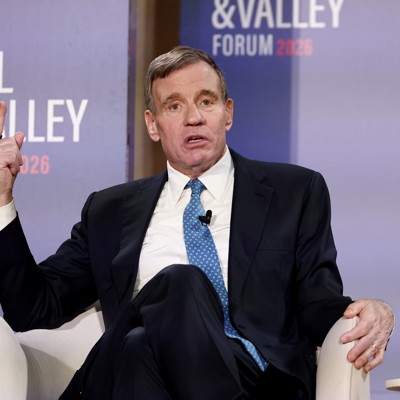
Mark Warner, the Senate Intelligence Committee’s top Democrat, pressed DHS over reports that states are no longer receiving the same cybersecurity and protection support ahead of the 2026 elections.
Senate Intelligence Committee Vice Chairman Mark Warner, D-Va., is demanding answers from the Department of Homeland Security over what he says is a sharp decline in federal election security support ahead of the 2026 midterms, warning that cuts to the Cybersecurity and Infrastructure Security Agency could leave states more exposed to cyber threats and foreign interference.
In a letter sent Wednesday to DHS Secretary Markwayne Mullin, Warner said state and local officials have reported that CISA is no longer providing the same level of election security training, intelligence sharing and cybersecurity assistance it offered in prior election cycles.
The letter adds to growing criticism over the Trump administration’s handling of CISA and its election security mission, which has faced deep staffing reductions enacted over the last year.
“While the states are taking valiant and expensive measures to protect their elections, it is impossible for states to independently obtain intelligence, subject-matter expertise, and real-time incident reporting, and information at the scale and speed required to protect state elections from physical and cyber threats,” Warner wrote.
DHS and CISA spokespeople did not immediately respond to requests for comment.
Efforts under the Trump administration to scale back CISA and its election security resources have strained relationships with state and local officials and have raised concerns that jurisdictions may be far less prepared to counter threats in November, officials in Michigan and Georgia said late last month.
The administration’s fiscal 2027 budget proposal would eliminate the agency’s election security program funding, including information-sharing efforts and election security advisor positions.
Warner’s letter also cited testimony delivered last week by the head of U.S. Cyber Command and the National Security Agency, who said that foreign adversaries are expected to target the 2026 elections.
The senator asked DHS to explain what CISA is doing to warn state and local officials about malign influence campaigns and cyber threats targeting election infrastructure. He also requested records of election-related training, cybersecurity reviews, incident responses and outreach efforts that have been conducted by the agency since January 2025.
He also asked DHS whether any CISA personnel were involved in an FBI raid tied to election systems in Fulton County, Georgia — where Director of National Intelligence Tulsi Gabbard was publicly seen alongside federal officials — or in her office’s seizure and testing of voting machines in Puerto Rico.
The letter comes as the future of CISA’s election security role has become increasingly uncertain. Republican lawmakers and many Trump allies have long criticized the agency’s election-related activities, particularly after CISA publicly pushed back on false claims surrounding the 2020 election.
Facts Only
* Senator Mark Warner pressed the Department of Homeland Security (DHS) over reports of reduced state cybersecurity and election security support.
* Warner warned that cuts to the Cybersecurity and Infrastructure Security Agency (CISA) could leave states exposed to cyber threats and foreign interference.
* State and local officials reported that CISA is no longer providing the same level of election security training, intelligence sharing, and cybersecurity assistance as in prior election cycles.
* The request was sent to DHS Secretary Markwayne Mullin.
* The request followed staffing reductions enacted over the last year within CISA and its election security mission.
* The administration’s fiscal 2027 budget proposal would eliminate funding for CISA’s election security program, including information-sharing and advisor positions.
* Warner cited testimony that foreign adversaries are expected to target the 2026 elections.
* Warner requested an explanation of what CISA is doing to warn officials about malign influence campaigns and cyber threats.
* Warner requested records of election-related training, cybersecurity reviews, incident responses, and outreach efforts conducted by the agency since January 2025.
* Warner asked DHS if any CISA personnel were involved in specific activities, including an FBI raid in Fulton County, Georgia, and the seizure/testing of voting machines in Puerto Rico.
Executive Summary
Full Take
The narrative frames the reduction of federal election security support not just as an administrative decision but as an existential threat to state autonomy and electoral integrity. The underlying pattern involves institutional restructuring (staffing cuts, budget elimination) being leveraged to erode public trust and create perceived vulnerability. The language deployed—focusing on "malign influence campaigns," "physical and cyber threats," and "foreign adversaries"—activates fear appeals, linking perceived federal failures to immediate, concrete danger for state officials and voters.
The structural conflict is between the operational reality of federal agencies facing fiscal constraints and the functional requirements of local jurisdictions needing specialized, real-time expertise to protect elections. The demands made by Warner extend beyond mere information requests; they probe the accountability and potential complicity of federal entities in specific high-stakes incidents (Fulton County, Puerto Rico). This moves the discussion from policy execution to institutional history, implicitly challenging the public narrative regarding CISA's role and previous controversies.
The pattern detected is an appeal to systemic insecurity (Evasion, Systemic) used to generate outrage and justify demands for transparency. The root cause driving this specific narrative is the friction between centralized federal priorities and decentralized local security needs. The implication is that when federal support is reduced, the cost is borne by the states, and the public must choose between accepting institutional ambiguity or demanding exhaustive accountability. The missing perspective is an objective assessment of how necessary security functions are prioritized during fiscal constraint, rather than focusing solely on the political conflict over the allocation of resources.
Sentinel — Human
The text reads like standard, fact-based political reporting, utilizing specific details and focusing on documented demands, suggesting a human journalistic origin.