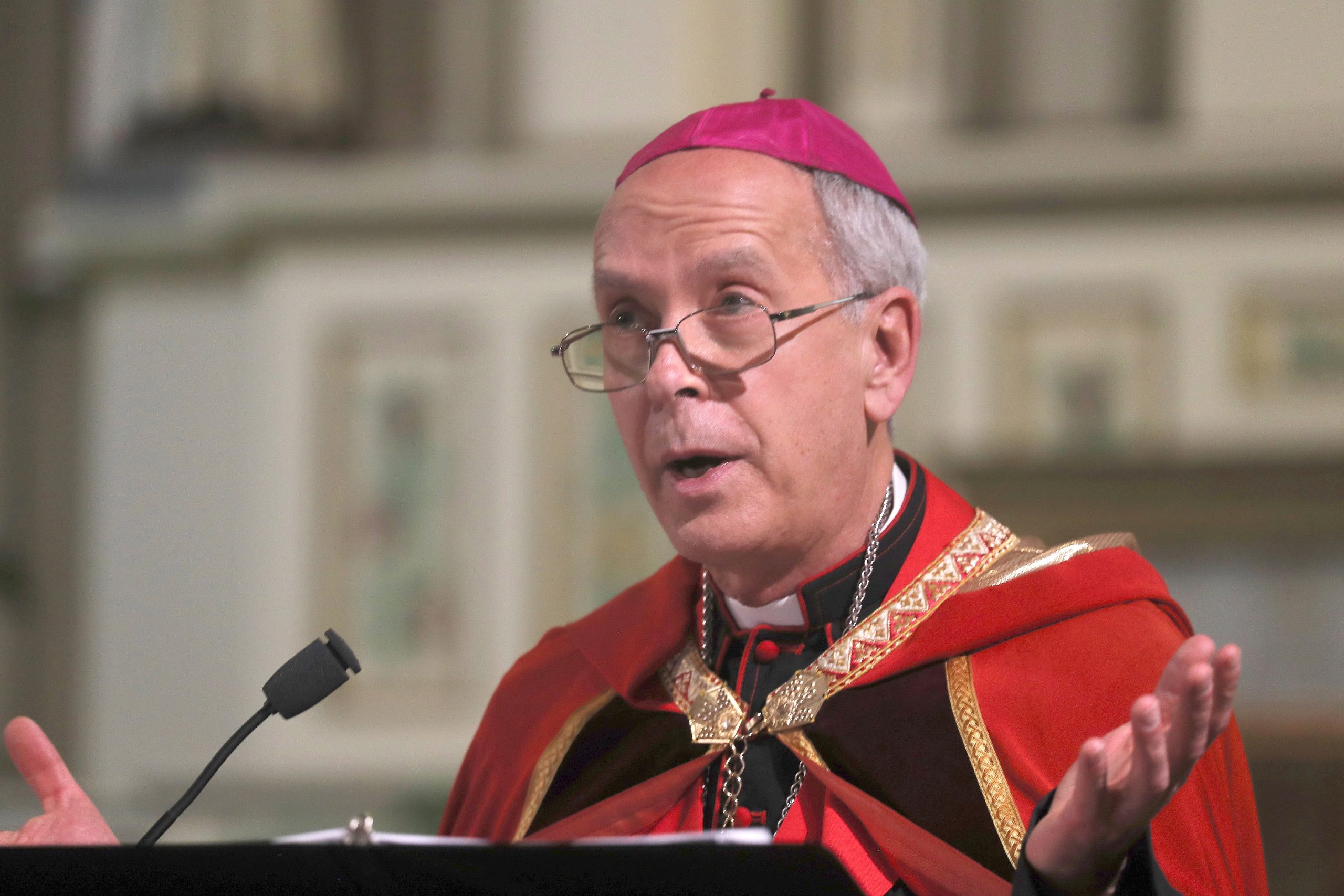
In a pastoral letter released on March 15, Bishop Mark Seitz of the Diocese of El Paso implored immigration enforcement agents not to follow orders that violated their consciences. “No one has to obey an illegal order,” he wrote, asking those executing the mass deportation campaign at the behest of the Trump administration to “carefully discern the moral requirements of the Gospel at this moment with integrity and honesty.”
The bishop’s pastoral letter on mass detention and deportation was read during Sunday Mass across the diocese. It was the “first pastoral letter released by a Catholic bishop on this particular topic,” according to a diocesan press release.
“When we take off our masks and encounter each other as neighbors, we can reclaim our common dignity,” Bishop Seitz wrote. He also pledged “pastoral support” to immigration agents as they “navigate the demands of conscience with sincerity.”
Kevin Appleby, a senior fellow at the Center for Migration Studies, commended Bishop Seitz for highlighting the issue of immoral orders. He described most Immigration and Customs Enforcement and Border Patrol agents as “honorable men and women who may disagree with the abusive tactics and inhumane policies being pushed by this administration.”
“They, too, may be the victims of intimidation and fear tactics within [the Department of Homeland Security],” he said.
The pastoral letter contained some of the strongest and most unambiguous condemnation of the U.S. mass deportation campaign from the U.S. Catholic hierarchy thus far.
“I must make clear, the current national campaign of mass detention and deportations is a grave moral evil, one which must be opposed, with prayer, peaceful action and acts of solidarity with those affected,” Bishop Seitz wrote.
“Mass deportations will not make our communities safer,” he added. “They separate families, divide neighbors and threaten our economic wellbeing.”
Recalling the nomadic experiences of Abraham and the earliest Israelites, Bishop Seitz said that “God’s people” are a “people on the move.” In his letter, he stressed the themes of care and hospitality for migrants that are abundant in the Hebrew Scriptures and the Gospels. He noted that “we meet Jesus as a child living in exile and as an adult with no place to lay his head.”
Bishop Seitz wrote that it was his hope that American Catholics will come to see Jesus in the migrants of today, who have shared their “fears, sufferings and worries about deportation” with him in recent months.
“Neighbors are being snatched as they walk out of immigration court proceedings downtown. Workers are being taken from construction sites across the city. Mothers and fathers are no longer able to work because the government has taken away their legal work permits. Young women are languishing in mental torture for months in private detention centers,” Bishop Seitz said.
“So many people are once again being made to feel like they are less than American.”
In the letter, Bishop Seitz pledged to “redouble” diocesan ministries to support immigrants and their families, including outreach to immigrants in detention and at courthouses and “work to end racism and make immigration reform a reality.” He emphasized that the church stands in solidarity with migrants against enforcement abuses.
Bishop Seitz spoke extensively of his experience on the border and the brutality of the Trump administration’s enforcement campaign in an address at Boston College adapted for publication in America on March 9. “Since Day One of the current presidential administration—our nation’s very carefully crafted system of protection at the border for receiving those fleeing threats to life and liberty,” he wrote, “has been effectively dismantled.”
“Asylum and international protection are over.”
Bishop Seitz wrote that the mass deportation campaign reflects an expansion of the precariousness of the borderlands to the rest of the nation and how Pope Leo XIV has been clear about the need for the U.S. church “to act, to speak up.”
The federal government is pouring more money than ever into immigration enforcement. Despite the ongoing government fight over D.H.S. funding, which has led to a shutdown of some D.H.S. capacity, ICE is fully funded through 2029 thanks to the $75 billion budget package passed by Congress in July.
According to the Brennan Center for Justice, the cash injection “more than tripled ICE’s annual budget and made it the largest federal law enforcement agency.” The agency is increasing the detention capacity at its facilities by the tens of thousands and shows no sign of stopping.
The additional resources made available to D.H.S. includes $45 billion for new detention centers, an expansion that has similarly alarmed Bishop Seitz. He called the rising numbers of deaths of immigrants held in detention “unacceptable.”
Facts Only
Bishop Mark Seitz of the Diocese of El Paso released a pastoral letter on March 15.
The letter was read during Sunday Mass across the diocese.
It urged immigration enforcement agents not to obey orders that violate their consciences.
Seitz described the mass deportation campaign as a "grave moral evil."
The letter pledged increased diocesan support for immigrants, including outreach to those in detention.
Seitz cited biblical themes of migration, referencing Abraham and Jesus.
The letter condemned family separations, economic harm, and psychological suffering caused by deportations.
Kevin Appleby, a senior fellow at the Center for Migration Studies, supported Seitz’s stance.
Appleby stated that many ICE and Border Patrol agents may disagree with current policies but face intimidation.
The Trump administration’s policies have dismantled asylum protections, according to Seitz.
Congress passed a $75 billion budget package in July, tripling ICE’s annual budget.
ICE is expanding detention capacity by tens of thousands.
Seitz called the rising deaths of immigrants in detention "unacceptable."
The letter is the first by a U.S. Catholic bishop specifically addressing mass detention and deportation.
Executive Summary
Bishop Mark Seitz of the Diocese of El Paso issued a pastoral letter on March 15 condemning the U.S. mass deportation campaign as a "grave moral evil." The letter, read during Sunday Mass across the diocese, urged immigration enforcement agents to refuse orders that violate their consciences, emphasizing the moral requirements of the Gospel. Seitz highlighted the human cost of deportations, including family separations, economic disruption, and the psychological toll on detainees, while pledging increased diocesan support for immigrants. He framed migration as a biblical theme, invoking the experiences of Abraham and Jesus as examples of displacement. The letter also criticized the Trump administration’s dismantling of asylum protections and the expansion of detention facilities, funded by a $75 billion budget package passed by Congress in July. Kevin Appleby of the Center for Migration Studies supported Seitz’s stance, noting that many enforcement agents may oppose the administration’s policies but face intimidation within the Department of Homeland Security. The letter marks the first such public condemnation by a U.S. Catholic bishop on this issue, reflecting growing church opposition to current immigration enforcement practices.
The federal government has significantly increased funding for immigration enforcement, with ICE’s budget tripled and detention capacity expanding rapidly. Seitz condemned the rising deaths in detention as "unacceptable" and called for systemic reform. His address at Boston College, published in *America* on March 9, further detailed the erosion of border protections under the Trump administration. While the letter has drawn attention for its moral clarity, it also underscores the tension between institutional policy and individual conscience within enforcement agencies. The diocesan press release noted this as the first pastoral letter by a Catholic bishop specifically addressing mass detention and deportation, signaling a potential shift in the church’s public advocacy on immigration.
Full Take
The strongest version of this narrative centers on moral leadership in the face of systemic injustice. Bishop Seitz’s pastoral letter is a rare and explicit condemnation of U.S. immigration policy from within the Catholic hierarchy, framing deportations not just as a political issue but as a violation of Gospel values. By directly appealing to the consciences of enforcement agents, he shifts the discourse from abstract policy debates to personal moral responsibility. The letter’s biblical framing—tying migration to the stories of Abraham and Jesus—elevates the issue to a sacred duty, making it harder to dismiss as mere partisan criticism. Seitz’s willingness to name the Trump administration’s policies as "abusive" and "inhumane" lends moral weight to the argument, while his pledge of pastoral support to conflicted agents adds a layer of practical compassion. The inclusion of Kevin Appleby’s perspective reinforces the idea that dissent exists within enforcement agencies, suggesting that the problem is systemic rather than individual.
Patterns detected: ARC-0024 Ambiguity (in the framing of "abusive tactics" without specific policy examples), ARC-0043 Motte-and-Bailey (appealing to universal moral principles while critiquing specific political actions).
The root cause of this narrative is the tension between state power and moral authority. Seitz’s letter assumes that institutional policies can be judged by a higher ethical standard, a paradigm that challenges the notion of unquestioning obedience to government orders. Historically, this echoes the role of religious leaders in civil rights movements, where appeals to conscience were used to resist unjust laws. The unstated assumption is that immigration enforcement, as currently practiced, is inherently incompatible with Christian ethics—a claim that invites debate but is presented here as self-evident.
The implications are significant for human agency: Seitz empowers individuals to act on their consciences, even at professional risk, while also highlighting the structural violence of detention and deportation. The beneficiaries of this narrative are immigrants and their advocates, who gain moral and institutional support. The costs are borne by enforcement agents caught between orders and ethics, and by policymakers who may face increased public pressure. Second-order consequences could include greater polarization over immigration, as well as potential pushback from authorities against religious interference in enforcement.
Bridge questions: How might enforcement agents reconcile their professional duties with moral objections? What alternative policies could address border security without the human costs described? Would this moral framework apply equally to all forms of law enforcement, or is immigration uniquely situated?
Counterstrike scan: If this were part of a coordinated influence campaign, the playbook would involve leveraging religious authority to delegitimize government policy, framing opposition as a moral imperative rather than a political choice. The actual content aligns with this pattern in its strategic use of biblical language and appeals to conscience, but it does not appear manipulative—rather, it reflects a genuine pastoral response to perceived injustice. The lack of partisan rhetoric and the focus on ethical principles suggest sincerity rather than coordination.
Sentinel — Human
The article exhibits strong human authorship signals, including emotional language, specific local details, and theological nuance, with no detectable signs of AI generation or synthetic manipulation.