July 2, 2026 | The National Interest
Why NATO Should Pivot Toward Economic Security
In the coming decades, military burden-sharing won’t be enough to ensure Transatlantic security.
July 2, 2026 | The National Interest
Why NATO Should Pivot Toward Economic Security
In the coming decades, military burden-sharing won’t be enough to ensure Transatlantic security.
The battlefield is shifting—from troops and trenches to critical minerals, maritime insurance, and export controls. China, Russia, Iran, and North Korea are all increasingly engaging in economic combat—so is the United States. For NATO to remain relevant, leaders need to use the upcoming Ankara, Turkey summit on July 7-8 to begin reinventing NATO with economic security as its core.
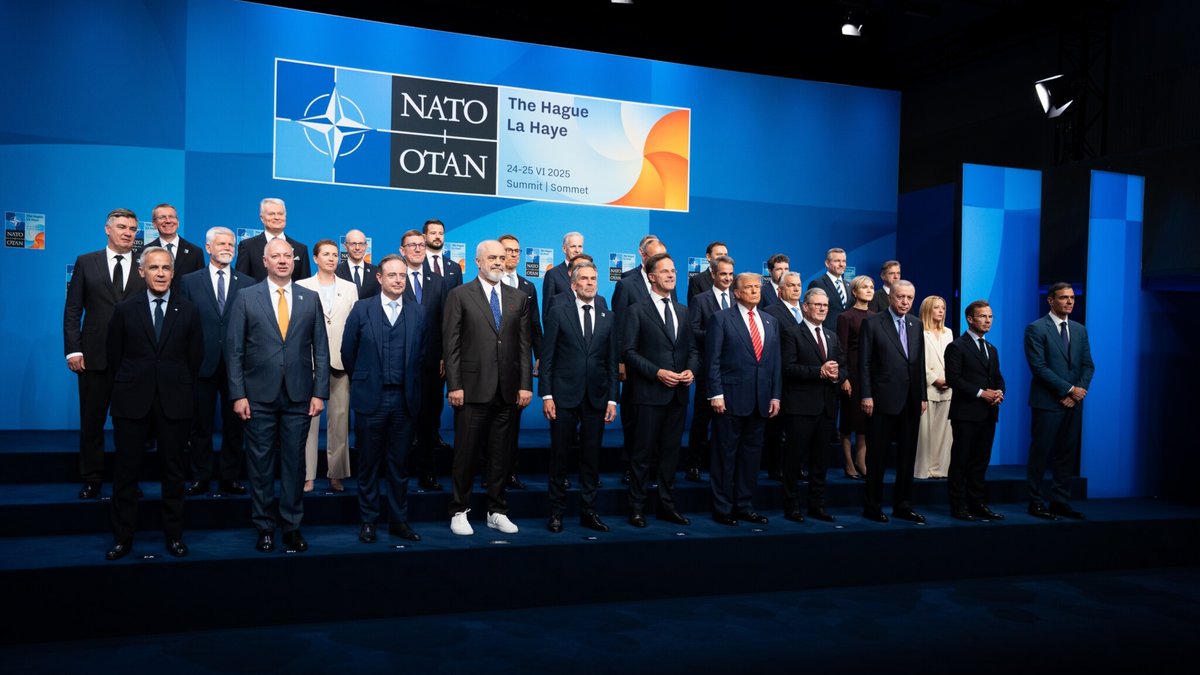
At last year’s summit, military spending was at the top of the agenda, with every member except Spain committing to spend 5 percent of national income on defense. But only 3.5 percent is slated to go to traditional defense; the remaining 1.5 percent of GDP is for resilience efforts —that is where economic security should come in.
In June, the Trump administration pressed NATO allies to remove telecom equipment from China’s Huawei over cyber and espionage risks. That vulnerability, however, is only one of many.
Over the past year, China has restricted and even denied exports of rare earths, critical minerals, magnets, and battery technology—all vital for the Western defense industrial base. Europe’s aerospace and defense industry warned production could stall as orders surged. NATO has named 12 defense-critical raw materials, from gallium to titanium, without which modern munitions, radars, and aircraft cannot be built. China dominates the supply of most of them.
If NATO is rearming, its industrial base must be defended against adversaries. Large defense budgets are meaningless when potential military opponents control the supply chains that turn money into military power.
The risk is systemic and growing. In 2024, China produced around 30 percent of global manufactured goods. By 2030, Beijing is forecast to control a shocking 45 percent of all industrial production, making nearly half of the stuff on which supply chains are built. China’s unethical practices—export dumping, intellectual property theft—represent a form of economic warfare that NATO countries are poorly defended against. Similarly, Europe’s energy dependence on Russian gas and exposure to the Kremlin-backed corruption represent vulnerabilities that weaken all of NATO.
NATO, and Europe more broadly, are insufficiently prioritizing economic security. It is studied and discussed, but not meaningfully addressed. NATO’s Economics and Security Committee passes resolutions as an advisory body with no power to act. NATO’s supply-chain work remains disconnected from military planning. The European Union, meanwhile, is agonizingly slow, consensus-driven, and indecisive. The EU’s economic statecraft depends on insufficient tools, such as an unused anti-coercion instrument and a Critical Raw Materials Act that still leaves defense firms scrambling in the face of China’s export controls.
An Economic NATO could fill that gap without the need for a new charter or huge bureaucracy. It could fold geoeconomics into what the alliance already does—planning, intelligence, procurement, and exercises—by treating economic warfare as a legitimate security threat.
At the July summit, NATO should prioritize two tasks.
First, NATO should mandate that members collectively map their defense supply chains to find where a single export control could stall a pan-European production line or leave soldiers with guns that lack bullets. The United States has begun this process domestically, but such mapping needs to be a part of NATO’s defense plans and its annual exercises. The alliance already stress-tests military mobility; it should also stress-test supply-chain chokeholds and shadow-fleet response plans.
Second, NATO should establish a shared reserve for critical minerals already flagged. Allies stockpile fuel and ammunition; in an age of weaponized supply chains, gallium and tungsten are ammunition. A template already exists: at the G7 summit this June, Canada offered allies priority access to its critical-minerals stockpile, and France, Germany, Italy, and South Korea agreed to build joint reserves with Ottawa.
In time, an “Economic NATO” could even provide a framework for an aligned transatlantic economic-security policy—starting with unified transatlantic export control and investment rules, preventing adversaries from engaging in enforcement arbitrage between America and Europe.
Putting economic security at the core of NATO will entail costs as supply chains are reinforced and domestic replacements are established. The 1.5 percent of GDP set aside for resilience, however, is perfectly sufficient to fund economic preparedness, infrastructure protection, and cybersecurity. Failure to prioritize economic security, of course, also has costs if large military budgets are vulnerable to tiny supply disruptions.
In 1914, a tangle of treaty obligations thrust Russia, France, and Great Britain into a military conflict with Germany and Austria-Hungary. In the years leading up to World War I, however, Russia failed to appreciate that its entire supply of tannin—a chemical compound necessary for boot leather—was produced by Germany. When supplies were cut off, soldiers were sent into battle without shoes.
NATO is a defense alliance, but the meaning of defense is changing. Collective defense must extend to the economic foundations that underwrite it. At this year’s summit, NATO must emphasize economic security. After all, NATO can’t afford to fight a war with China barefoot.
Josh Birenbaum is the deputy director of the Center on Economic and Financial Power at the Foundation for Defense of Democracies, focusing on economic statecraft, illicit finance, global corruption, and the weaponization of radical transparency. Josh is a former lawyer and analyst who founded and ran Joshua Birenbaum Consulting, advising large companies, start-ups, non-profits, think tanks, universities, medical centers, and governments. Josh obtained his JD from the University of Virginia and his BA from Bard College.
Antonia-Laura Pup is a Fulbright scholar, CEFP intern, and teaching assistant at the Walsh School of Foreign Service, Georgetown University. She previously served as policy advisor to the President of the Defense Committee in the Romanian Parliament, and as a local advisor in the European Parliament. In 2022, the Romanian Ministry of Foreign Affairs named her a “Youth Ambassador of Romania.”
Sentinel — Human
This text exhibits the clarity, specific focus, and authoritative synthesis characteristic of expert human geopolitical analysis, grounded in practical economic and defense policy concerns.