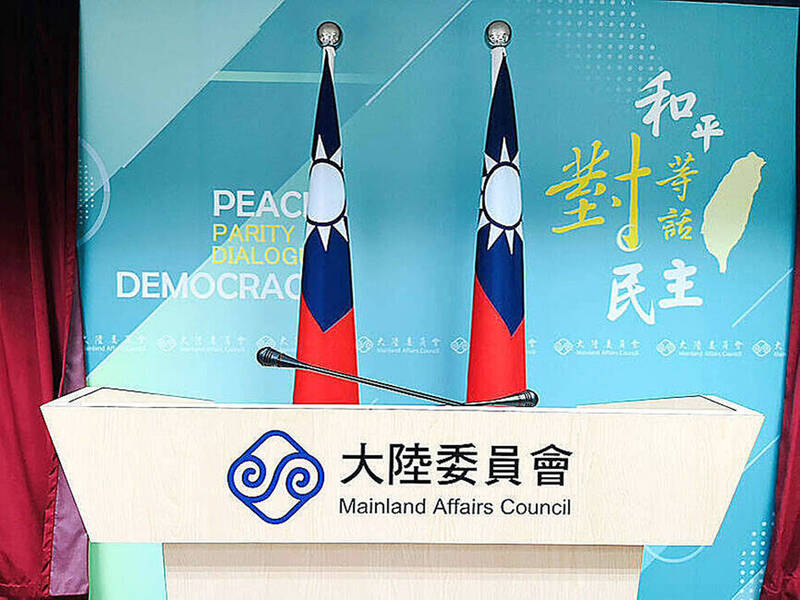
Taiwan’s exports to China under the Early Harvest Program of the Economic Cooperation Framework Agreement (ECFA) fell to a record low last year, the Mainland Affairs Council (MAC) said yesterday on the agreement’s 16th anniversary.
Exports covered by the program fell to US$13.1 billion last year, accounting for 13.1 percent of Taiwan’s exports to China, down from 26.3 percent in 2016 and the lowest level since the agreement took effect, the council said.
In the past few years, Beijing has used trade barrier investigations for political purposes to exert economic pressure on Taiwan and coerce Taiwanese, it said.
Photo: Chen Yu-fu, Taipei Times
These include its unilateral ruling on Dec. 15, 2023, that Taiwan’s import restrictions constituted a trade barrier, as well as announcements on Dec. 21, 2023, and May 31, 2024, suspending preferential tariffs on 146 ECFA product items, it said.
The moves show the use of cross-strait trade measures as political leverage and tools of economic pressure, weaponizing trade to force Taiwan to accept Beijing’s political positions, it said.
Such policies, changed or terminated at will, have seriously harmed the interests of businesses and people on both sides of the Taiwan Strait, it added.
Taiwanese investment in China has also declined sharply, accounting for 83.8 percent of Taiwan’s outbound investment at its peak in 2010, but falling to 3.8 percent last year and just 0.9 percent in the first five months of this year, the council said.
It attributed the trend to geopolitical tensions, US-China strategic competition, China’s economic slowdown, a worsening investment climate and what it described as Beijing’s economic coercion against Taiwan.
Despite those challenges, Taiwan’s economy remained resilient, the MAC said, citing economic growth of more than 8 percent last year and record per capita GDP of US$39,000.
The government would continue pursuing its “Taiwan first” and “rooted in Taiwan, global deployment” strategy by encouraging domestic investment, diversifying export markets, and expanding bilateral and regional economic cooperation to reduce dependence on China, and bolster Taiwan’s economic resilience and competitiveness, it said.
Separately, industry and economic analysts yesterday said that Taiwan’s experience under the ECFA offers lessons for countries that has become heavily dependent on China.
Taiwan’s economy grew heavily reliant on China after the ECFA was signed in 2010, but subsequent economic restructuring helped diversify markets and reconnect Taiwan with the global economy following a change in government, analysts said.
They cited Australia, whose exports to China exceeded 30 percent of total exports by 2020 before Beijing imposed retaliatory tariffs on products including barley and wine after Canberra called for an independent investigation into the origins of COVID-19, affecting about A$20 billion (US$13.8 billion) in annual exports.
South Korea, which signed a free trade agreement with China in 2015, also saw companies such as Samsung and LG lose ground as technologies were copied and Chinese competitors gained market share, they said.
In 2023, South Korea posted its first trade deficit with China in 31 years, totaling US$18 billion. A Korea Economic Research Institute report warned that China could overtake South Korea in semiconductors, electronics, shipbuilding, petrochemicals and biotechnology by 2030.
The analysts also cited Italy, the only G7 nation to join China’s Belt and Road Initiative, saying its trade deficit with China nearly doubled to 41 billion euros (US$46.7 billion) within four years. Italian Prime Minister Giorgia Meloni later called the decision a major mistake, and Italy withdrew from the initiative at the end of 2023.
Taiwan, Australia, South Korea and Italy sought economic gains through closer ties with China, but instead faced technology imitation, low-cost competition and market displacement that damaged domestic industries, the analysts said.
“There is no such thing as a free lunch,” they said, adding that no agreement with an authoritarian regime offers lasting economic benefits.
Sustainable growth depends on strengthening domestic competitiveness and integrating into democratic global supply chains, they said, pointing to Taiwan’s reduced reliance on the “one China” market over the past decade as a model for other countries.
Japan on Wednesday rejected Beijing’s accusations that the Japanese military harassed a Chinese aircraft carrier strike group during 40 days of exercises in “distant waters” of the Pacific. The Chinese navy earlier this week said that Japanese ships and aircraft “repeatedly engaged in close-range tracking, surveillance, harassment and provocation.” China said a formation led by its Liaoning aircraft carrier had operated in areas including the South China Sea and the western Pacific for “multiple rounds of day-and-night offensive and defensive exercise.” The Liaoning group “maintained a high state of alert throughout, launching carrier-based aircraft for combat sorties ... and steadily responding to the
GLOBAL CONCERN: The UK, German and French offices reiterated their opposition to unilateral changes to the Taiwan Strait ‘status quo,’ particularly by threat or force The UK, Germany and France’s de facto embassies in Taiwan, as well as the US’ office, yesterday expressed concern over China’s “special maritime law enforcement operations” in waters east of Taiwan, saying that such behavior threatens regional stability. In a joint statement issued by the British Office Taipei, the German Institute Taipei and the French Office in Taipei, the three offices, which represent their respective countries’ interests in Taiwan in the absence of official diplomatic ties, said that they had “noted with concern novel Chinese activity in the waters east of Taiwan.” “These actions threaten regional stability, and the freedom of navigation
COUNTER: The government should put forward a more proactive exchange policy for the youth and encourage them to engage with the wider world, the source said Beijing is trying to entice young Taiwanese to attend the Cross-Strait Sun Yat-sen Forum in Guangdong Province, China, by offering to cover all their expenses except round-trip airfare, an official said yesterday. “The cheapest things are the most expensive,” an official familiar with China’s “united front” work said, adding that such tours typically include visits to “red propaganda bases.” “These kinds of united front trips only end up bringing back a lot of falsehoods,” said the official, who wished to remain anonymous. The forum, which began on Saturday last week, ends today. China is offering an all-expense paid trip to Taiwanese participants aged
Torrential rain battered Taiwan for a second day yesterday and caused widespread flooding nationwide that led to at least two deaths as rising waters stranded residents and prompted emergency rescues. Premier Cho Jung-tai (卓榮泰) yesterday morning directed the Ministry of Economic Affairs to aid local governments with pumps to clear inundated areas. The heavy rain was brought by Tropical Storm Mekkhala as it moved northward east of Taiwan, strengthening southwesterly winds and an approaching weather front from southern China, the Central Weather Administration said. As of press time last night, the severe flooding had killed two people. Kaohsiung police said a 73-year-old woman surnamed
Sentinel — Human
This text exhibits strong journalistic structure and specific attribution, pointing toward a human-written report that synthesizes verifiable data rather than purely synthetic content.