Why the Islamic Revolutionary Guard Corps are likely making the decisions.
This article is brought to you by American Purpose, the magazine and community founded by Francis Fukuyama in 2020, which is proudly part of the Persuasion family.
The most important fact in Iran right now is not what the regime says about Mojtaba Khamenei’s health; it is what the regime has not revealed. After the February 28 attack that killed Ali Khamenei, the Islamic Republic appointed his second son, Mojtaba, as the third supreme leader on March 8.
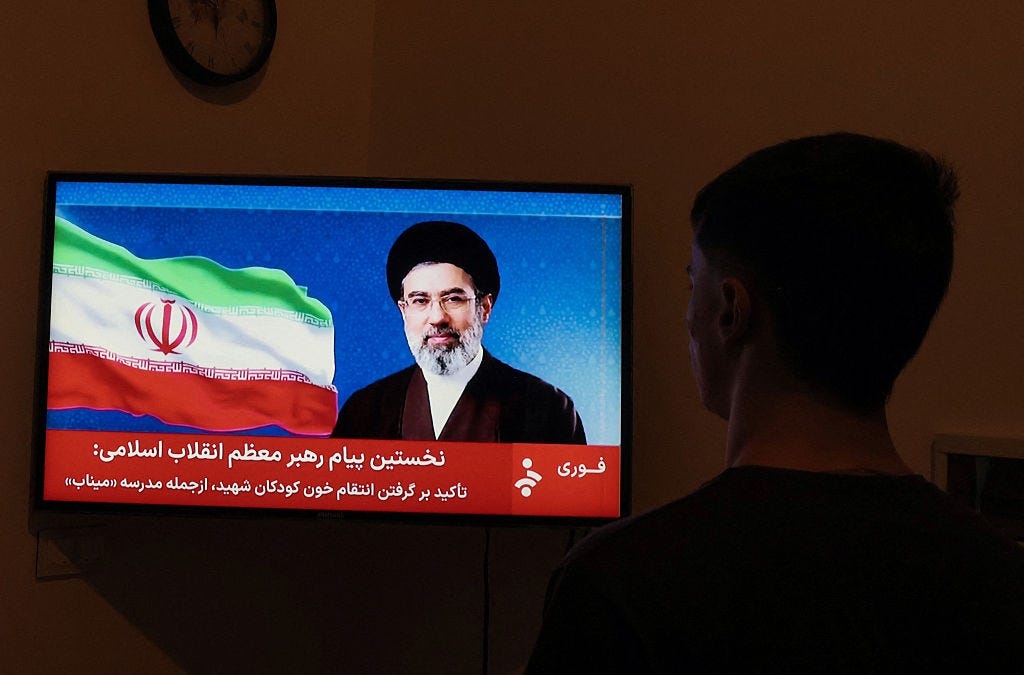
However, since the war began, Mojtaba has neither appeared in public nor delivered a televised speech. He has not released even a recorded audio message to the Iranian people. Even his first remarks as supreme leader were read by a television presenter. Although Iranian officials claim that Mojtaba is well and directing the war, many, including President Donald Trump, believe he is injured, and some think he may be in a coma.
That leaves one basic question at the center of Iranian politics today: If Mojtaba is wounded, incapacitated, or even in a coma, who is making the decisions? Who wrote his first message?
The Islamic Republic is not in a normal succession moment. It is in the middle of war, leadership decapitation, and an unprecedented crisis of command. In such a situation, the person with the title does not automatically assume power. Instead, power goes to the people who can communicate, coordinate, survive, and remain hidden. Mojtaba may have been elevated to preserve continuity after his father’s death, but continuity on paper is not the same as control in practice. If the new supreme leader cannot speak to the public, cannot appear before elites, and cannot reassure the system through his physical presence, then his position becomes vulnerable to capture by those operating around him.
Some may say the answer must lie with the visible civilian and semi-civilian leadership, figures such as President Masoud Pezeshkian or Judiciary Chief Gholam-Hossein Mohseni Ejei, who are still alive. After all, these are the men the public see. Pezeshkian and Ejei appeared recently at a Quds Day rally in Tehran, and have been the public faces of the state since Ali Khamenei’s death.
But that visibility is exactly why they are unlikely to be the real wartime decision-makers. If Israel or the United States can locate targets through public appearances, speeches, and open movement, the men standing before cameras are not the safest to manage sensitive military and security decisions.
Public figures have political value: They can signal continuity, calm internal audiences, and provide a formal face for the state. But in wartime Iran, the people likely making the hardest decisions are those who are not visible.
The real center of gravity is probably elsewhere, inside the hidden security apparatus around Mojtaba and, more importantly, the Islamic Revolutionary Guard Corps. The answer lies in the regime’s structure of power, which Mojtaba helped to build and shape. As the second most important man in his father’s office, the Bayt, he was aware of the underground tunnels, secure networks, and institutions through which the regime exercised power, formally and informally.
The Islamic Revolutionary Guard Corps, established in 1979 as the clerical regime’s bodyguards, has since the 1990s become the most important organization in the Islamic Republic. Ali Khamenei repeatedly treated the Guard as the central pillar of the regime’s survival. The organization strongly pushed for Mojtaba’s elevation and has tightened its grip over wartime decision-making despite major losses in its command structure. Even if Mojtaba is alive, the structure around him is likely already moving toward direct Guard control.
If that reading is correct, the people who matter most are not the politicians seen in public, but the less-visible security actors who have remained in the shadows since the war began. This includes Mohammad-Bagher Ghalibaf, the parliamentary speaker who has a long Revolutionary Guard background; Ahmad Vahidi, the new Islamic Revolutionary Guard Corps commander; Hossein Nejat, commander of the Guard’s security command; and Majid Khademi, the head of the Guard’s intelligence organization. Not all their roles can be confirmed directly in real time, especially when wartime reporting is incomplete, but the pattern is clear. The men with the guns, secure communications, and underground networks will make decisions in Mojtaba’s name if he cannot.
That would mean the Islamic Republic has moved one step further in its long transformation from clerical authoritarianism to security guardianship. Mojtaba’s succession was a sign that the system no longer cared much about public legitimacy, clerical stature, or even revolutionary symbolism. His possible incapacity would push the same process even further, effectively reducing the supreme leader from a decision-maker to a figurehead. The title would remain clerical, but the rule would become more military- and security-based.
All of this helps to explain why the regime’s behavior has become so rigid and escalatory. A hidden chain of command dominated by the Islamic Revolutionary Guard Corps is far less likely to compromise, de-escalate, or test a diplomatic opening. The men around Mojtaba are not pragmatists; they are hardliners shaped by intelligence work, internal repression, missile doctrine, and survivalist thinking. They do not see war as a reason for moderation, but as proof that only coercion, ideological discipline, and regional escalation can save the system.
In authoritarian systems, silence is never neutral. Iran’s silence strongly suggests that the Islamic Revolutionary Guard Corps’ security commanders are already making the most important decisions and Mojtaba’s rise means something darker than dynastic succession: It means the final masking of military and security rule behind a cleric’s name.
Saeid Golkar is a senior nonresident fellow on Iran Policy at the Council and the UC Foundation associate professor in the department of political science at the University of Tennessee at Chattanooga. Previously, he held research and teaching positions at Stanford University and Northwestern University.
This article was originally published by the Middle East Forum.
Follow Persuasion on X, Instagram, LinkedIn, and YouTube to keep up with our latest articles, podcasts, and events, as well as updates from excellent writers across our network.
And, to receive pieces like this in your inbox and support our work, subscribe below:
Facts Only
Mojtaba Khamenei was appointed Iran’s third supreme leader on March 8, following his father Ali Khamenei’s death in a February 28 attack.
Mojtaba has not appeared in public, delivered a televised speech, or released an audio message since his appointment.
Iranian officials claim Mojtaba is well and directing the war, but his first message as supreme leader was read by a television presenter.
Some, including former U.S. President Donald Trump, believe Mojtaba may be injured or in a coma.
The Islamic Revolutionary Guard Corps (IRGC) is likely the dominant decision-making body in Iran during the war.
Key IRGC figures include Mohammad-Bagher Ghalibaf (parliamentary speaker), Ahmad Vahidi (IRGC commander), Hossein Nejat (security command), and Majid Khademi (intelligence head).
The IRGC has historically been the central pillar of the regime’s survival and pushed for Mojtaba’s elevation.
Public figures like President Masoud Pezeshkian and Judiciary Chief Gholam-Hossein Mohseni Ejei are visible but unlikely to be the real wartime decision-makers.
The regime’s behavior has become more rigid and escalatory, suggesting IRGC dominance.
The IRGC’s influence may reduce the supreme leader’s role to a figurehead, shifting power from clerical to military-security rule.
The article was written by Saeid Golkar, a senior fellow on Iran policy at the Council and a professor at the University of Tennessee at Chattanooga.
Executive Summary
Full Take
The strongest version of this narrative is that Iran’s leadership vacuum has empowered the IRGC, transforming the supreme leader’s role into a symbolic one while hardliners drive policy. The article credibly highlights the IRGC’s historical dominance and the regime’s opacity, which fuels speculation about Mojtaba’s health and the true locus of power. However, the analysis leans heavily on inference—Mojtaba’s invisibility is framed as proof of IRGC control, yet alternative explanations (e.g., strategic secrecy, internal power struggles) are underweighted. The piece also assumes the IRGC’s unity and coherence, ignoring potential factions within the Guard or tensions with other elites.
Patterns detected: **ARC-0024 Ambiguity** (leveraging uncertainty to imply a specific narrative), **ARC-0043 Motte-and-Bailey** (presenting a narrow claim—IRGC influence—as proof of a broader one—total control).
Root cause: The narrative reflects a broader paradigm of authoritarian regimes where security apparatuses eclipse formal leadership, especially in crises. It assumes the IRGC’s primacy is inevitable, echoing historical patterns like Pakistan’s military dominance or Egypt’s deep state. Yet it overlooks the regime’s adaptive resilience—clerical and military elites often balance power rather than cede it entirely.
Implications: If the IRGC is indeed calling the shots, Iran’s policy will likely grow more confrontational, with less room for diplomacy. This benefits hardliners but risks further isolating Iran and escalating regional conflicts. The cost is borne by Iranian civilians, who face repression and economic strain, and by neighboring states caught in the crossfire.
Bridge questions: What evidence would disprove the IRGC’s dominance? Could Mojtaba’s silence be a deliberate strategy rather than incapacity? How might internal IRGC divisions alter this dynamic?
Counterstrike scan: A coordinated influence campaign would amplify uncertainty about Mojtaba’s health to justify preemptive strikes or regime change rhetoric. The article stops short of this, focusing on structural analysis rather than advocacy. No structural alignment detected.