If you buy from a link, we may earn a commission. Learn more
Another week down, and, per usual, a bunch of new tech and gadgets have been announced.
This past week, Sonos unveiled its first consumer speakers in over a year, HiFiMan introduced two Wi-Fi-streaming hi-fi headphones, and BenQ announced an affordable alternative to Apple’s Studio Display. But that’s just scratching the surface.
Below, we’ve rounded up all the most interesting new releases and announcements you might have missed from the past week.
Sonos Play
The Sonos Play is a portable speaker that’s sized (and priced) between the company’s Roam 2 and Move 2, and it works quite similarly to both. It has Bluetooth and Wi-Fi streaming capabilities, so you can integrate it with your home’s existing Sonos system or use it as a standalone Bluetooth speaker outside. Like the Move 2, the USB-C port on the Play’s back supports charging and line-in audio, so you can connect it directly to your computer or turntable (with a built-in preamplifier) and use it as a wired speaker.
HiFiMan’s HE1000 WiFi is a reimagined version of the company’s wired HE1000. It’s an open-back headphone with planar magnetic drivers, but each unit integrates an onboard DAC, a Class A/B amplifier, a proprietary processor, and a battery. As its name suggests, its main feature is Wi-Fi streaming. So it’s designed for audiophiles who want a superior wireless listening experience at home, in the studio, or in any quiet listening space.
BenQ’s 27-inch monitor, the MA270S, is positioned as an affordable rival to Apple’s recently refreshed Studio Display. It’s the same size, features a Nano Gloss panel with true 5K resolution, wide P3 color support, and single-cable Thunderbolt connectivity, so it works seamlessly with Macs. The main trade-offs are that it lacks a built-in speaker system and a fancy webcam, but at $600 less, it could be a bargain for many Mac users.
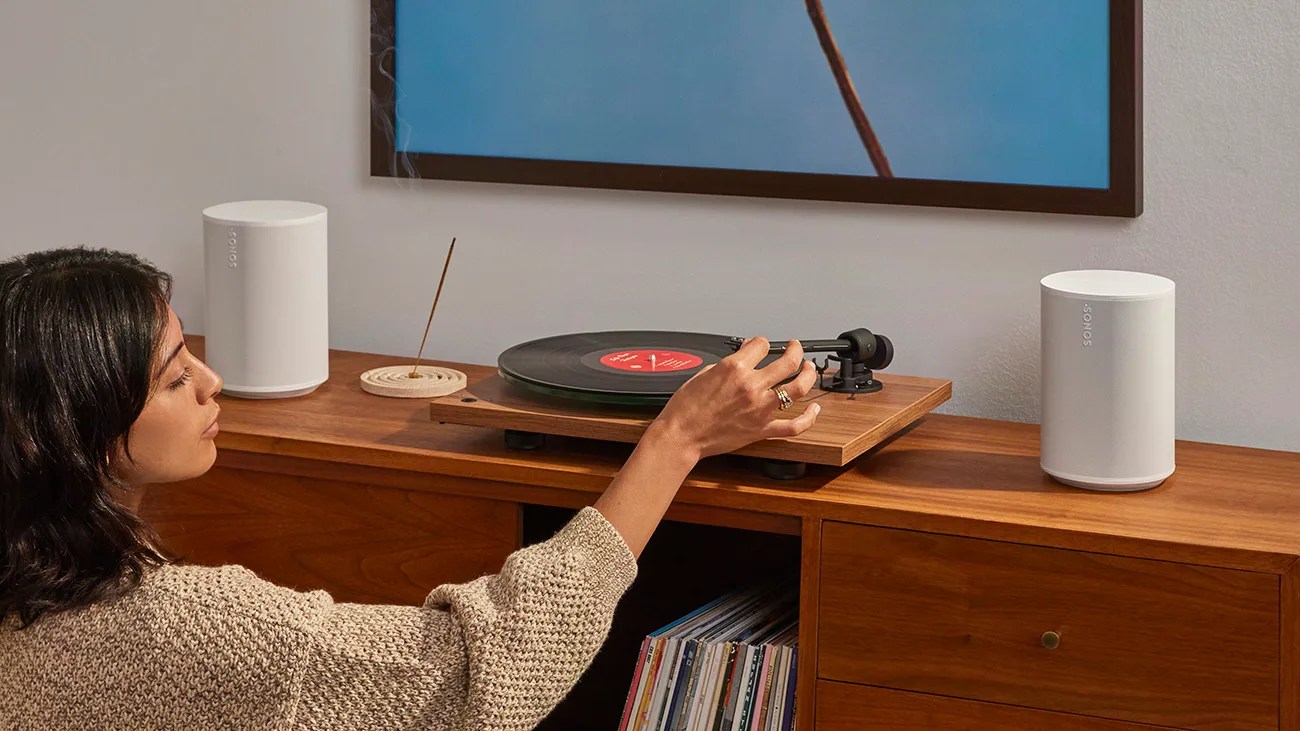
The Era 100 SL is a microphone-less version of the company’s Era 100, meaning it can’t be integrated with a voice assistant. Other than that, it looks and works the same. Two can be used as a stereo pair or as rear-channel speakers with a Sonos soundbar. It’s primarily designed for people who already have numerous Sonos speakers in their home and just want an affordable addition to their system.
The Arya WiFi is a reimagined, wireless version of HiFiMan’s Arya open-back wired headphones. Designed for audiophiles who want to listen to wireless headphones at home (or at work), they support Wi-Fi streaming and thus can play significantly higher-resolution audio than over Bluetooth. When streaming over Wi-Fi, each device can stream up to 32-bit/768kHz audio, with support for DSD512 and PCM (44.1kHz to 768kHz).
The Conductor Stellar combines a high-resolution DAC, a Class-A headphone amplifier, and a desktop preamp in a single spacecraft-inspired box. It’s positioned between the company’s entry-level Party Playmate 3 ($599) and Conductor Grand Tourer 4 ($2,799). Naturally, the Conductor Stellar is designed to effortlessly power any type of headphone, including demanding planar magnetic models, but it’s really optimized for high-end in-ear monitors thanks to a dedicated ultra-low-noise IEM amplification stage. The brand claims it sets a new benchmark for IEM listening.
The BasX TA2+ is a “no fuss” stereo integrated amplifier designed to be the hub of an entry-level hi-fi system. It packs an amplifier, preamplifier, DAC and tuner into a bespoke black box. Compared to its predecessor, the 2023-released BasX TA2, the primary difference with BasX TA2+ is that it adds way more modern connections. Emotiva has given it HDMI Arc and USB-C inputs, allowing you to connect your TV, computer or tablet.
The JBL Live 780NC is a pair of wireless over-ear headphones with active noise-cancellation. (They are slightly higher-end than the company’s wireless on-ear headphones, the Live 680NC.) They feature 40mm dynamic drivers, support spatial audio, and, as their name suggests, are designed to deliver a vibrant sound similar to a “live” concert. Their other headline feature is an incredible 80-hour battery life when ANC is off. Available in five different finishes.
UAG’s Metropolis Tracker Card is a credit card-shaped Bluetooth tracker that works with both Android smartphones and iPhones — it’s designed to help you keep track of your wallet. It has a high-quality polycarbonate housing and supports wireless charging (via Qi or MagSafe). Also, it has a built-in speaker to help you easily locate it if you misplace it.
Satechi’s Foldable Stand Hub is the newest addition to the brand’s OntheGo collection of travel-friendly accessories for various Apple gadgets. As its name suggests, it’s a stand and hub optimized for the iPad Pro, iPad Air, and iPad mini (2021 and later). The hub adds USB-C and USB-A ports for connecting various accessories, microSD card and SD card slots, and an HDMI port so you can pair the tablet with an external display (up to 4K@60Hz). And when you’re not using it, the stand folds flat for easy transport.
The Final DX4000CL is the newest addition to the brand’s DX series of closed-back wired headphones, slotting between its $599 DX3000CL and its flagship $1,999 DX6000CL. And like those other headphones, the DX4000CL aims to deliver a more natural, balanced sound than traditional closed-back headphones, which often lean toward bass-heavy sound.
Skullcandy’s Push 540 Open is a pair of wireless earbuds with an open-ear design, so you can hear your surroundings while you run, bike or workout. The most interesting thing is that they come with a detachable neckband that magnetically clips to each earhook, providing added security so you don’t have to worry about the earbuds falling out of your ears. This cable doubles as a carry strap for the case. Available in two finishes: bone (white) or black.
About the Author: Tucker Bowe has been on Gear Patrol’s editorial team since 2014. With a passion for consumer tech and hi-fi, he tracks everything from headphones and turntables to smartphones and wearables. If it lights up or makes noise, he probably covers it.
Want to stay up to date on the latest product news and releases? Add Gear Patrol as a preferred source to ensure our independent journalism makes it to the top of your Google search results.
Facts Only
Sonos unveiled the Play, a portable speaker with Bluetooth and Wi-Fi, priced between the Roam 2 and Move 2.
HiFiMan introduced the HE1000 WiFi and Arya WiFi, open-back headphones with planar magnetic drivers, onboard DACs, and Wi-Fi streaming.
BenQ announced the MA270S, a 27-inch 5K monitor with Nano Gloss panel, P3 color support, and Thunderbolt connectivity.
Sonos released the Era 100 SL, a microphone-less version of the Era 100 speaker.
HiFiMan launched the Conductor Stellar, a DAC/amp combo with Class-A amplification and IEM optimization.
Emotiva introduced the BasX TA2+, an integrated amplifier with HDMI Arc and USB-C inputs.
JBL released the Live 780NC, wireless over-ear headphones with ANC and 80-hour battery life.
UAG launched the Metropolis Tracker Card, a credit card-sized Bluetooth tracker with wireless charging.
Satechi introduced the Foldable Stand Hub, a travel-friendly iPad stand with USB, SD, and HDMI ports.
Final released the DX4000CL, a closed-back wired headphone priced between the DX3000CL and DX6000CL.
Skullcandy launched the Push 540 Open, wireless earbuds with an open-ear design and detachable neckband.
Executive Summary
Full Take
The strongest version of this narrative highlights a clear trend: the convergence of high-fidelity audio, wireless convenience, and multi-functional design in consumer tech. Companies like Sonos and HiFiMan are pushing boundaries by integrating Wi-Fi streaming into traditionally wired products, catering to audiophiles who demand lossless quality without sacrificing mobility. BenQ’s monitor challenges Apple’s dominance in the premium display market by offering comparable specs at a lower price, though with trade-offs in built-in features. The releases also reflect a broader shift toward modularity—devices like Satechi’s Foldable Stand Hub and Skullcandy’s Push 540 Open emphasize adaptability for different use cases, from travel to fitness.
Patterns detected: none. The article avoids emotional exploitation or distortion, presenting product announcements factually without exaggerated claims or forced binaries. However, the underlying paradigm assumes that technological advancement is inherently positive, without critiquing the environmental or economic costs of rapid product cycles. The narrative also presupposes that consumers prioritize convenience and performance over longevity or repairability.
For human agency, these innovations offer more choices but also risk creating dependency on proprietary ecosystems (e.g., Sonos’s speaker system). The second-order consequences include potential e-waste from frequent upgrades and the digital divide for those who can’t afford premium tech. Missing perspectives might include the labor conditions behind manufacturing or the long-term sustainability of these products.
Bridge questions: How do these releases reflect broader shifts in consumer priorities—convenience over durability, or performance over affordability? What trade-offs are consumers making when opting for wireless high-fidelity audio over wired alternatives? Would the narrative change if environmental impact were a central consideration?
Counterstrike scan: A coordinated influence campaign might exaggerate the "revolutionary" nature of these products, framing them as essential upgrades to drive consumerism. The actual content avoids this, focusing on features rather than hype, so no alignment with such a playbook is detected.
Sentinel — Human
The article exhibits strong human writing characteristics, with natural variance in sentence structure, specific product details, and an authorial voice consistent with Gear Patrol's editorial style.