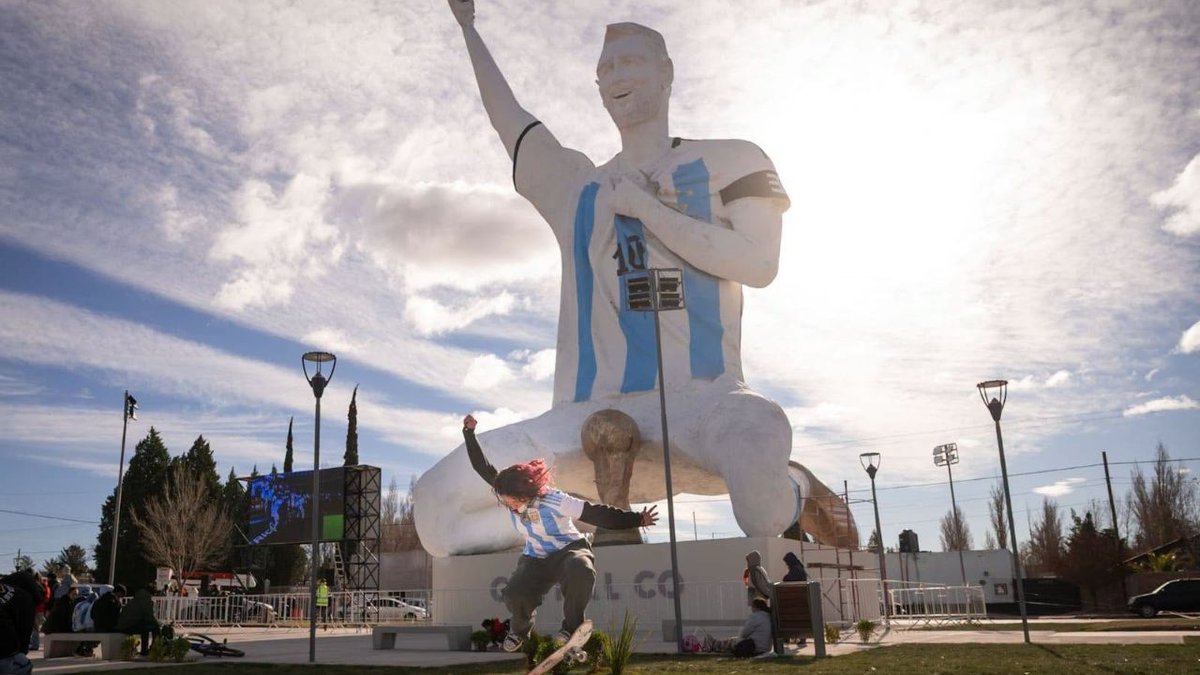
A 26-meter-tall statue of Lionel Messi unveiled in Cutral Co, a city in Patagonia, became the largest monument representing the Argentine star in the world — and a social media hot topic everywhere.
The monument depicts a kneeling Messi holding the Argentine men’s national football team jersey with one hand and pointing to the sky with the other, as if thanking the heavens for his victories.
It is painted bright white, except for the striped sky-blue and white jersey and golden boots. Inside, the structure is made up of concrete and repurposed steel pipes used in the oil extraction industry, which is characteristic of that area of Neuquén province.
Between Messi’s legs stands a golden World Cup, representing the trophy Argentina won in 2022. The original plan was for Messi to be holding it up towards the sky, but the strong Patagonian winds did not allow it. The addition was highly commented on on social media due to its unusual final placement.
Jokes aside, the statue is the result of over a year of hard work from its creator, Aldo Beroisa, and the people of Cutral Co, who all worked together for the piece to be ready for the start of the World Cup. The efforts even reached The New York Times, which published an article covering the details of how it was built and the people behind it.
Now, as Argentina has made its way into the round of 8 in a heart-wrenching match against Egypt on Tuesday, the statue has become a landmark where locals gather to celebrate the victory of the national team and its star, Messi.
Five meters taller than India’s 21-meter-high Messi monument, it is also part of a much larger collection of huge statues that make Cutral Co and nearby towns stand out.
You may also be interested in: The fourth star: Argentina’s 2026 World Cup anthem that’s finally getting off the ground
An open-air statue museum
National route 22 connects the provinces of Buenos Aires, La Pampa, Río Negro and Neuquén.
In Neuquén, on the edge of the cities Cutral Co and Plaza Huincul, the monotony of the Patagonian desert is cut off by a series of large monuments that rise high into the sky, most of them of religious nature — but also a few dinosaurs.
The creator is local artist Aldo Beroisa, an evangelical man with deep faith. When he was 19, he was hit by a truck and severely injured. After passing out for a few moments, he managed to utter “Help me, I’m alive” to those who had gathered to pray around him.
As he was being put inside the same truck that hit him so he could be taken to a hospital, he saw a white tunic. From that moment on, he believes Jesus Christ helped him survive, and years later he would be inspired to replicate that same tunic on several of his monuments as a way to thank Him.
Aldo Beroisa posing in front of his monument honoring the Malvinas veterans. Photo: Municipality of Zapala
His work includes a 13-meter-high sculpture of Jesus kneeling down with his arms open and wearing that same white tunic, as well as a massive reproduction of Leonardo Da Vinci’s Last Supper.
He has also made monuments in honor of the Argentine soldiers who died in the 1982 Malvinas war, and the victims of a 1976 fatal plane crash, as well as sculptures honoring women, among many others.
Two dinosaurs also welcome all those who visit Plaza Huincul — a Mapusaurus Roseae and Argentinosaurus Huinculensis, two specimens discovered in the area. He has over 45 sculptures and monuments scattered around not only Cutral Co and Plaza Huincul, but also other Patagonian towns and cities. All of them were paid for by the local governments.
“The route is my gallery art,” he said in an in-depth article about his life published by outlet Diario Río Negro in 2023.
You may also be interested in: No pain, no gain: why are Argentines hard-coded to endure?
Facts Only
* A 26-meter statue of Lionel Messi was unveiled in Cutral Co, Patagonia.
* The statue depicts a kneeling Messi holding the Argentine men’s national football team jersey and pointing to the sky.
* The monument is painted bright white with striped sky-blue and white jersey details and golden boots.
* The structure is made of concrete and repurposed steel pipes from the oil extraction industry.
* A golden World Cup trophy is placed between Messi’s legs.
* The statue was created through collaboration between Aldo Beroisa and the people of Cutral Co.
* The creation process involved over a year of work before the World Cup.
* Aldo Beroisa was injured when he was 19 and subsequently found inspiration in religious figures to replicate their imagery on his monuments.
* The artist has created sculptures honoring Malvinas veterans, victims of a plane crash, and women.
* Two dinosaur specimens, *Mapusaurus Roseae* and *Argentinosaurus Huinculensis*, are present in the area.
Executive Summary
Full Take
Sentinel — Human
The text reads like journalistic feature writing, effectively weaving together a public spectacle with rich local history and biographical details.