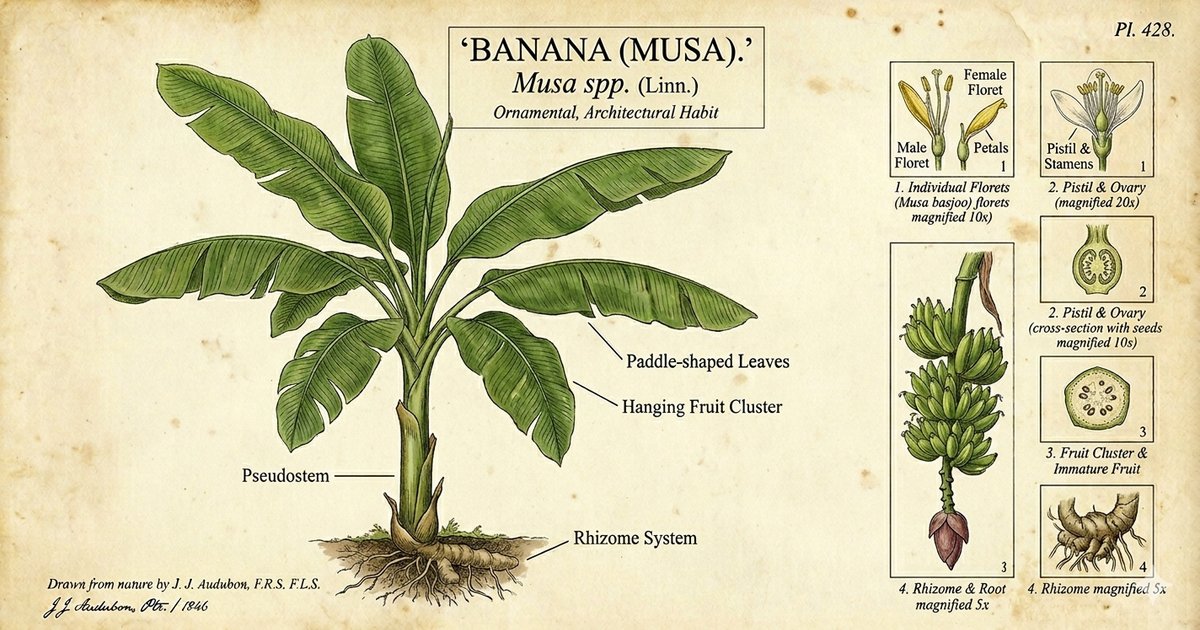
As the Fort Collins summer reaches its peak, nothing transforms a High Plains landscape into a lush, private oasis quite like the towering presence of the Banana (Musa). While we are far from the humid tropics, these rapid-growing giants have become a favorite for local gardeners looking to add vertical drama and an "exotic" structural layer to their patios and borders.
Engineering the Giant
The Banana is not a tree, but rather the world’s largest herbaceous perennial. What appears to be a trunk is actually a "pseudostem"—a tight cylinder of overlapping leaf bases. This structure is a marvel of hydraulic engineering, capable of pushing out massive, paddle-shaped leaves at an astonishing rate when the heat of July arrives. In our region, the sight of a new leaf unfurling like a green sail is a true marker of the midsummer stride.
High Plains Success Strategies
Growing a tropical giant in a semi-arid, high-altitude environment requires a specific tactical approach to overcome our low humidity and occasional wind:
Wind Management and Siting: The most significant challenge in Larimer County is our notorious wind gusts coming off the foothills. The massive leaves of the Banana act like sails and are prone to "shredding" in high winds. While this tattered look is natural for the plant, placing your Musa in a sheltered microclimate—such as a courtyard, the lee side of a fence, or a corner of a deck—will help preserve the clean, architectural lines of the foliage.
Hydration and Feeding: Bananas are essentially "liquid" plants; they require a significant and consistent water supply to maintain their massive cell structure. In the intense, drying sun of Fort Collins, they benefit from deep, daily watering. Furthermore, to achieve their full five-to-eight-foot height in a single Colorado season, they are heavy feeders. Regular applications of a nitrogen-rich fertilizer will ensure the leaves remain a deep, vibrant emerald rather than a stressed lime-green.
The Ultimate "Thriller"
In container design, the Banana is the undisputed "thriller." Its broad, smooth leaves provide a bold textural contrast to the fine, lacy textures of companions like the Asparagus Fern or the trailing cascades of Bacopa. By placing a Banana at the center of a large planter, you create a focal point that draws the eye upward, making even a small suburban patio feel like a secluded tropical retreat. While they will succumb to the first frost of October, the sheer speed and scale of their summer growth make them one of the most rewarding investments for the Front Range gardener.
Facts Only
Banana plants (Musa) are herbaceous perennials, not trees, with a pseudostem made of overlapping leaf bases.
They grow rapidly in Fort Collins, Colorado, during the summer, reaching heights of five to eight feet in a single season.
The plants require sheltered microclimates to protect their large leaves from wind damage.
Bananas need deep, daily watering and nitrogen-rich fertilizer to maintain healthy growth.
They are used as focal points in container gardens, providing bold textural contrast to other plants.
Banana plants succumb to frost and will die in October in the Fort Collins climate.
The article describes their use in local gardens for creating a tropical aesthetic.
Executive Summary
Full Take
This piece presents banana plants as a novel gardening solution for Fort Collins, emphasizing their exotic appeal and rapid growth despite the region's challenging climate. The narrative leans into the idea of "engineering" nature to achieve desired aesthetic outcomes, framing the banana plant as a triumph of human ingenuity over environmental constraints. However, the focus on visual drama and "tropical retreat" aesthetics raises questions about the broader implications of cultivating non-native species in semi-arid regions. What are the ecological trade-offs of introducing such water-intensive plants into a high-plains environment? The article acknowledges the need for heavy watering and fertilization but does not explore potential long-term sustainability concerns or the plant's impact on local ecosystems.
The framing also reflects a cultural trend toward "instant gratification" gardening—prioritizing rapid, showy growth over slow, adaptive native species. While the banana plant's seasonal lifespan is noted, the piece does not address whether this approach aligns with broader conservation goals or water-use policies in Colorado. The emphasis on "thriller" plants in container design suggests a consumerist approach to gardening, where visual impact is prioritized over ecological resilience.
Patterns detected: none
Root cause: The narrative is driven by a paradigm of aesthetic consumption in gardening, where exoticism and rapid growth are valued over ecological suitability. The unstated assumption is that human intervention can successfully "engineer" nature to fit desired outcomes, regardless of climate constraints.
Implications: For gardeners, this approach offers short-term visual rewards but may contribute to unsustainable water use and ecological disruption. The broader cultural implication is a reinforcement of the idea that nature can be manipulated to serve human desires, rather than adapting to local conditions.
Bridge questions: How might the cultivation of banana plants in Fort Collins affect local water resources over time? What native or drought-resistant alternatives could provide similar aesthetic benefits without the same environmental costs? Would the long-term success of such gardening practices depend on continued human intervention, or could they adapt to become self-sustaining?
Counterstrike scan: If this narrative were part of a coordinated campaign, it might promote a consumerist approach to gardening, encouraging the purchase of non-native plants and fertilizers. However, the content does not exhibit signs of manipulation or bad faith, instead presenting a straightforward gardening tip without overt commercial intent.