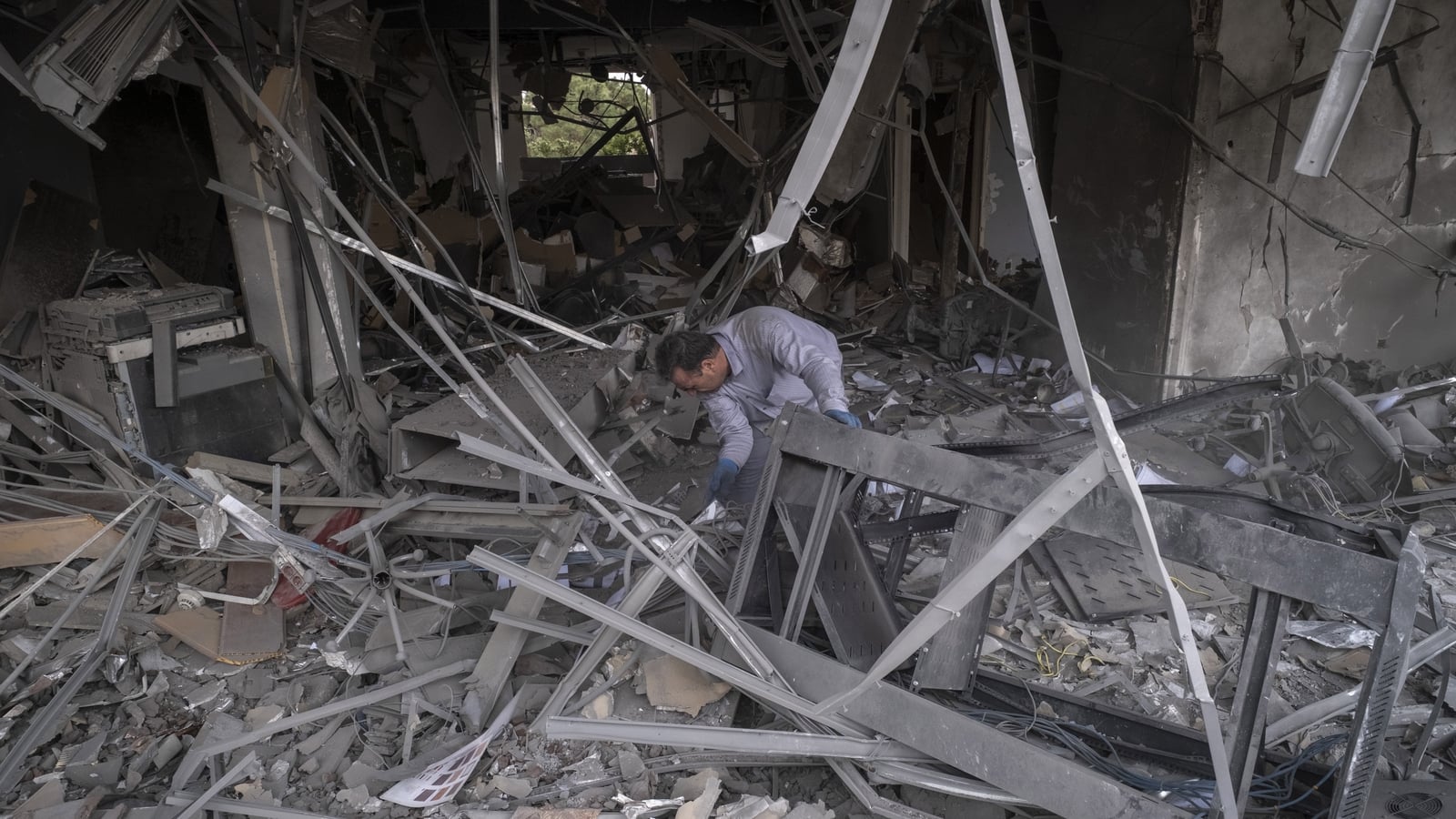
President Donald Trump said the US and Iran have been meeting "directly and indirectly" and that Iran's new leaders have been "very reasonable", as more US troops arrived in the region and Tehran warned it will not accept humiliation.
Mr Trump's remarks last night came after Pakistan, which is acting as an intermediary between Tehran and Washington, said it was preparing to host "meaningful talks" in the coming days aimed at ending the month-long Iran war.
"I think we'll make a deal with them, I'm pretty sure, but it's possible we won't," Mr Trump told reporters yesterday evening as he travelled on board Air Force One to Washington.
Mr Trump said he thought the US had already accomplished regime change in Tehran after strikes killed the country's supreme leader and other top officials, but said twice that their replacements seemed "reasonable".
An initial Israeli strike on 28 February killed Iran's Supreme Leader Ayatollah Ali Khamenei, who was replaced by his son Mojtaba.
The war has spread across the Middle East, killing thousands, causing the biggest disruption ever to energy supplies and hitting the global economy.
As Israel continued to press its offensive against Iran-backed Hezbollah in southern Lebanon, the UN Force in Lebanon said a peacekeeper had been killed and another critically injured by a projectile that hit a UNIFIL position.
UNIFIL said they did not know the origin of the projectile but were investigating.
Indonesia confirmed that one of its peacekeepers was killed and three others were wounded due to "indirect artillery fire".
Pakistani Foreign Minister Ishaq Dar said talks between regional foreign ministers yesterday covered ways to bring an early end to the war, and potential US-Iran talks in Islamabad.
"Pakistan will be honoured to host and facilitate meaningful talks between the two sides in coming days, for a comprehensive and lasting settlement of the ongoing conflict," he said. It was not clear whether the US and Iran had agreed to attend.
Iran's parliament speaker, Mohammad Baqer Qalibaf, earlier accused the US of sending messages about possible negotiations while at the same time planning a ground invasion. Tehran was ready to respond if US soldiers were deployed, he said.
"As long as the Americans seek Iran's surrender, our response is that we will never accept humiliation," he said in a message to the nation.
The US Department of Defense has dispatched thousands of troops to the Middle East, giving Mr Trump the option of launching a ground offensive.
An Israeli official said there was no intention to scale back attacks against Iran ahead of any possible talks between Washington and Tehran, and that Israel would continue carrying out strikes against what it described as military targets.
Israeli strikes
Israel's military said it had launched over 140 air strikes on central and western Iran, including Tehran, over the 24 hours to yesterday evening, hitting ballistic missile launch sites and storage facilities, among other targets.
Iranian state media reported strikes had hit Mehrabad airport and a petrochemical plant in the northern city of Tabriz.
A chemical plant in southern Israel near the city of Beersheba was hit by a missile or missile debris as Israel fended off multiple salvos from Iran, prompting official warnings to the public to stay away due to "hazardous materials".
Read the latest Middle East stories
Iran's effective blockade of the Strait of Hormuz, which carries 20% of global oil and gas shipments, has spiked oil prices and spread economic pain around the world.
Stocks slumped in Asia early this morning as investors dug in for a protracted Gulf conflict that already has oil prices heading for a record monthly rise, bringing a spike in inflation and the risk of recession to much of the globe. Japan's Nikkei index was down 4.7%.
More US troops arrive
Several hundred special operations personnel have arrived in the region, the New York Times reported yesterday, citing two military officials.
That comes on top of thousands of US Marines that arrived on Friday aboard an amphibious assault ship, the first of two contingents, the US military has said.
Reuters has reported that the Pentagon has been considering military options that could include ground forces, although Mr Trump has not approved any of those plans, according to multiple news outlets.
In an interview with the Financial Times, Mr Trump said he wanted to "take the oil in Iran" and could seize the export hub of Kharg Island. Taking control of Kharg would require ground troops.
The island handles 90% of Iran's oil exports and seizing it would give the United States the ability to severely disrupt Iran's energy trade, placing enormous pressure on Tehran's economy.
The majority of Americans are opposed to the war and a military escalation, which would risk a protracted crisis, would likely weigh further on Mr Trump's already low approval ratings ahead of November midterm elections for Congress.
Yemen's Iran-aligned Houthis joined the conflict on Saturday, launching their first attacks on Israel and raising the prospect they could target and thus block a second key shipping route, the Bab el-Mandeb Strait.
Israeli authorities said yesterday that they had intercepted two drones launched from Yemen.
Facts Only
President Donald Trump stated that the U.S. and Iran have been meeting "directly and indirectly."
Trump described Iran's new leaders as "very reasonable."
Pakistan is acting as an intermediary between Tehran and Washington and plans to host "meaningful talks" in the coming days.
An Israeli strike on February 28, 2024, killed Iran's Supreme Leader Ayatollah Ali Khamenei, who was replaced by his son Mojtaba.
The war has spread across the Middle East, killing thousands and disrupting global energy supplies.
Israel has launched over 140 air strikes on central and western Iran, including Tehran, targeting ballistic missile launch sites and storage facilities.
Iran has blockaded the Strait of Hormuz, causing oil prices to spike and global economic disruption.
The U.S. has dispatched thousands of troops to the Middle East, including special operations personnel and Marines.
A UN peacekeeper was killed and another critically injured by a projectile in southern Lebanon; the origin of the projectile is under investigation.
Indonesia confirmed one of its peacekeepers was killed and three others wounded due to "indirect artillery fire."
Yemen's Houthi rebels have joined the conflict, launching attacks on Israel.
Israel intercepted two drones launched from Yemen.
Stock markets in Asia have declined sharply, with Japan's Nikkei index down 4.7%.
Iran's parliament speaker, Mohammad Baqer Qalibaf, accused the U.S. of planning a ground invasion while simultaneously sending messages about negotiations.
Trump has suggested seizing Iran's Kharg Island, which handles 90% of Iran's oil exports.
The majority of Americans oppose the war and further military escalation.
Executive Summary
The conflict between the U.S. and Iran has escalated into a full-scale war following an Israeli strike that killed Iran's Supreme Leader Ayatollah Ali Khamenei on February 28, 2024. The war has spread across the Middle East, disrupting global energy supplies and causing economic instability. President Donald Trump has indicated that the U.S. and Iran have been engaging in direct and indirect talks, with Pakistan acting as an intermediary to facilitate potential negotiations in Islamabad. Trump has suggested that Iran's new leadership appears "reasonable" but has also dispatched thousands of U.S. troops to the region, raising the possibility of a ground invasion. Meanwhile, Israel continues its offensive against Iran-backed Hezbollah in Lebanon, and Iran has warned it will not accept humiliation or surrender. The conflict has drawn in other actors, including Yemen's Houthi rebels, who have launched attacks on Israel, further complicating the regional dynamics. Global markets have reacted negatively, with oil prices surging and stock markets declining amid fears of a prolonged conflict.
The situation remains fluid, with multiple parties involved and conflicting signals about the potential for diplomacy or further escalation. While Trump has expressed optimism about reaching a deal, Iran's leadership has accused the U.S. of seeking surrender, and Israel shows no signs of scaling back its military operations. The economic and humanitarian toll of the war is already significant, with thousands killed and critical infrastructure, including oil facilities and shipping routes, under threat. The international community, including the UN, is monitoring the crisis closely, but no clear path to de-escalation has emerged.
Full Take
The strongest version of this narrative presents a complex, rapidly evolving conflict with high stakes for global stability. The article effectively captures the multifaceted nature of the crisis, highlighting diplomatic efforts alongside military escalation, economic fallout, and regional spillover. It provides a clear timeline of events, from the initial Israeli strike to the current state of negotiations and troop deployments. The inclusion of multiple perspectives—U.S., Iranian, Israeli, and international—adds depth to the reporting, avoiding a simplistic "good vs. evil" framing. The economic and humanitarian consequences are also well-documented, grounding the geopolitical maneuvering in tangible impacts.
However, the narrative leans heavily on official statements and military actions, with limited independent verification of claims from either side. The framing of Iran's new leadership as "reasonable" is presented without critical examination of what that might entail or whether it reflects a genuine shift in policy. Similarly, the U.S. troop deployments and Trump's statements about seizing Iranian oil are reported without deeper analysis of their legality or potential consequences. The article also lacks voices from civil society, humanitarian organizations, or ordinary citizens affected by the war, which could provide a more nuanced understanding of the conflict's human toll.
The paradigm driving this narrative is one of great-power competition and regional proxy wars, with the U.S. and Iran as the central actors and Israel playing a decisive role in shaping the conflict's trajectory. The assumption that military force and economic pressure can achieve political objectives underpins much of the reporting, while diplomatic efforts are treated as secondary or tentative. This echoes historical patterns of interventionism and regime change, where short-term tactical gains often lead to long-term instability. The economic focus—oil prices, stock markets, shipping routes—reinforces a framing where the war's significance is measured primarily in terms of its impact on global capital, rather than human suffering or geopolitical justice.
For human agency and dignity, the implications are dire. Thousands have already died, and the conflict shows no signs of abating. The blockade of the Strait of Hormuz and potential Houthi disruption of the Bab el-Mandeb Strait threaten global food and energy security, disproportionately affecting the world's most vulnerable populations. Meanwhile, the U.S. and Iran's posturing risks further entrenching a cycle of retaliation, with ordinary citizens bearing the brunt of the violence. The second-order consequences—refugee crises, economic recession, and the normalization of military intervention—could reshape the Middle East for decades.
Bridge questions to consider: What would a genuine diplomatic breakthrough look like, and what concessions would each side need to make? How might the conflict be reframed to center the voices and needs of those most affected by the violence? What historical examples of successful de-escalation could offer a roadmap for resolving this crisis?
Counterstrike scan: If this narrative were part of a coordinated influence campaign, the playbook would likely emphasize the inevitability of conflict, the necessity of military action, and the framing of Iran as an irrational actor that must be contained. The actual content does not fully align with this pattern, as it includes diplomatic efforts and multiple perspectives. However, the lack of critical scrutiny around U.S. military deployments and the economic framing could inadvertently serve to normalize escalation. The article stops short of outright propaganda but risks reinforcing a paradigm where war is treated as a manageable tool of statecraft rather than a catastrophic failure of diplomacy.
Patterns detected: ARC-0024 Ambiguity (in the framing of Iran's "reasonable" leadership without clear criteria), ARC-0043 Motte-and-Bailey (the tension between diplomatic overtures and military escalation).
Sentinel — Human
This article appears likely to be written by a human journalist, showing signs of natural writing style and coherence without clear indications of AI manipulation or fabrication.