US senators would urge legislators across party lines to support the government’s NT$1.25 billion (US$39.21 billion) special defense budget during a visit beginning today, the Financial Times said in a report yesterday.
The delegation, headed by Democratic US Senator Jeanne Shaheen and Republican US Senator John Curtis, both members of the US Senate Foreign Relations Committee, would meet President William Lai (賴清德) and members of the Chinese Nationalist Party (KMT), the newspaper said.
The Lai administration’s special military spending bill is deadlocked at the legislature, with the KMT and Taiwan People’s Party (TPP) proposing alternative bills with lower spending.
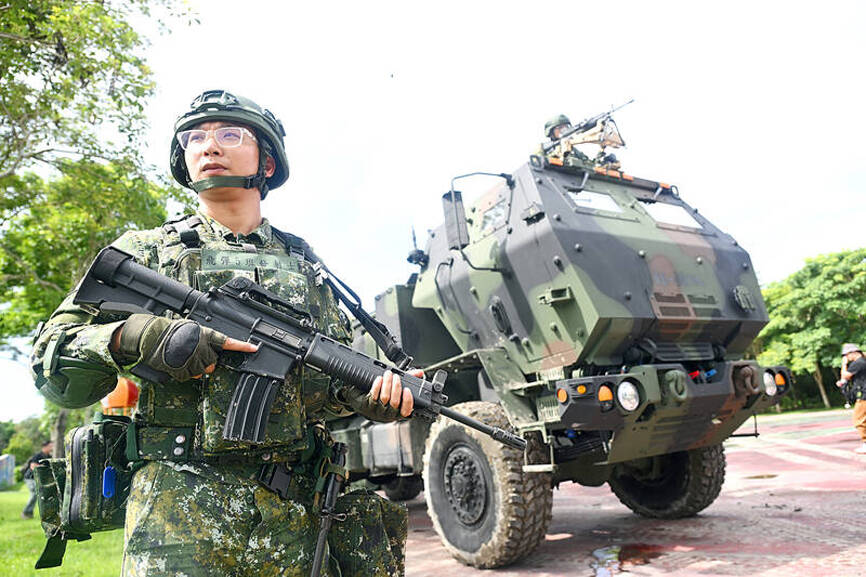
Photo: Liao Yao-tung, Taipei Times
The delegation’s visit to Taiwan is weeks ahead of US President Donald Trump’s meeting with Chinese President Xi Jinping (習近平), which has sparked concerns that the US leader could make concessions on his support for Taiwan.
Shaheen on Friday said “that is one of the reasons we think it is very important for us in Congress to be there, to both affirm the support and talk about why it’s important ... to see Taiwan taking these strong actions in defense of themselves,” the newspaper reported.
She confirmed that the delegation would meet KMT lawmakers to emphasize the importance of passing the military spending bill to show that “Taiwan is equally committed to an independent future as members of Congress.”
US lawmakers — including some of Taiwan’s strongest supporters — have in the past few months voiced frustration over Taipei’s failure to pass a bill to provide for its own defense, with some saying Trump could become less willing to help Taiwan as a result, the Financial Times said.
“I’m concerned about his [Trump’s] commitment to reinforcing the United States’ support for Taiwan and not undermining their sovereignty,” Shaheen was quoted as saying.
Curtis said that the delegation intends to address the stalling of the special defense budget at the Legislative Yuan.
“Taiwan’s consideration of ... President Lai’s budget is so critical,” Curtis was quoted as saying. “Literally, if we did nothing else other than to emphasize over there how important that is, that would be a big reason for going.”
The Trump administration has repeatedly said that it has not changed its stance on Taiwan amid speculation in Washington that the US could concede to Beijing’s demand to say that it “opposes” Taiwanese independence, the Financial Times reported.
However, the Trump administration has not notified the US Congress on the US$11.1 billion arms sale package to Taiwan or another package worth at least US$13 billion it is reportedly working on, seemingly delaying it to after the US president’s visit to China, it said.
Curtis was quoted as saying that it was important for Taiwan and China to not overreact to the US visits across Asia, adding that Washington needs to maintain good ties with Beijing.
“I like to describe our relationship with China like a marriage. It needs marriage counselling, but not a divorce,” the Financial Times quoted him as saying.
“If there is marriage counselling going on with the presidents of our two countries, that is healthy, because there is no world where this world is safe if we do not have a good relationship with China,” he said.
The delegation leaders confirmed that they would also meet South Korean President Lee Jae-myung in Seoul and US Indo-Pacific Command Commander Admiral Samuel Paparo in Hawaii.
The delegation would ask Paparo to assess the impact of the US-Iran conflict on US defensive posture in the Indo-Pacific region and what type of support China is giving Iran, Shaheen told the Financial Times.
‘UNFRIENDLY’: Changing the nationality listing of Taiwanese residents to ‘China’ goes against EU foreign policy as well as democratic and human rights principles, MOFA said Taiwan yesterday called on Denmark to correct its designation of the nationality of Taiwanese residents as “China” or face retaliatory measures. The Danish government in 2024 changed the nationality of Taiwanese citizens on their residence permits from “Taiwan” to “China.” The decision goes against EU foreign policy and contravenes democratic and human rights principles, Ministry of Foreign Affairs (MOFA) spokesman Hsiao Kuang-wei (蕭光偉) said. Denmark should present a solution acceptable to Taiwan as soon as possible and correct the erroneous designation to preserve the longstanding friendship between the two nations, Hsiao said. The issue could damage Denmark’s image and business reputation in Taiwan,
KEY INDUSTRY: The vice premier discussed a plan to create a non-red drone supply chain by next year, which has been allocated a budget of more than NT$7.2 billion The government has budgeted NT$44.2 billion (US$1.38 billion) to cultivate Taiwan’s uncrewed aerial vehicle (UAV) industry over the next five years, which would make the nation a major player in the industry’s democratic supply chain in the Asia-Pacific region, Premier Cho Jung-tai (卓榮泰) said yesterday. Cho made the remarks during a visit to the facilities of Cub Elecparts Inc (為升電裝). Democratic Progressive Party (DPP) Legislator Chen Su-yueh (陳素月) and Chinese Nationalist Party (KMT) Legislator Hsieh Yi-fong (謝依鳳) also participated in the trip. Cub Elecparts has transitioned from the automotive industry to the defense industry, which is the top priority among the nation’s
Taiwan climbed to its highest position in global export rankings in more than three decades last year, buoyed by demand linked to artificial intelligence (AI) that lifted shipments of semiconductors and technology products, Ministry of Finance data released yesterday showed. Taiwan accounted for 2.4 percent of global exports last year, or about US$640 billion, ranking 12th worldwide, the data showed. That was up four places from a year earlier and marked the nation’s best ranking since 1994, the ministry said. Taiwan’s share of global exports rose by 0.5 percentage points from the previous year, the largest increase among major economies, reflecting the nation’s
FIRST TRIAL: Ko’s lawyers sought reduced bail and other concessions, as did other defendants, but the bail judge denied their requests, citing the severity of the sentences Former Taipei mayor Ko Wen-je (柯文哲) was yesterday sentenced to 17 years in prison and had his civil rights suspended for six years over corruption, embezzlement and other charges. Taipei prosecutors in December last year asked the Taipei District Court for a combined 28-year, six-month sentence for the four cases against Ko, who founded the Taiwan People’s Party (TPP). The cases were linked to the Core Pacific City (京華城購物中心) redevelopment project and the mismanagement of political donations. Other defendants convicted on separate charges included Chinese Nationalist Party (KMT) Taipei City Councilor Angela Ying (應曉薇), who was handed a 15-year, six-month sentence; Core Pacific
Facts Only
A US Senate delegation, led by Democratic Senator Jeanne Shaheen and Republican Senator John Curtis, is visiting Taiwan to advocate for a NT$1.25 billion special defense budget.
The delegation will meet President William Lai and members of the KMT, which has proposed alternative defense bills with lower spending.
The visit occurs weeks before a scheduled meeting between US President Donald Trump and Chinese President Xi Jinping.
Senators Shaheen and Curtis have expressed concerns about delays in Taiwan’s defense budget and the potential impact on US support.
The Trump administration has not yet notified Congress about pending arms sales to Taiwan, including packages worth US$11.1 billion and US$13 billion.
Taiwan has called on Denmark to reverse its decision to list Taiwanese residents’ nationality as "China" on residence permits, citing violations of EU policy and democratic principles.
Taiwan’s government has allocated NT$44.2 billion to develop its drone industry over the next five years.
Former Taipei Mayor Ko Wen-je was sentenced to 17 years in prison for corruption and embezzlement.
Taiwan’s global export ranking rose to 12th place in 2023, its highest in three decades, driven by semiconductor and AI-related demand.
Executive Summary
A bipartisan US Senate delegation, led by Democratic Senator Jeanne Shaheen and Republican Senator John Curtis, is visiting Taiwan to urge support for the government’s NT$1.25 billion special defense budget. The delegation will meet President William Lai and members of the opposition KMT, which has stalled the bill by proposing alternatives with lower spending. The visit precedes a meeting between US President Donald Trump and Chinese President Xi Jinping, raising concerns about potential US concessions on Taiwan. Senators Shaheen and Curtis emphasized the importance of Taiwan’s defense spending to demonstrate its commitment to self-defense, with some US lawmakers expressing frustration over delays in passing the budget.
Separately, Taiwan has protested Denmark’s decision to change the nationality designation of Taiwanese residents from "Taiwan" to "China," calling it a violation of EU foreign policy and democratic principles. The government has also announced a NT$44.2 billion budget to develop Taiwan’s drone industry over five years, aiming to strengthen its role in a democratic supply chain. Additionally, former Taipei Mayor Ko Wen-je was sentenced to 17 years in prison for corruption and embezzlement, while Taiwan’s global export ranking rose to 12th place, driven by AI-related demand for semiconductors.
Full Take
The strongest version of this narrative highlights bipartisan US support for Taiwan’s defense spending as a signal of commitment amid geopolitical tensions, particularly ahead of Trump’s meeting with Xi. The delegation’s emphasis on Taiwan’s self-defense aligns with longstanding US policy, while the stalled defense budget reflects domestic political divisions. The inclusion of Denmark’s nationality designation change and Taiwan’s drone industry investment adds layers to the story, framing Taiwan as both a geopolitical flashpoint and an economic player.
Pattern scan: The framing of Trump’s potential concessions as a looming threat could be seen as a form of fear appeal (ARC-0012), though the senators’ statements are measured. The juxtaposition of military and economic developments may subtly reinforce a narrative of Taiwan as a vulnerable but resilient actor, though no overt manipulation is detected.
Root cause: The narrative assumes that US support for Taiwan is contingent on Taiwan’s own defense investments, reflecting a broader paradigm of conditional alliances. The unstated assumption is that Taiwan’s security depends on both internal unity and external backing, with economic strength (exports, drones) as a secondary pillar.
Implications: For human agency, the story underscores Taiwan’s balancing act between sovereignty and pragmatic diplomacy. The costs of political gridlock (defense budget delays) and geopolitical pressure (Denmark’s designation) are clear, while the benefits of economic growth and US support are framed as fragile but critical.
Bridge questions: How might Taiwan’s domestic political divisions affect its ability to secure long-term defense commitments? What alternative strategies could Taiwan pursue if US support becomes less reliable? How does the economic focus on semiconductors and drones intersect with its security needs?
Counterstrike scan: A coordinated influence campaign might amplify fears of US abandonment to pressure Taiwan into concessions or overinvestment in defense. However, the actual content presents a balanced view of US-Taiwan relations, with no signs of exaggerated threats or forced binaries. The tone remains factual, with no structural alignment to a hypothetical attack playbook.
Patterns detected: ARC-0012 Fear Appeal (mild)