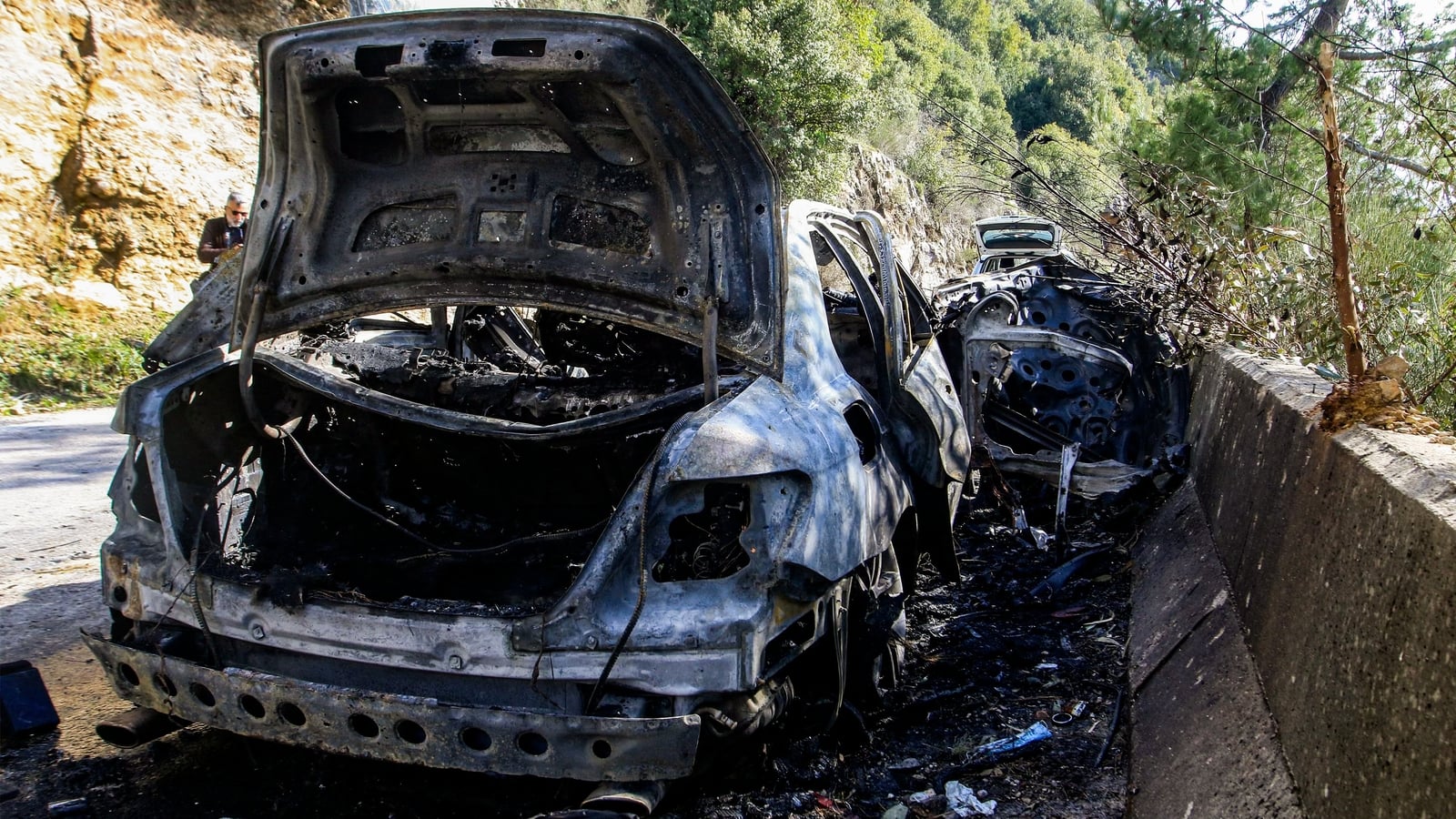
An Israeli strike has killed three journalists in south Lebanon, their channels and a Lebanese military source said, while Israel said one of them was a Hezbollah member.
This came as Israel continued its raids on southern Lebanon, and Hezbollah announced it had targeted Israeli forces that had entered border villages.
Lebanon was pulled into the Middle East war when Tehran-backed militant group Hezbollah fired rockets at Israel on 2 March to avenge the US-Israeli killing of Iran's supreme leader, Ayatollah Ali Khamenei.
Israel has responded with large-scale airstrikes across Lebanon and a ground offensive in the south.
A Lebanese military source told AFP earlier today that Ali Shoeib of Hezbollah's Al Manar channel and Fatima Ftouni of Al Mayadeen, seen as close to the Iran-backed movement, were killed in Jezzine, alongside Ftouni's brother, a cameraman.
Al Mayadeen and Al Manar confirmed the deaths of their journalists.
Mr Shoeib was one of Al Manar's most prominent war correspondents, having covered Israeli attacks on Lebanon for decades.
In a statement, the Israeli military said it had targeted Mr Shoeib, accusing him of being a "terrorist in the intelligence unit of Hezbollah's Radwan Force".
Mr Shoeib, it said, "operated within the Hezbollah terrorist organisation under the guise of a journalist for the Al Manar network, while operating systematically to expose the locations of IDF soldiers operating in southern Lebanon and along the border".
Lebanese President Joseph Aoun condemned the killings, calling them "a blatant crime that violates all the norms and treaties under which journalists enjoy international protection in wars".
Prime Minister Nawaf Salam said the targeting of journalists was "a flagrant violation of international humanitarian law."
Israel launched a new series of raids on southern Lebanon today and Lebanon's state-run National News Agency reported "a series of strikes" at dawn on southern towns and villages.
It said several Israeli strikes also targeted the city of Nabatiyeh, hitting "residential and commercial buildings and a fuel station".
At the same time, the agency reported strikes on border towns, particularly Taybeh, along with "an attempt by enemy forces to advance toward the Litani area".
The Israeli military said this morning that "at this time, the IDF continues to strike Hezbollah terrorist infrastructure across Lebanon".
Hezbollah, for its part, said in separate statements that it had targeted gatherings of Israeli forces in Debel, a predominantly Christian border town where some residents remain despite the fighting.
Israeli forces have been pushing into areas near the border in southern Lebanon, where Israeli officials have announced plans to establish a buffer zone up to the Litani River, around 30km) north of the border.
Pakistan will host talks next week
Pakistan will host talks next week with Saudi Arabia, Egypt and Turkey on the war in the Middle East, a senior foreign ministry official told AFP.
"We will host a quadrilateral meeting on Monday," the official said on condition of anonymity, adding that the exact representation was not yet confirmed.
Delegations are expected to arrive in Pakistan by tomorrow evening, the official added.
Pakistan has emerged as a key facilitator between Iran and the United States as the conflict drags on, serving as an intermediary for messages between the two sides.
Islamabad has longstanding links with Tehran and close contacts in the Gulf, while Prime Minister Shehbaz Sharif and army chief Field Marshal Amin Munir have struck up a personal rapport with US President Donald Trump.
Ankara's Foreign Minister Hakan Fidan told the private A Haber broadcaster that the meeting was initially planned to be held in Turkey.
"However, since our Pakistani counterparts are required to remain in their country, we moved the meeting to Pakistan," he said late yesterday.
"It is possible that we will meet there this weekend," he added.
Mr Fidan had said the talks would involve the foreign ministers of the four Muslim-majority countries.
Earlier yesterday, Germany's Foreign Minister Johann Wadephul said he expected a direct US-Iran meeting in Pakistan "very soon", without revealing his source.
While Tehran has refused to admit to holding official talks with Washington, Iran has passed a response to US President Donald Trump's 15-point plan to end the war via Islamabad, according to an anonymous source cited by the Iranian Tasnim press agency.
Mr Trump has appeared anxious to wind down the unpopular war, and on Thursday he extended a deadline by 10 days for Iran to reopen the blockaded Strait of Hormuz or face attacks against its civilian energy grid.
His special envoy Steve Witkoff said there were clear red lines for the US, including no uranium enrichment by Iran and the country giving up what he said was 10,000 kilograms of enriched stockpiled material.
The US expects its military operations against Iran to conclude within weeks, not months, and Washington can meet all its objectives without using ground troops, US Secretary of State Marco Rubio said yesterday.
Mr Rubio discussed with G7 foreign ministers the possibility that Iran, even after the conflict ends, could try to impose shipping tolls through the Strait of Hormuz.
He said European and Asian countries that benefit from trade through the waterway should contribute to efforts to secure free passage, downplaying US dependence on the trade.
1,900 dead in Iran
The war has spread across the Middle East, killing thousands of people and causing the biggest disruption ever to energy supplies, hitting the global economy with soaring oil, gas and fertiliser prices that have fuelled inflation fears.
In Iran, more than 1,900 people have been killed and at least 20,000 injured, said Maria Martinez of the International Federation of Red Cross and Red Crescent Societies.
Washington has dispatched two contingents of thousands of Marines to the region, the first of which is due to arrive around the end of March aboard a huge amphibious assault ship.
The Pentagon is also expected to deploy thousands of elite airborne soldiers.
The deployments have raised concerns that the war, which the US and Israel launched on 28 February with airstrikes that killed Iran's supreme leader and other top officials, could turn into a prolonged ground battle.
Iran's response, striking US and Israeli targets in the region as well as civilian targets in Gulf Arab nations and shipping, has disrupted global trade in energy and other commodities, raising fears of rising prices and recession.
Twelve US military personnel were wounded - including two seriously - by an Iranian missile and drone attack at the Prince Sultan airbase in Saudi Arabia, a US official told Reuters.
The Wall Street Journal reported that several refuelling aircraft were damaged in the attack.
The latest casualties add to the more than 300 US military service members who have been wounded since the start of the conflict. Earlier yesterday, the US military said 273 of them had already returned to duty.
Thirteen US troops have been killed in the conflict.
Israel says it identified launch of missile from Yemen
Yemen's Iran-aligned Houthis said they were ready to intervene militarily under certain conditions, including if new allies join the United States and Israel in their war against Iran or if the Red Sea is used to launch attacks on Iran.
The Israeli military said it had identified a launch of a missile from Yemen, the first time a missile has launched from there since the war erupted.
The launch comes hours after Iran-aligned Houthis said they were prepared to act if what the group called an escalation against Iran and the "axis of resistance" continued, but did not say what form any intervention would take.
The Houthis entry to the war raises the prospects of a broader regional confrontation, particularly given the Houthis' ability to strike targets far beyond Yemen and disrupt shipping lanes around the Arabian Peninsula and the Red Sea, which they had done in support of Hamas in Gaza after the 7 October 2023 attack on Israel.
Iran's Shia allies in Lebanon and Iraq have already joined the war in the region triggered by US and Israeli strikes on Tehran four weeks ago.
Attacks on Israel by Iran's Lebanese ally Hezbollah have also prompted an Israeli onslaught that has displaced a fifth of Lebanon's population.
The Israeli military said yesterday evening that Iran had launched missiles towards Israel.
A 60-year-old man was killed in the Tel Aviv area, the ambulance service said.
Ukraine says Iran lying about destroying anti-drone depot in UAE
Ukraine has said Iran was lying about having struck a depot housing Ukrainian anti-drone systems in the UAE, after Tehran said it destroyed a facility used to aid US forces.
Foreign ministry spokesman Georgiy Tykhy said "this is a lie, we officially refute this information", saying Tehran "often conducts such disinformation operations".
Ukraine has moved rapidly to provide anti-drone expertise, developed while fending off Iranian-designed drones launched by Russia, to the Gulf countries as they come under fire from Iran.
Tykhy was speaking after Iran's central military command Khatam Al-Anbiya said in a statement carried by state TV that it had destroyed a depot in the United Arab Emirates.
Earlier today, Ukrainian President Volodymyr Zelensky said on an unannounced tour of the Gulf that Kyiv and Abu Dhabi had agreed to cooperate on defence. Qatar also announced its own deal with Ukraine.
Ukraine and Saudi Arabia also signed an air defence agreement during Zelensky's visit to the kingdom, two senior officials said yesterday.
We need your consent to load this rte-player contentWe use rte-player to manage extra content that can set cookies on your device and collect data about your activity. Please review their details and accept them to load the content.Manage Preferences
New strikes on Iran, Israel, Saudi Arabia
Iranian media reported strikes on Iran's decommissioned heavy-water nuclear research reactor and a factory producing yellowcake uranium late yesterday, and said there were no radiation leaks or danger arising from either attack.
Iran informed the International Atomic Energy Agency there was no increase in off-site radiation levels at the yellowcake facility, the IAEA said on X, adding that it would look into the report.
There were also reports of an attack on the Bushehr nuclear power plant, which Iranian media said left no casualties or extensive damage.
At least five people were killed and seven were injured after a US-Israeli attack on a residential unit in Iran's northwestern city of Zanjan, Iranian media reported this morning.
Iranian Foreign Minister Abbas Araqchi said on X that Israel, in coordination with the US, had also hit two steel factories and a power plant.
"Attack contradicts POTUS extended deadline for diplomacy. Iran will exact HEAVY price for Israeli crimes," Mr Araqchi said, using an acronym for the US president.
A senior Iranian told Reuters that Tehran had not decided whether to respond to the proposal the US sent this week after attacks on industrial and nuclear infrastructure yesterday.
The official said Iran had expected its response to be delivered on yesterday or today, but said the continuing strikes while the US was seeking talks were "intolerable."
The US proposal, sent via Pakistan two days ago, is reported to include demands ranging from dismantling Iran's nuclear and missile programmes to relinquishing control of the world's most important trade route for energy supplies.
Iran still possesses missiles
The US, which has set out to neutralise Iran's long-range strike capabilities, can only confirm that about a third of the country's missile arsenal has been destroyed, five people familiar with the US intelligence told Reuters.
As the damage mounts and with no end in sight, Gulf Arab states are telling the US that any deal must not merely end the war but also permanently curb Iran's missile and drone capabilities and ensure global energy supplies are never again weaponised, four Gulf sources said.
Stock markets fell yesterday while the Brent crude oil benchmark LCOc1 topped $112, having risen more than 50% since the war began.
In the US, where Mr Trump is politically vulnerable to rising fuel prices, diesel in California hit an all-time high at an average $7.17 a gallon, the American Automobile Association said.
Facts Only
An Israeli strike killed three journalists in south Lebanon: Ali Shoeib of Hezbollah's Al Manar channel, Fatima Ftouni of Al Mayadeen, and Ftouni's brother, a cameraman.
Israel accused Shoeib of being a Hezbollah intelligence operative, while Lebanon condemned the killings as violations of international law.
Hezbollah has targeted Israeli forces in border villages, and Israel has conducted large-scale airstrikes and a ground offensive in southern Lebanon.
The conflict began after Hezbollah fired rockets at Israel on March 2, retaliating for the US-Israeli killing of Iran's supreme leader.
Pakistan will host diplomatic talks on March 11 with Saudi Arabia, Egypt, and Turkey to address the Middle East war.
The US and Iran are engaged in indirect negotiations via Pakistan, with Iran responding to a US proposal to end the war.
Over 1,900 people have been killed in Iran, and global energy prices have surged due to the conflict.
The US has deployed additional military forces to the region, including Marines and elite airborne soldiers.
Yemen's Houthis have threatened military intervention if the conflict escalates further.
Iran has accused Israel and the US of attacking its nuclear and industrial sites, vowing retaliation.
Ukraine has denied Iranian claims of striking a Ukrainian anti-drone depot in the UAE.
Global stock markets have fallen, and oil prices have risen over 50% since the war began.
Executive Summary
The conflict in the Middle East has escalated significantly, with Israel conducting airstrikes in southern Lebanon that killed three journalists, including Ali Shoeib of Hezbollah's Al Manar channel and Fatima Ftouni of Al Mayadeen. Israel claims Shoeib was a Hezbollah operative, while Lebanon condemns the killings as violations of international law protecting journalists. Meanwhile, Hezbollah has targeted Israeli forces near border villages, and Israel has launched a ground offensive in southern Lebanon, aiming to establish a buffer zone up to the Litani River. The war, which began after Hezbollah retaliated for the US-Israeli killing of Iran's supreme leader, has now drawn in multiple regional actors, including Yemen's Houthis, who have threatened military intervention if the conflict escalates further. Pakistan is set to host diplomatic talks involving Saudi Arabia, Egypt, and Turkey to address the crisis, while the US and Iran engage in indirect negotiations via Islamabad. The conflict has disrupted global energy supplies, with oil prices surging over 50% since the war started, and has resulted in over 1,900 deaths in Iran alone, alongside widespread regional instability.
The situation remains volatile, with ongoing strikes on Iranian nuclear and industrial sites, and Iran vowing retaliation. The US has deployed additional military assets to the region, raising concerns about a prolonged ground war. Meanwhile, Gulf states are pushing for a deal that would permanently curb Iran's missile and drone capabilities and prevent future energy supply disruptions. The humanitarian toll is severe, with thousands wounded and displaced, and global economic repercussions deepening as fuel prices hit record highs in some regions.
Full Take
The strongest version of this narrative presents a rapidly escalating regional conflict with clear geopolitical fault lines: Israel and the US on one side, Iran and its proxies (Hezbollah, Houthis) on the other, with Gulf states and global powers scrambling to mediate. The reporting acknowledges multiple perspectives—Israel's justification for targeting journalists as Hezbollah operatives, Lebanon's condemnation as a war crime, and the broader humanitarian and economic fallout. The inclusion of diplomatic efforts (Pakistan-hosted talks) and economic consequences (soaring oil prices) adds depth, avoiding a simplistic "good vs. evil" framing.
However, patterns of emotional exploitation and distortion are detectable. The repeated emphasis on civilian casualties (journalists, residential buildings) and economic pain (oil prices, inflation) could serve as rage bait, stoking moral outrage without proportional context on military necessities or strategic objectives. The framing of Iran's response as "intolerable" while downplaying US-Israeli strikes on Iranian infrastructure hints at a motte-and-bailey tactic—condemning Iran's actions while justifying Western military escalation. The article also leans on authority games, citing anonymous sources (e.g., "senior Iranian official," "US official") to lend credibility to claims that cannot be independently verified.
Root causes include the long-standing US-Israel-Iran proxy conflict, now exacerbated by direct strikes on Iranian leadership and nuclear sites. The unstated assumption is that military pressure will force Iran to capitulate, yet historical patterns (e.g., Iraq, Afghanistan) suggest such strategies often backfire, fueling nationalism and prolonged resistance. The second-order consequences—global energy shocks, refugee crises, and the potential for a broader regional war—are underplayed relative to the immediate tactical reporting.
Bridge questions: What evidence would change your assessment of whether Shoeib was a legitimate journalistic target or a combatant? How might Gulf states' demands for permanent curbs on Iran's capabilities reshape the region's power balance? What perspectives from Iranian civilians or Lebanese displaced by the conflict are missing here?
Counterstrike scan: A coordinated influence campaign would amplify civilian casualties to demonize one side while framing the other's actions as defensive, use anonymous sources to spread unverifiable claims, and omit contextualizing historical grievances (e.g., Iran's support for proxies as a response to perceived Western aggression). This article partially aligns with that playbook—particularly in its selective outrage over journalist killings without equivalent scrutiny of Hezbollah's embedded media operations—but stops short of full manipulation by including diplomatic efforts and economic impacts. The tone remains largely factual, though the structural emphasis on suffering over strategy may still serve a narrative of victimhood.
Patterns detected: ARC-0024 Ambiguity (anonymous sources), ARC-0043 Motte-and-Bailey (condemning Iran's strikes while justifying Western actions), ARC-0018 Emotional Exploitation (focus on civilian casualties and economic pain).