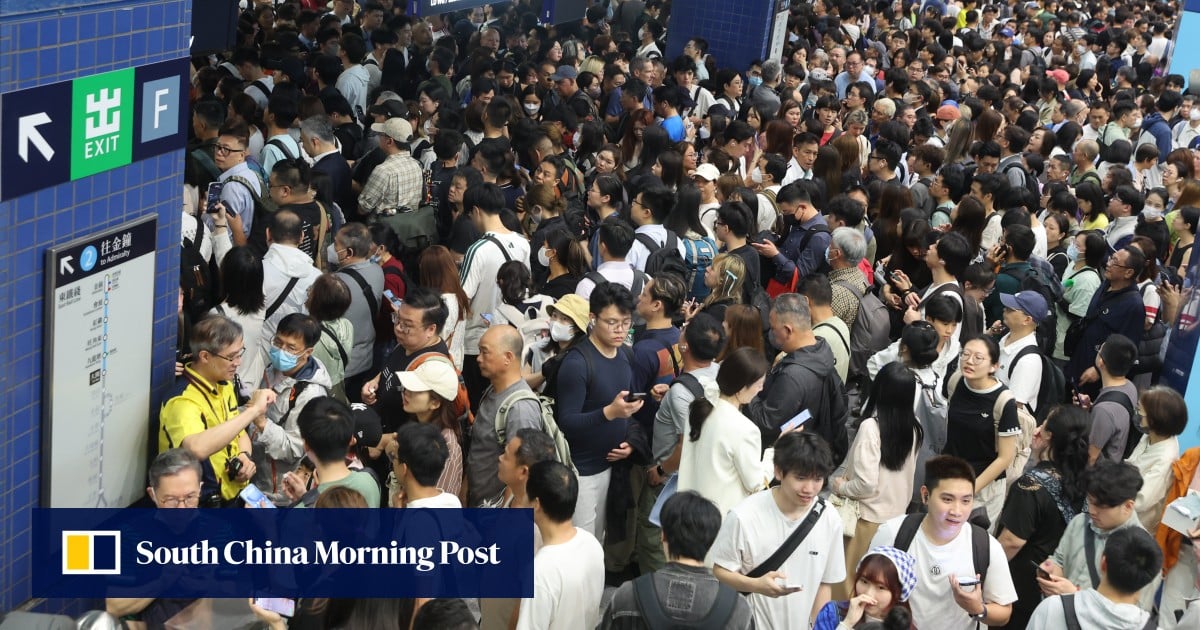
Passenger opened train emergency exit on Friday causing a two-hour service disruption during evening rush hour
Hong Kong railway experts have called for tougher penalties and stronger public education to prevent the misuse of emergency exits on trains following a recent incident on the MTR East Rail line that caused more than two hours of disruption during evening rush hour.
The experts also cast doubt on a lawmaker’s proposal to make emergency doors less accessible, saying the move could compromise passenger safety.
A preliminary investigation found that a passenger had opened the emergency exit ramp in the rear driver’s cabin of a northbound train that was travelling from Kowloon Tong to Tai Wai station.
The man, 35, was later found inside the tunnel near a Kowloon Tong station exit, having suffered an electric shock.
As of Saturday afternoon, he remained in critical condition at the Prince of Wales Hospital in Sha Tin.
Legislative Council transport panel member Michael Lee Chun-keung of the Liberal Party suggested installing a protective cover – similar to those used on fire alarm call points – over emergency exit handles.
Facts Only
A passenger opened an emergency exit ramp in the rear driver’s cabin of a northbound MTR East Rail line train.
The incident occurred on Friday during evening rush hour between Kowloon Tong and Tai Wai stations.
The action caused more than two hours of service disruption.
The passenger, a 35-year-old man, was found inside the tunnel near a Kowloon Tong station exit.
He suffered an electric shock and was hospitalized in critical condition at Prince of Wales Hospital in Sha Tin.
As of Saturday afternoon, he remained in critical condition.
Railway experts have called for tougher penalties and stronger public education to prevent misuse of emergency exits.
Legislative Council transport panel member Michael Lee Chun-keung proposed installing protective covers over emergency exit handles.
Experts expressed concern that such covers could compromise passenger safety.
The preliminary investigation confirmed the passenger’s action as the cause of the disruption.
Executive Summary
A passenger opened an emergency exit on a northbound MTR East Rail line train traveling from Kowloon Tong to Tai Wai station during Friday evening rush hour, causing over two hours of service disruption. The 35-year-old man was later found inside the tunnel near a Kowloon Tong station exit, having suffered an electric shock, and remained in critical condition at Prince of Wales Hospital as of Saturday afternoon. Railway experts have called for tougher penalties and stronger public education to prevent misuse of emergency exits, while questioning a lawmaker’s proposal to install protective covers over emergency exit handles, citing potential safety risks. The incident has sparked debate over balancing passenger safety with deterrence measures, with some suggesting structural changes could compromise emergency accessibility.
The disruption highlights ongoing challenges in managing public transit systems, where individual actions can have significant collective consequences. While the motive behind the passenger’s actions remains unclear, the incident underscores the need for both preventive measures and public awareness campaigns. The proposal to modify emergency exits reflects broader tensions between security and functionality in urban infrastructure, with stakeholders weighing the risks of misuse against the necessity of quick evacuation in genuine emergencies.
Full Take
This incident reveals a tension between public safety and individual behavior in high-stakes urban infrastructure. The strongest version of the narrative acknowledges a legitimate concern: misuse of emergency exits can cause significant disruptions, endangering lives and eroding trust in public transit. The call for tougher penalties and education is reasonable, as deterrence and awareness are critical in preventing reckless actions. However, the lawmaker’s proposal to physically restrict access to emergency exits introduces a classic trade-off—balancing security against functionality. The experts’ pushback highlights a principled stance: solutions must not undermine the primary purpose of emergency systems, even if they are occasionally misused.
Pattern-wise, the discussion risks slipping into a false binary—either prioritize deterrence or safety—without exploring intermediate solutions. The emotional weight of the disruption (rush hour chaos, a man in critical condition) could be leveraged to justify hasty policy changes, but the experts’ caution tempers this. No overt manipulation patterns are detected, but the framing leans toward problem-solving rather than interrogating root causes, such as mental health crises or systemic stressors that might drive such behavior.
Root cause assumptions remain unstated: Is this an isolated act of recklessness, a mental health emergency, or a symptom of broader societal strains? The focus on penalties and physical barriers sidesteps deeper questions about why someone would take such a risk. Implications for human dignity are significant—harsher penalties may deter some, but they could also criminalize distress without addressing underlying issues. Second-order consequences might include reduced public trust in emergency systems if access is perceived as overly restricted.
Bridge questions: What alternative measures could deter misuse without compromising safety? How might mental health support or crisis intervention play a role in preventing such incidents? Would public transit systems benefit from more visible education campaigns, or are structural changes inevitable?
Counterstrike scan: A coordinated influence campaign might exploit this incident to push for broader surveillance or restrictive policies under the guise of safety, framing dissent as indifference to public welfare. However, the actual content focuses on pragmatic debate rather than fear-mongering or authoritarian overreach. The discussion remains within bounds of reasonable policy discourse.
Patterns detected: none