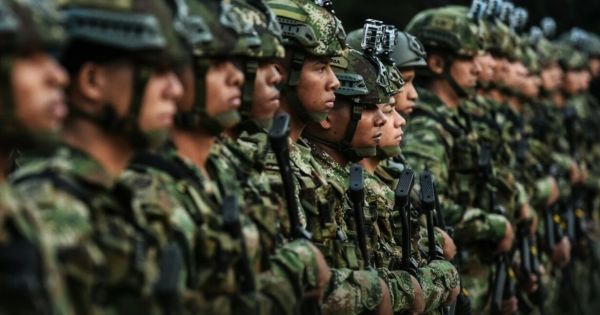
A UN expert group on mercenaries warned on Friday of a significant increase in the recruitment of Colombian mercenaries, driven by the proliferation of armed conflicts worldwide. After an 11-day visit to Colombia, the body estimated that more than 10,000 citizens — nearly all former military and police personnel — have been recruited abroad over the past decade, with offers ranging from $2,000 to $6,000 per month.
“The proliferation of conflicts in the world has increased demand and, consequently, supply. There is a very diversified demand, and Colombians are filling it,” said expert Joana de Deus Pereira at a press conference in Bogotá, specifically citing the Middle East escalation, the war in Sudan, and Russia's invasion of Ukraine.
Group chair Michelle Small explained that former Colombian military personnel are highly sought after in the global market. “After the demobilization processes of the FARC and paramilitaries, Colombia found itself with a large number of people trained for combat entering civilian life,” she stated. The primary motivation is economic, with salaries far exceeding military pensions in Colombia. Offers come from private security companies, national armies, and paramilitary organizations.
Much of the recruitment takes place through social media. Platforms such as Facebook, Instagram, Telegram, TikTok, and WhatsApp serve as common channels due to their accessibility and the difficulty of tracking them. The delegation also warned of growing predatory or deceptive recruitment, with companies paying far less than advertised or using fake job contracts. “This type of recruitment can constitute labor exploitation and human trafficking,” Small noted.
During the group's visit, which ran from March 16 to 27, the Colombian government signed Law 2569, ratifying the international convention on the use of mercenaries and seeking to prohibit their recruitment and financing. The legislation had been approved by Congress in December and required President Gustavo Petro's signature to take effect.
However, the group's preliminary report identified gaps in state oversight. The experts pointed to “limited financial and human resources, along with weak supervision and a lack of presence in remote areas” within the Superintendency of Private Security and Surveillance. Colombia has approximately 1,300 private security companies with over 400,000 employees, not counting informal firms that evade all oversight. They also flagged more than 60,000 unlicensed weapons in circulation.
The group expressed concern for over 600 families actively seeking news of relatives recruited as mercenaries or volunteers in foreign wars. Many report deaths, disappearances, or kidnappings, and the Colombian government has faced significant difficulties obtaining information through diplomatic channels. Body repatriation remains exceptional, as most are never located or remain buried in foreign territory.
The group will present its final conclusions to the UN Human Rights Council in September.
Top Comments
Disclaimer & comment rulesNo comments for this story
Please log in or register (it’s free!) to comment. Login with Facebook
Facts Only
A UN expert group on mercenaries warned of increased recruitment of Colombian mercenaries.
Over 10,000 Colombian citizens, mostly former military and police, have been recruited abroad in the past decade.
Salaries offered range from $2,000 to $6,000 per month.
Conflicts in the Middle East, Sudan, and Ukraine are cited as key drivers of demand.
Recruitment often occurs through social media platforms like Facebook, Instagram, Telegram, TikTok, and WhatsApp.
Colombia ratified an international convention on mercenaries in March 2024, prohibiting their recruitment and financing.
The UN group identified gaps in state oversight, including weak supervision of private security firms.
Colombia has approximately 1,300 private security companies with over 400,000 employees.
Over 60,000 unlicensed weapons are in circulation in Colombia.
More than 600 families are seeking information about relatives recruited as mercenaries.
The UN group will present its final report to the UN Human Rights Council in September.
Executive Summary
Full Take
The UN's warning about Colombian mercenaries reflects a broader trend of privatized warfare, where economic desperation and global conflict intersect. The strongest version of this narrative highlights legitimate concerns: former combatants, trained but underemployed, are vulnerable to exploitation by private security firms and foreign governments. The use of social media for recruitment underscores the challenges of regulating modern mercenary networks, which operate in legal gray areas. However, the narrative also risks oversimplifying the motivations of those recruited—some may see this as economic opportunity rather than coercion.
Patterns detected: none. The report avoids emotional manipulation or distortion, focusing on verifiable data and systemic gaps. Yet, it raises questions about the root causes: Why does Colombia struggle to reintegrate former military personnel? How does the global demand for mercenaries reflect failures in international conflict resolution? The implications for human dignity are stark—families left without answers, recruits trapped in exploitative contracts, and governments unable to protect their citizens.
A coordinated influence campaign might exploit this issue to undermine trust in Colombia's government or justify militarized responses. However, the UN's report appears to be a factual assessment rather than a manipulated narrative. The key question remains: How can nations balance the need for security with the ethical risks of mercenary labor?
What perspectives are missing? How might former mercenaries describe their experiences? What would change if economic opportunities in Colombia improved?
Sentinel — Human
This text shows signs of a low probability of being synthetic, with indicators pointing towards a likely human origin. The article presents a balanced, journalistic style without repeating common argumentative patterns.