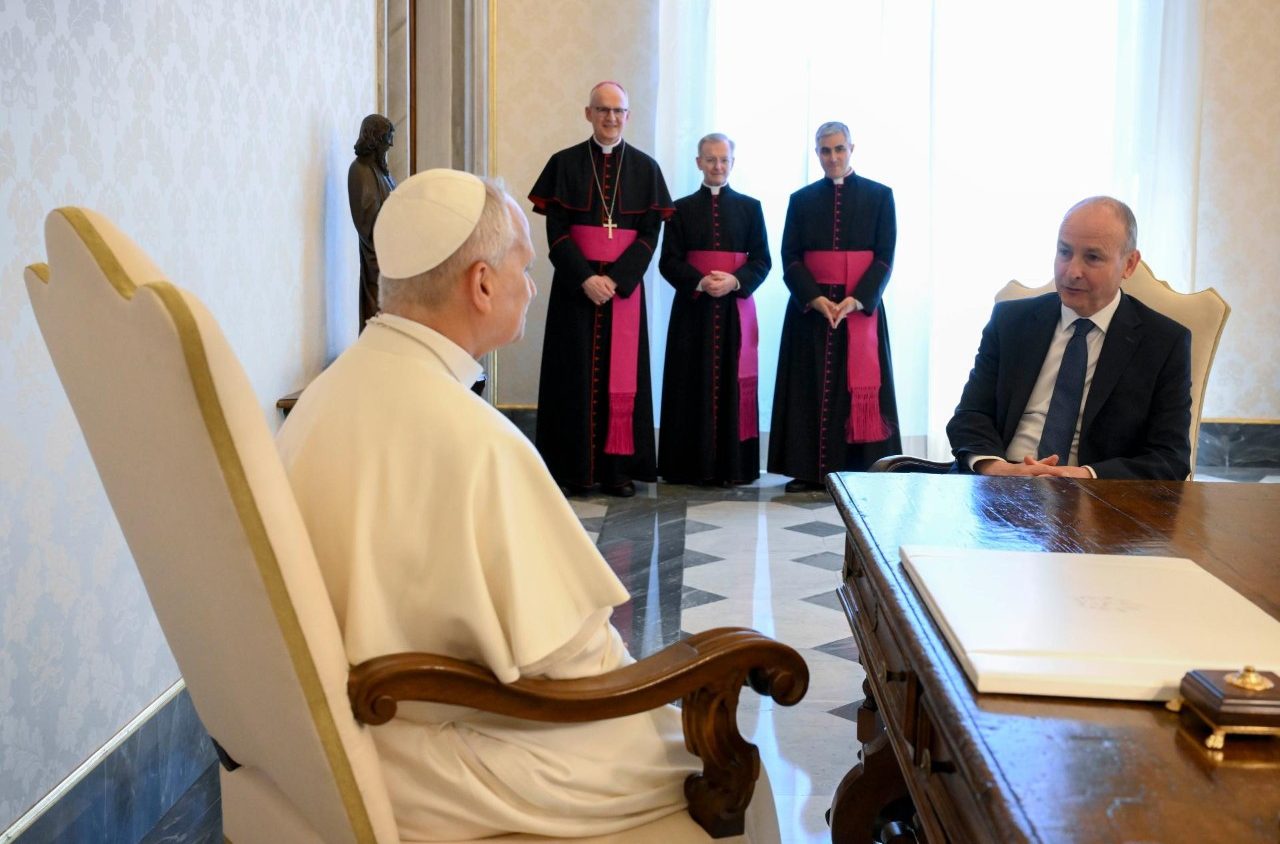
The first encyclical of Pope Leo XIV – “Magnifica Humanitas,” on safeguarding the human person in the time of artificial intelligence — will be published Monday, March 25.
Ahead of the document’s release, the pope approved the creation of a Vatican commission on artificial intelligence.
Theme was also part of the World Day of Communications message by the Pope this week, in which the Holy Father wrote on the defining issue of our time: Artificial intelligence and the need to steer it for the good of humanity.
A Vatican conference analyzing AI’s impact on media, communities and inequalities was titled “Preserving Human Voices and Faces,” echoing the theme of the Pope’s message. Key speakers charted the impact of AI both in terms of a dystopian future and of hope that people will act in the service of the common good.
One observer at the conference examined the “algorithmization” of contemporary life and the challenges emerging technologies present to preserving human dignity.
Pope Leo met with participants at the conference and encouraged efforts to educate people about AI while leading them to Christ and a “restored trust in technology.”
Pope Leo prays for peace in Middle East as Conditions Worsen
Meeting the head of the Armenian Apostolic Church this week, Pope Leo prayed for peace in the Middle East and Lebanon, which are “once again torn apart by violence and war,” he said.
The Holy See’s representative at the United Nations called for warring parties to show the moral commitment to protect civilians in conflict.
Meanwhile the humanitarian emergency in Gaza deepens as the U.N. reported sharp increases in skin diseases, including scabies and chickenpox, along with a rise in illnesses linked to widespread rodent infestations.
While 90% of Gaza’s water and sanitation infrastructure has been destroyed, 22 hospitals have been bombed just since the beginning of this year. Only half of the hospitals are still functioning, and none at full capacity.
United States to be Consecrated to Sacred Heart of Jesus
In the United States, the Catholic bishops prepared to consecrate America to the Sacred Heart of Jesus on June 11, eve of the feast of the Sacred Heart.
The consecration comes as the U.S. celebrates the 250th anniversary of the signing of the Declaration of Independence on July 4.
Parishes and individual Catholics are being invited to take part through 250 Hours of Adoration and/or 250 Works of Mercy to prepare for the consecration.
Care for Our Common Home on Laudato Si’ Week
As the Church marked Laudato Si’ Week, Pope Leo said during his Regina Coeli prayers on Sunday that to care for peace is to care for life. The annual event celebrates the anniversary of Pope Francis’ encyclical on care for our common home, inviting all people to move from hope to action.
This week a historian discussed how climate change, shifting wildlife and political borders are reshaping Indigenous communities, and why their environmental knowledge matters.
In Canada, St. Jerome’s University in Ontario launched the new Pope Francis Institute, which aims to keep the pastoral and intellectual legacy of the late Pope alive.
The Catholic bishops of Oceania met in Guam to discuss the issues of migration and modern slavery in particular.
Pope Leo Teaches on the Mass, Visits Observatory, OKs Beatifications
At his general audience this week, Pope Leo offered a catechesis on the Second Vatican Council’s teaching on the liturgy. The Mass sustains the Church and, “through the power of His Spirit, (Christ) continues to act” as “He sanctifies and unifies the Church,” the pope said.
Pope Leo later paid a visit to the Vatican Observatory and met with staff, and authorized the beatification of a “founding father” of the modern state of Lebanon, plus 80 Spanish martyrs killed during the anti-Catholic persecution that accompanied the Spanish Civil War in the 1930s.
Share this story
Facts Only
* The first encyclical of Pope Leo XIV, “Magnifica Humanitas,” on safeguarding the human person in the time of artificial intelligence, will be published Monday, March 25.
* The Pope approved the creation of a Vatican commission on artificial intelligence.
* The Pope wrote on Artificial intelligence and the need to steer it for the good of humanity in the World Day of Communications message.
* A Vatican conference analyzed AI’s impact on media, communities, and inequalities, titled “Preserving Human Voices and Faces.”
* Pope Leo met with conference participants and encouraged educating people about AI and restoring trust in technology.
* Pope Leo prayed for peace in the Middle East and Lebanon.
* The Holy See’s representative at the United Nations called for warring parties to protect civilians in conflict.
* The humanitarian emergency in Gaza involves reported increases in skin diseases, rodent infestations, destruction of water/sanitation infrastructure, and the bombing of hospitals.
* The Catholic bishops prepared to consecrate America to the Sacred Heart of Jesus on June 11.
* The Church marked Laudato Si’ Week, prompting discussions on care for peace and life.
* A historian discussed how climate change, shifting wildlife, and political borders are reshaping Indigenous communities.
* St. Jerome’s University in Ontario launched the new Pope Francis Institute in Canada.
* The Catholic bishops of Oceania met in Guam to discuss migration and modern slavery.
* Pope Leo offered a catechesis on the liturgy during a general audience.
* Pope Leo visited the Vatican Observatory and authorized beatifications.
Executive Summary
Pope Leo XIV is releasing an encyclical titled “Magnifica Humanitas” concerning the safeguarding of the human person in the age of artificial intelligence. Ahead of this release, the Pope approved the creation of a Vatican commission on AI. This theme was addressed in the Pope’s World Day of Communications message, which focused on steering artificial intelligence for the good of humanity. A Vatican conference analyzed AI’s impact on media, communities, and inequalities, exploring both dystopian futures and hope. Pope Leo encouraged educating people about AI while fostering a “restored trust in technology.”
Separately, Pope Leo prayed for peace in the Middle East and Lebanon, and the Holy See’s representative at the United Nations called for warring parties to protect civilians. Simultaneously, the humanitarian emergency in Gaza is ongoing, marked by increases in skin diseases, rodent infestations, and extensive destruction of water and sanitation infrastructure, along with the bombing of hospitals.
The Church marked Laudato Si’ Week, prompting reflections on caring for peace and life, and discussions on climate change, shifting borders, and Indigenous environmental knowledge. Other activities included the preparation for the consecration of the United States to the Sacred Heart of Jesus, meetings of Catholic bishops regarding migration, and Pope Leo’s visit to the Vatican Observatory.
Full Take
The narrative structure connects profound existential threats—the ethical challenge of artificial intelligence and the physical reality of global conflict and environmental collapse—under the umbrella of moral authority and institutional action. The use of the Pope’s voice serves to transform complex, often chaotic geopolitical and technological realities into actionable moral imperatives. This process establishes a framework where technological advancement (AI) and material suffering (Gaza, climate change) are viewed as inseparable challenges to human dignity, allowing for a unified call to action centered on peace, stewardship, and trust.
The pattern detected is Emotional exploitation, specifically weaponized moral panic and fear appeals, by linking technological and environmental crises directly to moral failure. The framework often employs the Authority Games, leveraging the perceived moral weight of the Catholic Church to legitimize calls for specific political and social responses, often by positioning spiritual faith as the sole source of solutions. This functions as a mechanism for distraction, where immediate humanitarian suffering (Gaza) or abstract future threats (AI) are used to redirect public focus away from systemic political failures or the complex economic realities of conflict and climate change.
The root cause driving this narrative is the need for meaning and agency in an increasingly volatile world. The implication is that stability and human dignity depend on aligning technological development and political action with spiritual values. The costs are borne by the complex realities of political conflict, economic inequality, and the struggle to manage rapid technological change. The challenge lies in ensuring that the pursuit of moral unity does not become a substitute for confronting the specific, material causes of suffering and injustice, thereby demanding independent inquiry into the structures that perpetuate these crises.
Sentinel — Human
This text exhibits the formal structure and dense aggregation of factual reporting, strongly suggesting human journalistic compilation rather than purely synthetic generation.