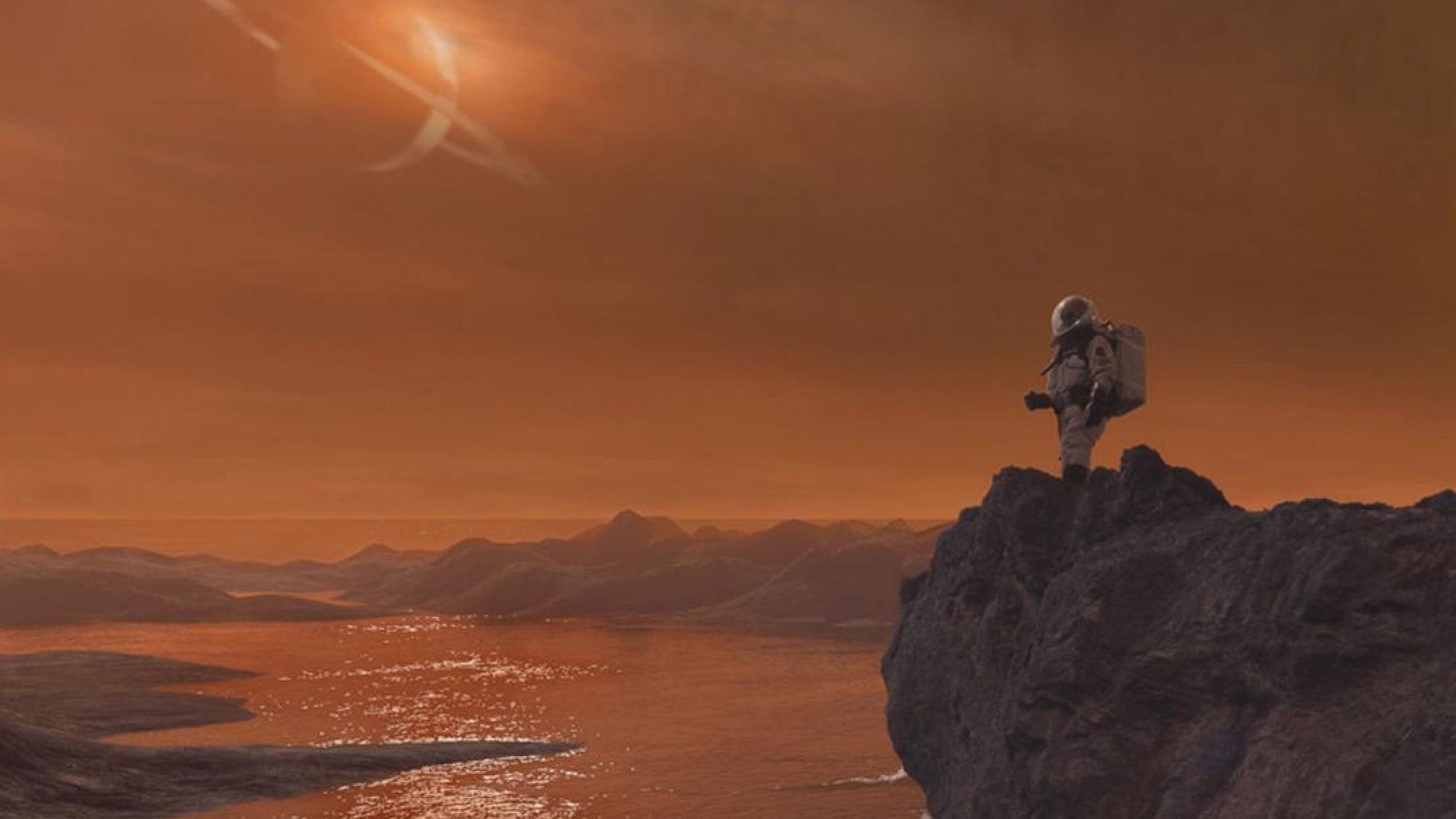
"It's not too soon to begin thinking about this."
After "re-booting" the moon and establishing a base there, followed by dispatching expeditionary crews to Mars, where should humanity go?
Next month, a first-of-its-kind gathering will blueprint an eventual crewed trek to tantalizing Titan, the largest of Saturn's many moons. That inaugural "Humans to Titan Summit" will make the case for an astronaut outing to that far-off moon, detailing the science goals and concepts of human missions to Titan as well as necessary forerunner robotic efforts.
And there is already a robotic Titan mission on the books — NASA's nuclear-powered Dragonfly octocopter mission, which is targeted to launch in 2028. Could it help fuel a human leap?
Foundational talks
"It's not too soon to begin thinking about this," said Amanda Hendrix, director of the Planetary Science Institute, headquartered in Tucson, Arizona. She is also president of the advocacy group Explore Titan and co-author of "Beyond Earth: Our Path to a New Home in the Planets" (Pantheon Books, 2016).
"The idea of the summit is to bring together people from different communities — engineers, scientists, industry, academia, robotic and human spaceflight experts," Hendrix told Space.com. "We're having foundational talks about what precursor missions do we need in order to get us on the road to Titan, eventually with humans."
Hendrix noted that, after Apollo's last human foray to the moon in 1972, there was a gap of decades, a lull in launching astronauts beyond Earth orbit — a pause just filled by NASA's recent Artemis 2 mission, which sent four astronauts around the moon and back to Earth.
"Now we are, hopefully, back on track [with] humans going to the moon, with NASA talking about Mars as the next human destination," said Hendrix. "I think having a concept in our mind after Mars can guide our thinking, give us a path and keep us motivated for the future."
Visits, past and future
The Saturn moon has had visitors already. On Jan. 14, 2005, the European Space Agency's robotic Huygens probe — part of the NASA-ESA Cassini-Huygens mission to Saturn — touched down on Titan.
Making a 2.5-hour descent through Titan's atmosphere, the Huygens probe provided a stream of data for 72 minutes once on the moon's surface. It set the still-standing record as the most distant landing from Earth.
"Huygens showed us many things," Hendrix said. She cited the dynamics of Titan's atmosphere, the look of its surface — which features water-ice "rocks," dry river beds, lakes and dunes — as well as the overall haziness at the landing locale.
"It does look otherworldly," Hendrix said.
Next up for Titan is Dragonfly, now scheduled to launch no earlier than 2028 for a six-year voyage to Titan. Once landed, the craft will spend three years flying from spot to spot to investigate a range of sites, perhaps revealing its potential to host life.
A dynamic world
"Dragonfly is an awesome, super-important mission to a fascinating and active world," said Hendrix. "Titan is not a static place. It is a dynamic world," she said, "probably a place that's very close to an early-Earth kind of environment."
Dragonfly will give us a leg up in the effort to send humans to Titan, Hendrix said, "but there's still a lot to do and learn."
"Ultimately, we're trying to get humans on the surface and living there. I think that's doable in the long-term, for sure," she said. A precursor mission might involve robotic orbiting of Titan — perhaps even a human crew circuiting the Saturn moon. Radar and infrared scanning of its surface could be done, she said, along with gauging what impact Titan's changing seasons have on the moon's atmosphere.
"A lot can be done, and should be done, robotically. But with humans on the surface, there's work only humans can do," Hendrix said.
Surmountable issues
So, how best to strut the right stuff on Titan?
First, there's more atmospheric pressure than here on Earth. "You don't need a pressure suit like you do on the moon or Mars. What you do need to do is keep warm. It's very cold there. There's also a little more gravity than the Earth's moon," said Hendrix.
Because of Titan's atmosphere, "you can strap wings to your arms and move through the atmosphere under your own power, or strap on a jet pack and power yourself around. You've got that atmosphere and low gravity. There are many options for transport on Titan, which Dragonfly is taking advantage of," Hendrix said.
Also, you'd have to make your own oxygen, Hendrix said, which is not available in Titan's thick, nitrogen atmosphere laced with methane. A Titan-based habitat would need a power source. And, given the precipitation of molecules and gunk that rains down and settles on the surface, there's a need to protect equipment, she said.
"This is all surmountable," said Hendrix, saying that Dragonfly and other precursor missions could yield information useful for human visits to Titan.
The Humans to Titan Summit 2026 is being held June 11-12 in Boulder, Colorado. The goal is "to explore the concept of Titan as the next human exploration destination after Mars, how it could be done and what we would need to do now," according to the event's website.
"We want the workshop to invigorate the community to think about what we need to do and what the possibilities are … to plant the seed that this is a real possibility," Hendrix concluded.
You must confirm your public display name before commenting
Please logout and then login again, you will then be prompted to enter your display name.
Leonard David is an award-winning space journalist who has been reporting on space activities for more than 50 years. Currently writing as Space.com's Space Insider Columnist among his other projects, Leonard has authored numerous books on space exploration, Mars missions and more, with his latest being "Moon Rush: The New Space Race" published in 2019 by National Geographic. He also wrote "Mars: Our Future on the Red Planet" released in 2016 by National Geographic. Leonard has served as a correspondent for SpaceNews, Scientific American and Aerospace America for the AIAA. He has received many awards, including the first Ordway Award for Sustained Excellence in Spaceflight History in 2015 at the AAS Wernher von Braun Memorial Symposium. You can find out Leonard's latest project at his website and on Twitter.
Facts Only
The Humans to Titan Summit 2026 will be held June 11-12 in Boulder, Colorado.
The summit is organized by Explore Titan, an advocacy group co-founded by Amanda Hendrix.
Amanda Hendrix is director of the Planetary Science Institute and co-author of "Beyond Earth: Our Path to a New Home in the Planets."
The summit aims to discuss human missions to Titan, including science goals and necessary robotic precursor missions.
NASA's Dragonfly mission, a nuclear-powered octocopter, is scheduled to launch in 2028 and will explore Titan for three years.
The European Space Agency's Huygens probe landed on Titan in 2005, providing data during a 2.5-hour descent and 72 minutes on the surface.
Titan has a nitrogen-methane atmosphere, water-ice "rocks," dry river beds, lakes, and dunes.
Titan's atmosphere allows for easier mobility than the Moon or Mars due to higher pressure and lower gravity.
Human missions to Titan would require oxygen production, power sources, and protection from surface precipitation.
The summit follows NASA's Artemis 2 mission, which recently sent astronauts around the Moon.
Titan is described as a dynamic world with potential similarities to early Earth.
The summit seeks to establish Titan as a post-Mars human exploration destination.
Executive Summary
Full Take
The narrative of Titan as humanity's next frontier after Mars is compelling, but it raises important questions about priorities, feasibility, and the underlying assumptions driving space exploration. The summit's focus on Titan reflects a broader pattern in space advocacy: the tendency to frame distant, high-risk missions as inevitable next steps, often without sufficient public debate about opportunity costs. While Titan's scientific value is undeniable—its Earth-like processes and potential for life make it a fascinating target—the push for human missions may be premature. The article highlights practical challenges (oxygen production, extreme cold) but does not critically examine whether robotic exploration alone could achieve the same scientific goals at a fraction of the cost and risk.
The framing of Titan as a "new home" echoes historical patterns of frontier expansion, where unfamiliar landscapes are romanticized as destinations for human settlement. This rhetoric can obscure the fact that Titan's environment is fundamentally hostile to human life, requiring massive technological interventions just to survive. The article also assumes that Mars is the consensus next step, despite ongoing debates about whether lunar bases or other destinations (e.g., Venusian atmosphere) might be more practical. The summit's goal of "planting the seed" that Titan is a real possibility is a classic example of ARC-0024 Ambiguity—using aspirational language to normalize a speculative idea without addressing the immense hurdles.
Root cause: The narrative is driven by a paradigm of perpetual expansion, where human spaceflight is justified by the need for "motivation" and "a path forward." This assumes that space exploration must follow a linear progression (Moon → Mars → Titan) rather than being guided by scientific return or feasibility. The implications are significant: diverting resources to Titan could delay more immediate priorities, such as sustainable lunar bases or asteroid mining. Who benefits? Space agencies, aerospace contractors, and advocacy groups gain momentum and funding. Who bears the costs? Taxpayers and alternative space science programs that might offer higher near-term returns.
Bridge questions: What would a cost-benefit analysis of human vs. robotic Titan missions reveal? How does the push for Titan align with (or compete against) other space exploration priorities? What ethical considerations arise from framing Titan as a "new home" when it cannot naturally support human life?
Counterstrike scan: If this were part of a coordinated campaign, the playbook would involve framing Titan as the "logical next step" to create urgency, using ambiguous language to downplay risks, and leveraging the prestige of past missions (Huygens, Dragonfly) to lend credibility. The actual content does not fully match this pattern—it acknowledges challenges and focuses on scientific goals—but the underlying assumption that human missions are inevitable warrants scrutiny.
Patterns detected: ARC-0024 Ambiguity
Sentinel — Human
The text presents a well-structured, factually grounded argument, relying heavily on expert testimony and specific mission data, suggesting a foundation in human-sourced journalistic investigation rather than pure synthetic generation.