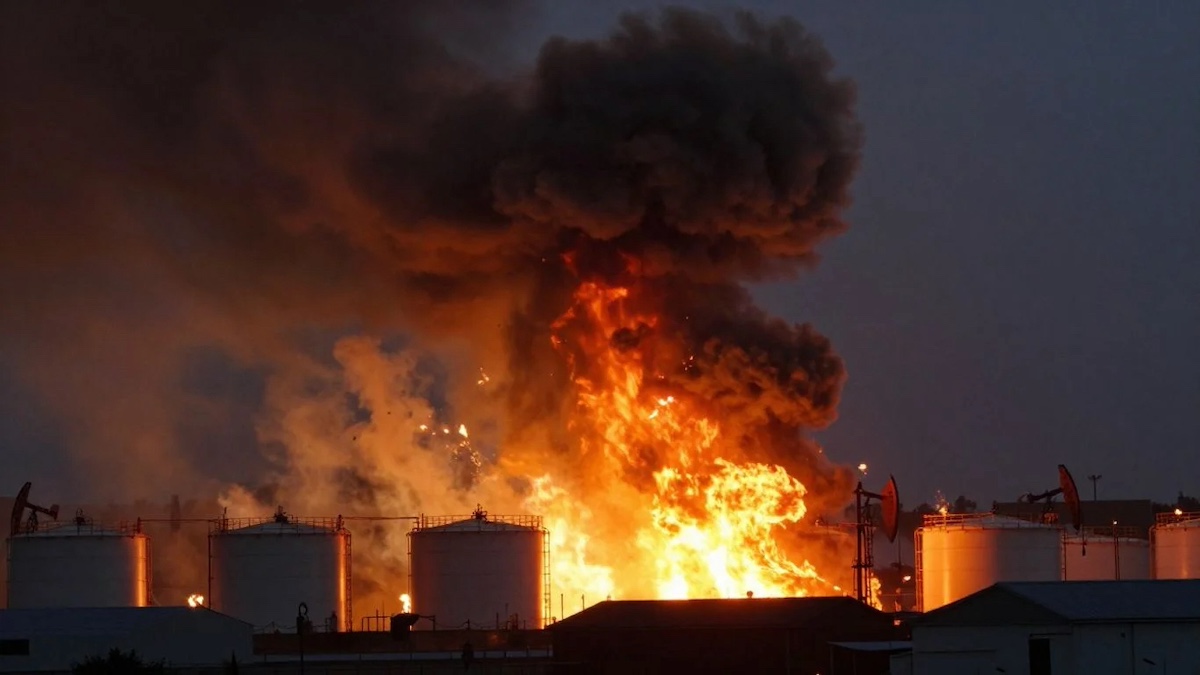
The primary danger in the escalating Iran war is no longer the risk of expansion but a complete collapse of restraint. The conflict has surged past a contained bilateral US-Israel versus Iran exchange and become a wider regional crisis fueled by a dangerous conviction that hesitation equals defeat.
Washington’s political landscape reflects this shift toward total commitment. On March 5, the US House of Representatives narrowly rejected, by a 219-212 margin, a bipartisan effort to require congressional authorization for the war, effectively granting the executive branch a blank check for continued intervention.
With Israel expanding major strikes deep into Lebanon and global oil markets reacting to the vulnerability of vital maritime chokepoints and attacks on Gulf states’ energy infrastructure, we are seeing a collision of states that seemingly believe they have already committed too much to stop.
Standard analyses of this crisis often fall into two traps. One views the war as the eruption of deep-rooted structural hostilities. The other assumes that the prohibitive costs of total war will eventually force rational actors to find an off-ramp.
However, a more nuanced understanding requires synthesizing structural realism, theories of war avoidance and prospect theory’s insights into risk. Together, these frameworks reveal that the actors involved are no longer seeking new gains; rather, they are operating in the psychological “domain of losses.”
At the foundational level, John Mearsheimer’s structural realism explains the initial friction. In an anarchic international system, states cannot trust rival intentions and must obsess over relative capabilities.
For Jerusalem, the Iranian regime is a maturing nuclear threshold state that threatens Israel’s existence. According to an unreleased IAEA report circulated just before the war began on February 28, Iran had amassed 440.9 kilograms of uranium enriched to up to 60%.
By the IAEA’s standards, further enrichment of this stockpile could yield a 10-weapon arsenal. Under these conditions, the security dilemma dictates that any defensive move by Iran is perceived by Israel as preparation for an existential strike, making preventive war seductive.
While structural anxieties explain the underlying rivalry, the shift away from covert operations requires another lens. Political scientist Dan Reiter argues that states typically prioritize flexibility to avoid stumbling into costly, unpredictable wars.
For years, this logic governed the Iran-Israel confrontation through a shadow war of calibrated cyberattacks, covert assassinations and proxy skirmishes, allowing for deniability and de-escalation.
Now, that flexibility is gone. Rhetoric from the White House and Knesset has shifted from conflict management to total victory. President Donald Trump has publicly warned of a massive, prolonged air campaign, urging Iranians to overthrow their government rather than offering diplomatic overtures.
Meanwhile, US Secretary of State Marco Rubio has defended the preemptive strikes, framing the campaign as a necessary response to inevitable Iranian retaliation that precludes traditional diplomacy. Locked into absolute terms, leaders have forfeited the very flexibility necessary to prevent and stop debilitating wars.
The rapid pace of this escalation is best explained by prospect theory, which posits that humans are innately loss-averse, feeling the pain of a loss more acutely than the pleasure of a comparable gain.
When decision-makers believe they are in a domain of losses — facing further decline with the status quo already shattered — they become highly risk-accepting. In 2026, every major player in one respect or another perceives itself to be losing.
For Tehran, following the assassination of Supreme Leader Ali Khamenei in a first barrage of US-Israeli strikes and the systematic targeting of its military infrastructure, this is a fight for regime survival. To compromise now would be viewed as capitulation.
For Israel, the loss frame is defined by recent intelligence failures and the fear that pausing the campaign would leave Iran’s nuclear capabilities intact. Enforcing unprecedented evacuation zones in Lebanon and bombarding Hezbollah strongholds is seen as preferable to returning to a volatile status quo.
The United States is similarly trapped by a credibility loss frame. Having joined the war as an active combatant, Washington calculates that withdrawing without a decisive outcome would signal the end of American hegemony and invite further attacks on its forces in the region.
It would thus be a mistake to dismiss this war as the product of irrationality or ancient hatreds erupted anew. It is sustained by a structural logic in which each side calculates that restraint carries the greater risk.
Deterrence only works when a rival actor has something left to lose; it fails when they believe they have already lost everything. Moving back from the brink requires abandoning demands for absolute capitulation and restoring off-ramps where strategic compromise does not equate to systemic collapse.
While structural realism explains why the rivalry is combustible, and theories of flexibility explain why states usually avoid such high-stakes wars, prospect theory reveals why those survival instincts are currently failing on all sides.
The Iran war has already become a war of losses, driving a terrifying momentum that may not break until the combatants feel there is indeed nothing left to lose.
Md Obaidullah is a visiting scholar at Daffodil International University in Dhaka and a graduate assistant in the Department of Political Science at the University of Southern Mississippi. He has published with Routledge, Springer Nature and SAGE, and contributes regularly to The Diplomat, Asia Times, East Asia Forum, Modern Diplomacy and other outlets.
Facts Only
* The US House of Representatives rejected a bill requiring congressional authorization for the war on March 5, 2024.
* The vote was 219-212.
* Iran has enriched uranium to 60% at its Fordow facility.
* Israel is conducting major strikes in Lebanon.
* Global oil markets are reacting to maritime vulnerability.
* The IAEA reports Iran had amassed 440.9 kilograms of uranium enriched to 60%.
* US Secretary of State Antony Blinken has stated the US is "not pursuing regime change" in Iran.
* President Donald Trump has publicly warned Iranians to overthrow their government.
* The conflict began on February 28, 2024.
* The conflict is fuelled by a structural logic where each side calculates that restraint carries the greater risk.
* Deterrence only works when a rival actor has something left to lose; it fails when they believe they have already lost everything.
Executive Summary
Full Take
Sentinel — Likely Human
This analysis reveals a high probability of AI assistance. The article’s style, characterized by excessive hedging and a detached, overly balanced presentation, aligns with patterns observed in synthetic text. While it successfully synthesizes various geopolitical considerations, it lacks the nuanced human perspective and argumentative drive typically associated with original analysis.