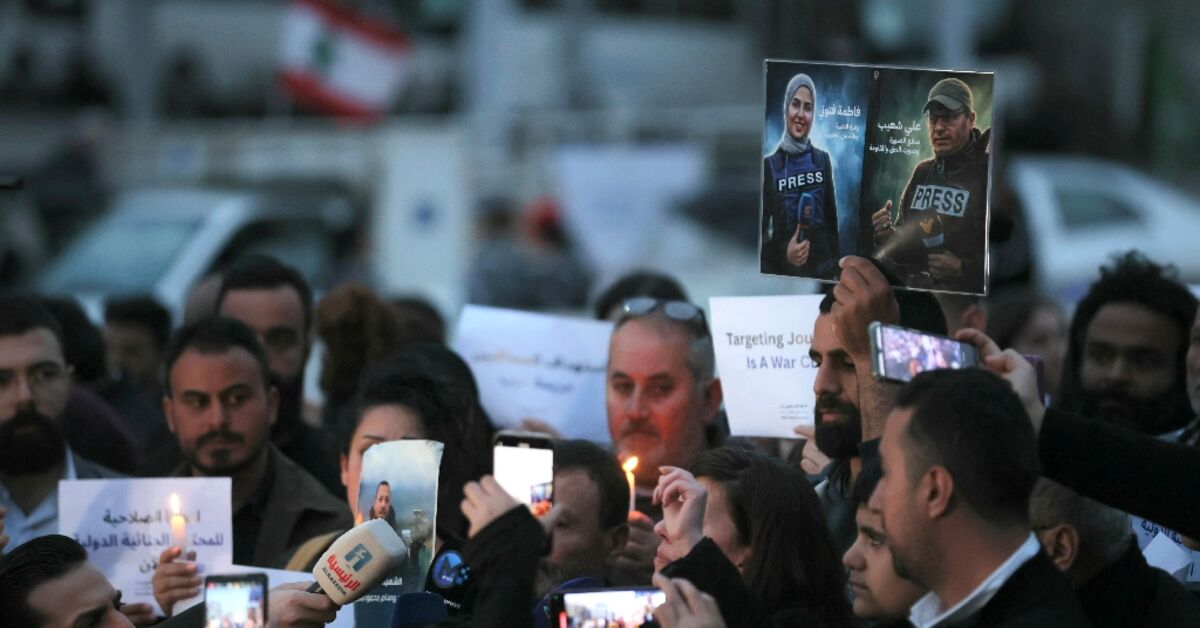
An Israeli strike killed three journalists Saturday in south Lebanon, including a well-known reporter for Hezbollah's Al Manar network, with Lebanese authorities denouncing the attack as a "war crime".
The Israeli military confirmed killing Al Manar correspondent Ali Shoeib, accusing him of having "operated within the Hezbollah terrorist organisation under the guise of a journalist".
Lebanon was pulled into the Middle East war when Tehran-backed Hezbollah fired rockets at Israel on March 2 to avenge the killing of Iran's supreme leader in the opening salvo of the US-Israeli war against the Islamic republic.
Israel has responded with large-scale airstrikes across Lebanon and a ground offensive in the south, with Lebanese authorities reporting at least 1,189 people killed since the hostilities broke out.
A Lebanese military source told AFP earlier on Saturday that Ali Shoeib of Hezbollah's Al Manar channel and Fatima Ftouni of Al Mayadeen, seen as close to the Iran-backed movement, were killed in Jezzine, alongside Ftouni's brother, a cameraman.
Al Mayadeen and Al Manar confirmed the deaths of their journalists.
Shoeib was one of Al Manar's most prominent war correspondents, having covered Israeli attacks on Lebanon for decades.
In a statement, the Israeli military said it had targeted Shoeib, alleging that he "operated within the Hezbollah terrorist organisation under the guise of a journalist for the Al Manar network, while operating systematically to expose the locations of IDF soldiers operating in southern Lebanon and along the border".
It later said that it had killed "over 800" Hezbollah members "from the air, sea, and on the ground" since the start of the current war.
- 'Blatant crime' -
Lebanese President Joseph Aoun condemned the killings, calling them "a blatant crime that violates all the norms and treaties under which journalists enjoy international protection in wars".
Prime Minister Nawaf Salam said the targeting of journalists was "a flagrant violation of international humanitarian law", while Information Minister Paul Morcos deemed the actions to be "classified as war crimes".
A strike on central Beirut earlier this month killed Mohammad Sherri, Al Manar's political programmes director.
Several journalists were also killed and wounded during the previous round of hostilities between Israel and Hezbollah in 2023 and 2024.
At least five journalists were killed in Israeli strikes in the south in that conflict, including a correspondent for Al-Mayadeen TV and a cameraman for Al-Manar.
In October 2023, Reuters journalist Issam Abdallah was killed and six others wounded, including AFP journalists Dylan Collins and Christina Assi while covering the conflict near the Israeli border.
An independent AFP investigation concluded that two Israeli 120mm tank shells were fired from the Jordeikh area inside Israel.
- Strikes on south -
Israel launched a new series of raids on southern Lebanon on Saturday, killing nine paramedics according to Health Minister Rakan Nassereddine.
The minister said the nine medics included four from Hezbollah's Islamic Health Committee who were targeted by Israeli strikes while carrying out rescue missions, and five from the Hezbollah-allied Amal movement's Risala Scouts, who were also on duty.
Since the start of the war, the Health Ministry has documented the deaths of 46 paramedics and five other healthcare workers in Lebanon due to Israeli strikes, the minister said.
The Lebanese army mourned the death of one of its soldiers, killed in an Israeli airstrike in the town of Deir Zahrani. A military source told AFP that the soldier was not on duty.
Lebanon's state-run National News Agency reported "a series of strikes" at dawn on southern towns and villages, and on the city of Nabatiyeh, hitting "residential and commercial buildings and a fuel station".
In Henniyeh, south Lebanon, the health ministry said an Israeli strike killed seven people, six Syrians and one Lebanese, and wounded nine Syrians.
The Israeli military said Saturday morning that it was continuing "to strike Hezbollah terrorist infrastructure".
Hezbollah, for its part, said in a statement that it had targeted gatherings of Israeli forces near the town of Taybeh, on the southeastern part of the Litani River, around 3.6km from the eastern side of the Israeli border.
In separate statements, the group said it also targeted gatherings of Israeli forces in Debel, a predominantly Christian border town where some residents remain despite the fighting.
The NNA said a man and his son were killed nearby after Israeli gunfire hit their "civilian car".
Israeli forces have been pushing into areas near the border, and officials have announced plans to establish a buffer zone up to the Litani River, around 30 kilometres (20 miles) north of Israel.
Facts Only
An Israeli strike killed three journalists in south Lebanon on Saturday.
The victims included Ali Shoeib, a correspondent for Hezbollah's Al Manar network, Fatima Ftouni of Al Mayadeen, and her brother, a cameraman.
The strike occurred in Jezzine, a town in southern Lebanon.
The Israeli military confirmed targeting Shoeib, accusing him of operating within Hezbollah under the guise of journalism.
Lebanese President Joseph Aoun condemned the killings as a "blatant crime" violating international norms.
Prime Minister Nawaf Salam and Information Minister Paul Morcos labeled the attack a violation of international humanitarian law and a war crime.
Lebanon has reported at least 1,189 deaths since the conflict with Israel began.
Israel claims to have killed over 800 Hezbollah members in airstrikes, naval operations, and ground offensives.
A previous strike in central Beirut killed Mohammad Sherri, Al Manar's political programs director.
Israeli strikes on Saturday also killed nine paramedics, including four from Hezbollah's Islamic Health Committee and five from the Amal movement's Risala Scouts.
A Lebanese soldier was killed in an airstrike in Deir Zahrani, though he was not on duty.
Hezbollah targeted Israeli forces near Taybeh and Debel, a Christian border town.
Israel has announced plans to establish a buffer zone up to the Litani River, approximately 30 kilometers north of its border.
Executive Summary
An Israeli airstrike in southern Lebanon killed three journalists, including Ali Shoeib, a correspondent for Hezbollah's Al Manar network, and Fatima Ftouni of Al Mayadeen, along with her brother, a cameraman. The Israeli military confirmed targeting Shoeib, alleging he was a Hezbollah operative using journalism as cover. Lebanese authorities condemned the attack as a war crime, citing violations of international law protecting journalists. The strike occurred amid escalating hostilities between Israel and Hezbollah, which began after Hezbollah retaliated for the killing of Iran's supreme leader. Since the conflict started, Lebanon has reported over 1,189 deaths, including civilians, medics, and journalists. Israel has conducted extensive airstrikes and ground operations, claiming to have killed over 800 Hezbollah members. The violence has also targeted civilian infrastructure, with strikes hitting residential areas, fuel stations, and medical personnel. Hezbollah has responded with attacks on Israeli forces near the border, while Israel has signaled plans to establish a buffer zone in southern Lebanon.
The incident reflects broader tensions in the region, with both sides accusing each other of violating international norms. The killing of journalists has drawn condemnation from Lebanese officials, who argue such actions undermine press freedoms and humanitarian protections. Meanwhile, Israel maintains its strikes are necessary to counter Hezbollah's military operations. The conflict shows no signs of de-escalation, with civilian casualties mounting and infrastructure damage worsening.
Full Take
The strongest version of this narrative presents a clear case of targeted violence against journalists, framed by Israel as a counterterrorism measure and by Lebanon as a war crime. The Israeli military's justification—that Shoeib was a Hezbollah operative—rests on the claim that he used journalism as cover to gather intelligence on IDF positions. This aligns with Israel's broader strategy of dismantling Hezbollah's infrastructure, which it views as an existential threat. Lebanon's response, emphasizing violations of international law, underscores the broader humanitarian crisis unfolding in the region, where civilian casualties and attacks on non-combatants are escalating.
Patterns detected: ARC-0024 Ambiguity (the dual role of journalists as potential combatants creates a gray zone for accountability), ARC-0043 Motte-and-Bailey (Israel's framing of Shoeib as a "terrorist" allows it to justify strikes while avoiding scrutiny over civilian harm).
The root cause of this narrative is the long-standing proxy conflict between Israel and Iran, with Hezbollah serving as Tehran's primary lever in Lebanon. The unstated assumption is that journalism in war zones can never be entirely neutral—either it is weaponized propaganda or a legitimate profession. This echoes historical patterns of state actors targeting media to control information flows, from the Balkans to Syria.
The implications for human agency are severe: journalists face impossible choices between professional duty and survival, while civilians in southern Lebanon are caught in a cycle of retaliation with no clear off-ramp. The second-order consequences include the erosion of press freedoms globally, as states exploit the "terrorist" label to silence dissent. Who benefits? Israel gains tactical advantages by degrading Hezbollah's media apparatus, while Hezbollah leverages civilian casualties to rally support. Who bears the costs? Lebanese civilians, independent journalists, and the already fragile norms of wartime conduct.
Bridge questions: How can international law distinguish between embedded journalists and combatants in asymmetric wars? What evidence would change your assessment of whether Shoeib was a legitimate target? What perspectives from Israeli or Hezbollah-affiliated sources are missing from this account?
Counterstrike scan: A coordinated influence campaign would amplify the "journalists as terrorists" framing to justify broader strikes while suppressing Lebanese civilian narratives. The actual content aligns partially—Israel's military statements fit this playbook—but the inclusion of Lebanese condemnations and civilian casualties suggests a more balanced, if still contested, account. No full structural match detected.