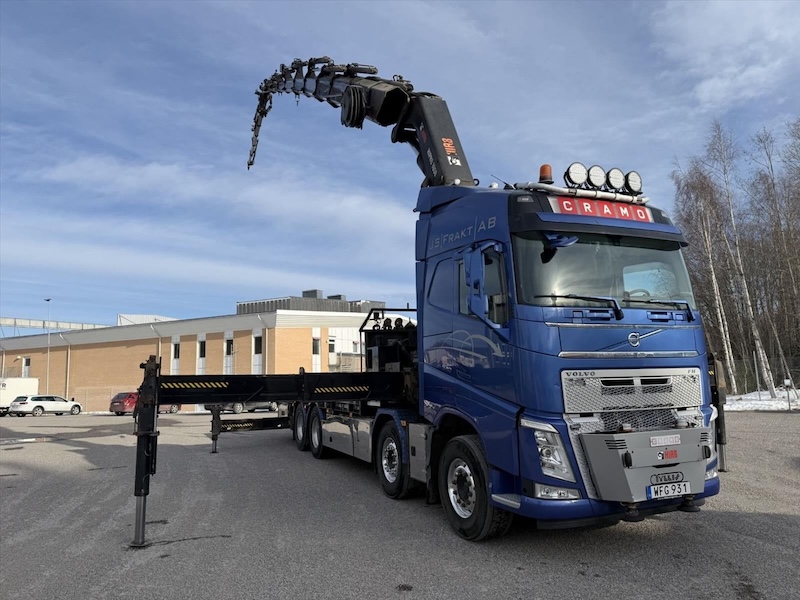
A number of individuals have spoken about robotics with respect to heavy equipment. However, they typically consider autonomous mining vehicles, warehouse management systems, and construction machines.
The majority of these individuals overlook an extremely obvious shift that is taking place in truck mounted cranes. Crane trucks are becoming smart due to the advent of new technology to assist the operator by making his job safer.
Automation in crane trucks is not about full autonomy
While robotics in heavy equipment doesn’t necessarily mean an entirely unmanned machine, the trend is clearly toward assisted operation.
Today’s truck-mounted loader cranes are increasingly relying on integrated control systems that track the boom’s location, load conditions, machine geometry and stability in real time. That changes the operator’s role from simply manually controlling the crane to supervising the lift.
That matters because crane-truck operations typically do not occur in perfect conditions. The crane may be situated on uneven terrain, near buildings, within urban delivery areas or on constrained industrial property. Under those conditions, robot-assisted operation provides repeatable results and reduces the possibility of operator error.
European loader-crane regulations describe the minimum requirements for design, calculation, testing and inspections for hydraulic loader cranes mounted on vehicles. More recently, there has been an increased emphasis on higher levels of safety in the control circuits.
When companies evaluate upgrades to their fleets, the buyer side is just as important as the technology side. A company evaluating the best crane truck configuration that can be found on platforms like Truck1, regardless if it is a new or used unit, will also have to consider lifting class, chassis type, control configuration, and service condition.
Sensor fusion and stability control are driving crane trucks toward robotic behavior
The most critical layer of automation for crane trucks is safety logic tied to sensor inputs. A crane truck operates in a dynamic environment. Capacity varies with boom length, angle, reach and support conditions. Therefore, stability control systems, load limiting devices and motion limiters play a crucial role in today’s operation.
From a robotics standpoint, that is important because the machine is increasingly determining what permissible motions are available. While the operator determines what is to be lifted, the software determines the safe motion parameters. That is a classic example of human-in-the-loop automation.
Additionally, the introduction of smart control systems also increases productivity. Because the operator does not have to estimate safe operating limitations by intuition alone, they can dedicate more cognitive resources to performing the task. Smart control systems can decrease set-up time, reduce trial and error movements, and provide improved consistency among different crews.
In heavy equipment, incremental improvements in productivity translate to significant cost savings associated with reduced machine down time, failed lifts, and re-positioning.
Remote control and digital interfaces are transforming the role of the operator
A new important robot trend involves replacing physical controls placed on an operator with remotely controlled and digitally enabled robotic systems. The ability for operators to use remote controls allows operators to view the load path in a safe manner while being physically unconfined to a single point of control.
The remote control of a crane operation provides the operator with an enhanced line-of-sight and lessens the amount of guess work required to operate the crane near hazards or obstructions.
This is not just an insignificant ergonomic issue. The remote control of crane operations changes the way that crane operations are carried out on site. When the operator is removed from the fixed control station, the importance of designing the software increases.
The clarity of the interface, the quality of feedback provided, the delay in response, and alarm logic all become critical components of the machine’s effective safety system.
Telematics and fleet intelligence are becoming integral components of the machine
Robotics in the area of heavy equipment does not merely include the machine’s operation itself. However, it also includes activities which take place before and after operating.
Once crane trucks provide operational data that can create actionable information, fleet managers can track how much they are using their cranes, when and why they require maintenance, when servicing is due and the types of loads they typically carry. Thus, there exists a feedback mechanism from the equipment’s on-site performance and the manager’s purchasing decisions.
This represents the beginning of digital fleet intelligence as relating the lift capability of a machine. Therefore, a crane truck that has good uptime, clear diagnostic information and consistent control behavior could be considered more valuable than a larger crane truck that has poor deployment characteristics.
Moreover, this paradigm is important for used-equipment buyers because the quality of the equipment can no longer be assessed based on either the amount of wear and tear and/or the age of the equipment.
In fact, the overall value of a crane truck is increasingly being measured by the quality of its electronic and safety systems as well as whether those systems meet today’s operational standards.
Facts Only
Truck-mounted loader cranes are incorporating integrated control systems that monitor boom location, load conditions, machine geometry, and stability in real time.
European regulations set minimum requirements for the design, calculation, testing, and inspection of hydraulic loader cranes mounted on vehicles.
Recent regulatory emphasis has focused on higher safety standards in control circuits for loader cranes.
Companies evaluating crane truck upgrades consider factors such as lifting class, chassis type, control configuration, and service conditions.
Stability control systems, load limiting devices, and motion limiters are critical components in modern crane truck operations.
Smart control systems reduce setup time, decrease trial-and-error movements, and improve consistency among different crews.
Remote control systems allow operators to manage crane operations from safer positions with better visibility.
Telematics and fleet intelligence systems track crane usage, maintenance needs, servicing schedules, and typical load types.
The value of crane trucks is increasingly determined by the quality of their electronic and safety systems, not just physical condition or age.
Automation in crane trucks involves human-in-the-loop systems where software defines safe motion parameters while operators determine lift objectives.
Crane truck operations often occur in suboptimal conditions, including uneven terrain, urban areas, or constrained industrial sites.
The introduction of digital interfaces and remote controls has changed the design priorities for crane operation software, including interface clarity, feedback quality, and alarm logic.
Executive Summary
The heavy equipment industry is undergoing a significant transformation in truck-mounted crane technology, driven by automation and smart control systems. While much attention has been given to autonomous mining vehicles and warehouse robots, crane trucks are quietly evolving with integrated safety and productivity features. Modern loader cranes now rely on real-time sensor fusion to monitor boom position, load conditions, and stability, shifting the operator's role from manual control to supervised oversight. This change is particularly valuable in challenging environments, such as uneven terrain or urban spaces, where human error can lead to accidents. European regulations have increasingly emphasized safety in control circuits, reflecting broader industry trends.
Beyond safety, these advancements enhance productivity by reducing setup time and minimizing trial-and-error movements. Remote control systems further improve operations by allowing operators to maneuver cranes from safer vantage points, improving visibility and reducing guesswork near hazards. Additionally, telematics and fleet intelligence systems now provide actionable data on usage, maintenance needs, and load patterns, enabling better decision-making for fleet managers. The value of crane trucks is increasingly tied to the quality of their electronic and safety systems rather than just physical wear or age, reshaping how buyers evaluate both new and used equipment.
Full Take
The narrative presents a compelling case for the quiet revolution in crane truck automation, emphasizing safety, productivity, and data-driven decision-making. At its strongest, it highlights a pragmatic shift toward human-in-the-loop systems, where technology augments rather than replaces human judgment. This is a refreshing counterpoint to the more sensationalist narratives about full automation displacing workers. The focus on real-time sensor fusion and stability control addresses legitimate operational risks in dynamic environments, while remote control systems offer tangible ergonomic and safety benefits. The discussion of telematics and fleet intelligence also underscores a broader trend toward data-driven asset management, which could democratize access to high-quality equipment by making performance metrics more transparent.
However, the narrative leans heavily on industry-driven optimism, with little acknowledgment of potential downsides. For instance, the reliance on complex control systems introduces new failure modes—software bugs, sensor malfunctions, or cybersecurity vulnerabilities—that could offset safety gains. The assumption that operators will seamlessly adapt to supervisory roles also overlooks the cognitive load of managing semi-autonomous systems, which can be more taxing than manual control in some cases. Additionally, the emphasis on productivity gains may pressure operators to work faster, potentially undermining the very safety benefits these systems aim to provide.
Rooted in the paradigm of "smart" industrial equipment, this narrative assumes that technological progress is inherently beneficial, with minimal consideration for unintended consequences. Historically, similar shifts in automation have led to deskilling, where operators become dependent on systems they don’t fully understand, or to over-reliance on technology in edge cases where human intuition might be superior. The focus on European regulations suggests a regional bias, raising questions about how these standards apply in less regulated markets where cost pressures might prioritize affordability over advanced safety features.
For human agency, the implications are mixed. Operators gain tools that reduce physical strain and improve precision, but they may also lose autonomy as software dictates "permissible motions." Fleet managers benefit from data-driven insights, but this could also lead to surveillance-like oversight of operator performance. Second-order consequences might include consolidation in the crane manufacturing industry, as smaller players struggle to keep up with the R&D demands of smart systems, or a widening skills gap between operators trained on legacy equipment and those proficient in digital interfaces.
Bridge questions: How might the introduction of these systems affect liability in accidents—will operators or software developers bear responsibility? What safeguards are in place to prevent data from telematics systems from being used punitively against operators? How do these advancements interact with labor dynamics, such as union negotiations or wage structures tied to skill levels?
Counterstrike scan: If this were part of a coordinated influence campaign, the playbook would likely emphasize the inevitability of automation, frame resistance as Luddism, and highlight productivity gains while downplaying risks. The actual content aligns partially with this pattern—it celebrates progress and assumes net benefits—but it avoids overt dismissal of concerns or exaggerated claims. The focus on safety and human-in-the-loop systems suggests a more balanced intent, though the lack of critical scrutiny of potential drawbacks is notable. No clear manipulation patterns detected, but the absence of counterarguments is a mild red flag for confirmation bias.
Patterns detected: none