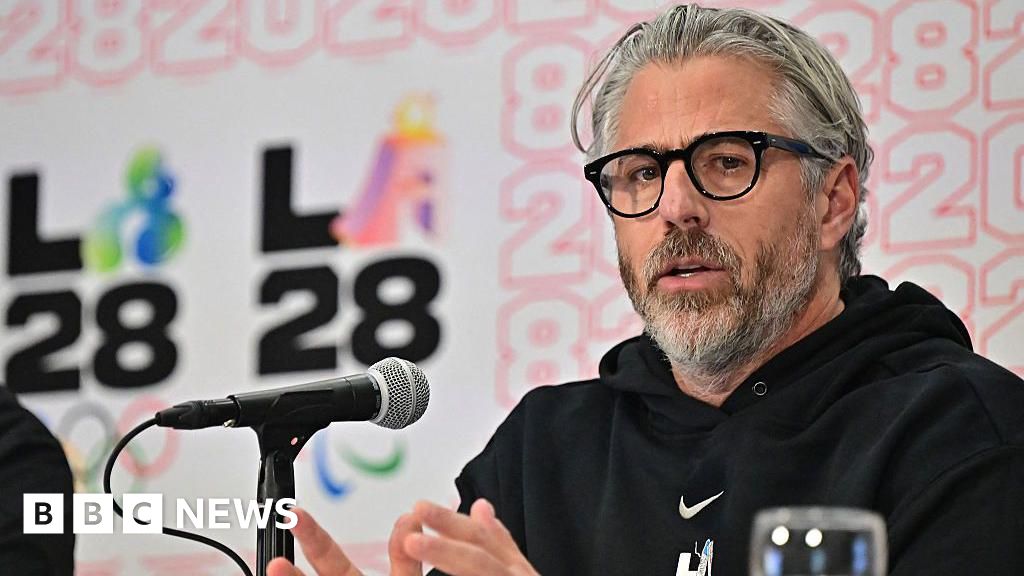
The Los Angeles City Council has unanimously approved a measure urging the Olympics committee to investigate LA 2028 chief Casey Wasserman over ties to paedophile Jeffrey Epstein.
Wasserman is facing mounting calls to leave the post after disclosures surfaced showing that he flew on Epstein's jet and exchanged flirtatious emails with the late financier's jailed associate, Ghislaine Maxwell, in 2003.
The resolution, while not enforceable and largely symbolic, displays the simmering discomfort in the Summer Games' next host city over Wasserman.
The sports and entertainment executive has not been accused of any wrongdoing, and has expressed regret for the exchanges, which are from decades ago.
The city council's resolution, adopted in a 12-0 vote, expresses "concern regarding the potential conflict between the Olympic movement's values and Casey Wasserman's association with the Epstein files".
It calls for a "thorough and transparent" examination of Wasserman's involvement with Epstein.
The LA28 executive committee announced last month that Wasserman would remain in his post after it hired an outside counsel to review any potential misconduct by Wasserman.
"We found Mr Wasserman's relationship with Epstein and Maxwell did not go beyond what has already been publicly documented," the committee said at the time.
After the city council vote on Friday, the board told the BBC in a statement that it had already made it's decision on Wasserman's future and was instead focused on moving forward with the Games.
"With the Board's position on leadership established, LA28's focus remains on delivering a fiscally responsible, privately funded Games that protects taxpayers and benefits Los Angeles," the statement reads. "We are on track to deliver a successful Olympic and Paralympic Games in 2028."
The vote came amid a litany of calls for his ousting, ranging from celebrities to politicians, including the city's mayor Karen Bass. An array of musicians and athletes represented by Wasserman's talent firm announced they would be splitting with the agency.
In response, Wasserman announced he started the process of selling the major LA-based agency, noting he had "become a distraction".
"I'm deeply sorry that my past personal mistakes have caused you so much discomfort," Wasserman wrote to the agency's 4,000 employees in the email, which was obtained by the BBC.
He continued: "It's not fair to you, and it's not fair to the clients and partners we represent so vigorously and care so deeply about."
Wasserman, who is one of many prominent figures included in the millions of Epstein documents, has not been accused of wrongdoing by any of Epstein's victims. The appearance of his name in the files does not imply criminal activity of any kind. The BBC has contacted his representatives about the city council vote.
Wasserman has previously said he "deeply regrets" his discussions with Maxwell, who is serving a 20-year prison sentence for facilitating the sexual abuse of teenage girls by Epstein.
He noted that his email exchanges with Maxwell "took place over two decades ago, long before her horrific crimes came to light," and he never had any business dealings with Epstein.
Facts Only
* Casey Wasserman is the chief of LA28.
* The Los Angeles City Council unanimously approved a measure.
* The measure urges an investigation into Wasserman’s ties to Jeffrey Epstein.
* Wasserman flew on Epstein’s jet in 2003.
* He exchanged emails with Ghislaine Maxwell in 2003.
* The resolution is not enforceable.
* The sports executive has expressed regret for the exchanges.
* The committee reviewed Wasserman’s involvement.
* The committee found no wrongdoing beyond public disclosures.
* The City Council voted 12-0.
* Wasserman sold his agency.
* Musicians and athletes affiliated with Wasserman's agency split.
* The LA28 executive committee is continuing with the Games.
Executive Summary
Full Take
The narrative presented here is a carefully constructed attempt to manage a potentially explosive scandal, employing a strategy of “controlled discomfort.” The resolution, while lacking legal teeth, serves a crucial function: to appease public outrage without directly confronting Wasserman’s past. The framing emphasizes “potential conflict” and “concern,” actively avoiding accusations of wrongdoing and leveraging the ambiguity inherent in the historical timeframe— “decades ago.” This represents a classic motte-and-bailey tactic, elevating a minor detail (his past association) into a full-blown ethical crisis, while simultaneously limiting the scope of any investigation to merely “examining involvement,” effectively neutralizing the threat. The parallel actions—selling the agency, announcing a review—demonstrate a calculated attempt to preempt further scrutiny and signal a desire to move forward.
The pattern detectable here is a sophisticated application of ‘bad faith’ – specifically, ‘sealioning.’ The initial disclosures, coupled with the City Council’s reaction, are designed to generate a predictable media frenzy, drawing attention to Wasserman’s name and amplifying the perceived scandal. The BBC’s emphasis on the “mounting calls” and “simmering discomfort” feeds into this predetermined pattern, creating a sense of urgency and reinforcing the impression of a significant problem. Further, there's an implicit use of 'systemic' – a calculated effort to diffuse any sustained pressure by framing the issue as a broader concern about the Olympic movement's values.
The underlying assumption driving this narrative is that public trust, particularly in the context of a major sporting event, is fundamentally fragile and susceptible to manipulation. The real cost isn't necessarily Wasserman’s past, but the effort and distraction this situation generates— a cost borne by the LA28 organizing committee, and potentially by the integrity of the Games themselves. The question becomes: is this a genuine attempt at accountability, or a calculated exercise in damage control? The presence of multiple actors – the council, the committee, Wasserman, the agency – all contributing to this complex dynamic suggests a coordinated, albeit opaque, effort to shape the narrative.
Sentinel — Likely Human
This article presents a factual account of a City Council resolution regarding Casey Wasserman's ties to Jeffrey Epstein, employing standard journalistic language and acknowledging the controversy surrounding his involvement. The text exhibits characteristics consistent with human-authored reporting, though subtle reliance on vague attribution warrants careful consideration.