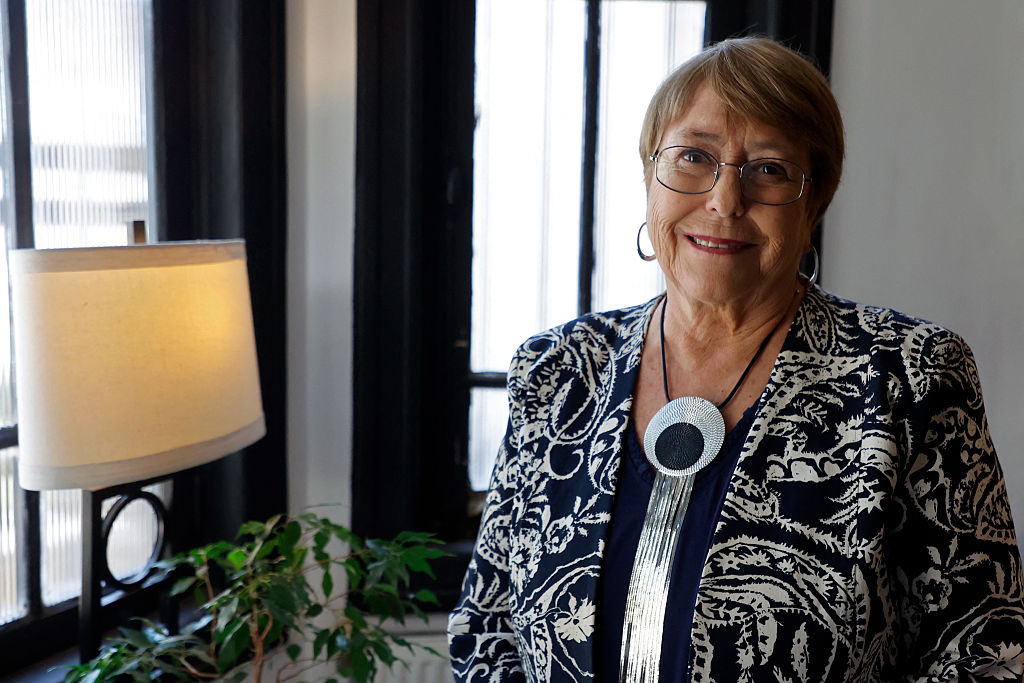
Republican lawmakers are actively opposing the nomination of Dr. Michelle Bachelet for United Nations secretary-general due to her “pro-abortion zealot intent.”
Bachelet, a Chilean politician, supported abortion access during her time in leadership positions including her two terms as the 33rd and 35th president of Chile from 2006 to 2010 and from 2014 to 2018.
The next secretary-general will begin a five-year term on Jan. 1, 2027. To be elected, a candidate must receive at least nine votes from the 15 members of the U.N. Security Council, and none of the five permanent members — China, France, Russia, the United Kingdom, and the United States — can veto the decision. Chile’s newly elected president withdrew support for Bachelet on March 24.
“Nevertheless, out of respect for former President Bachelet’s distinguished career — and should she decide to proceed with her candidacy — Chile will refrain from supporting any other candidate in this electoral process,” according to the statement from the Ministry of Foreign Affairs.
Nearly 30 Republican lawmakers are urging the U.S. to “use its veto power” to prevent Bachelet from being selected “to preserve the role for a more qualified candidate,” they wrote in a letter to U.S. Secretary of State Marco Rubio on March 25.
In the letter, the 23 representatives and five senators outlined their “deep concern” with Bachelet’s past performance and priorities in her previous roles, arguing that her selection would only harm the Trump administration’s vision for the U.N.
A State Department spokesperson outlined what the U.S. is seeking in a secretary‑general.
“The United States is looking for a practical, driven, and reform-focused candidate who will safeguard the valuable contributions of member states, restore competent management, and streamline the organization significantly,” a spokesperson for the State Department told EWTN News.
“Any new secretary-general needs to return the U.N. to its primary purpose — maintaining peace and security in the world rather than the absurd, politicized, woke ideology that has undermined the institution’s effectiveness,” the spokesperson said.
“The United States will be actively assessing the candidate field to determine the best individual with the most exceptional qualifications and will not be prejudging a candidate based on immutable characteristics,” the spokesperson said.
No woman has ever held the post of U.N. secretary-general.
Lawmakers list concerns about Bachelet’s stance
“In her previous roles with the United Nations High Commissioner for Human Rights (OHCHR), as executive director of UN Women, and as president of Chile, Dr. Bachelet has repeatedly prioritized an extreme abortion agenda at the expense of state sovereignty,” lawmakers wrote to Rubio.
They specifically noted when she called the 2022 Dobbs v. Jackson Women’s Health Organization decision a “huge blow to women’s human rights” and referred to the U.S. Supreme Court overturning Roe v. Wade as “a major setback.”
She also expressed her view that “abortion is firmly rooted in international human rights law and is at the core of women and girls’ autonomy,” in an OHCHR statement.
“The truth is that killing an unborn child by abortion can never be construed to be a human right,” lawmakers said. “Every person — born and unborn — deserves to have his or her human rights secured and protected.”
When Bachelet was appointed to be the first executive director of UN Women, “Planned Parenthood Federation of America celebrated,” they said. In her position, “Bachelet declared that ‘reproductive rights,’ a euphemistic term that encompasses elective abortion, was ‘absolutely fundamental’ to that mission,” they said.
During her second race for president, “Bachelet campaigned on weakening Chile’s pro-life law protecting unborn life in all circumstances,” they said. After her reelection, she authored “a bill to legalize abortion in certain situations.”
The U.S. lawmakers also addressed Bachelet’s “failure to oppose coerced abortion in China” and other violations of the Chinese Communist Party (CCP).
In May 2022, Bachelet traveled to China at the invitation of the CCP “to investigate years of reports of severe human rights abuses in the Xinjiang Uyghur Autonomous Region,” they wrote. Instead of identifying “the atrocities committed by the CCP against the Uyghurs as a genocide,” she “released a watered-down report literally minutes before her term expired,” lawmakers wrote.
“She has demonstrated that she is not a candidate who will respect state sovereignty, refrain from divisive ideologies,” or focus on mutual concerns of U.N. member states, lawmakers concluded.
Signers included Republicans Sen. James Lankford of Oklahoma, chair of the Select Committee on Ethics; Rep. Chris Smith of New Jersey, chair of the House Foreign Affairs Subcommittee on Africa; and Rep. Andy Harris of Maryland, chair of the Appropriations Subcommittee on Agriculture, Rural Development, FDA, and Related Agencies.
Contracts were not reinstated after the Trump administration’s suspension of contracts under the U.S. Refugee Assistance Program.
Facts Only
Dr. Michelle Bachelet is facing opposition for the United Nations secretary-general position due to her pro-abortion stance.
Bachelet served as president of Chile from 2006 to 2010 and again from 2014 to 2018, during which she advocated for abortion access.
She also held positions with the United Nations High Commissioner for Human Rights (OHCHR) and UN Women.
Bachelet expressed her support for abortion rights in various statements and actions throughout her career.
The next U.N. secretary-general will begin a five-year term on Jan. 1, 2027.
To be elected, a candidate must receive at least nine votes from the 15 members of the U.N. Security Council, without a veto from any of its five permanent members.
Chile's newly elected president withdrew support for Bachelet on March 24, but may still abstain from supporting other candidates in the electoral process.
Nearly 30 Republican lawmakers are urging the U.S. to use its veto power to prevent Bachelet's selection due to her stance on abortion and perceived harm to the Trump administration's vision for the U.N.
Executive Summary
Full Take
In a skeptical analysis, this article presents the ongoing controversy surrounding Dr. Michelle Bachelet's nomination for United Nations secretary-general due to her pro-abortion stance. The opposition from Republican lawmakers is based on Bachelet's actions and statements supporting abortion rights during her time as president of Chile and her roles with the United Nations.
Steelman: The strongest version of this narrative acknowledges that Dr. Michelle Bachelet has a long history of advocating for abortion rights, which has led to opposition from certain political groups, particularly in the U.S., who see her nomination as detrimental to their interests.
Patterns detected: ARC-0024 Ambiguity (The article presents conflicting views on Bachelet's potential election and the role of the U.S. veto, without explicitly stating whether she will ultimately be elected or not); ARC-0043 Motte-and-Bailey (Some criticism of Bachelet's stance on abortion is framed as a concern for state sovereignty, while other statements reveal a more ideological opposition to her views).
Root cause: The opposition to Dr. Michelle Bachelet stems from deep cultural and political divisions around the issue of abortion, which are reflected in differing perspectives on its role in international human rights law.
Implications: If elected, Bachelet's nomination could create further tension between the U.N. and certain member states, particularly those with strong anti-abortion sentiments. This tension may affect the organization's ability to address global issues effectively.
Bridge questions: What are the potential benefits and drawbacks of having a secretary-general who is an outspoken advocate for abortion rights? How can the U.N. balance the diverse perspectives on this issue within its membership while maintaining its primary purpose of maintaining peace and security?