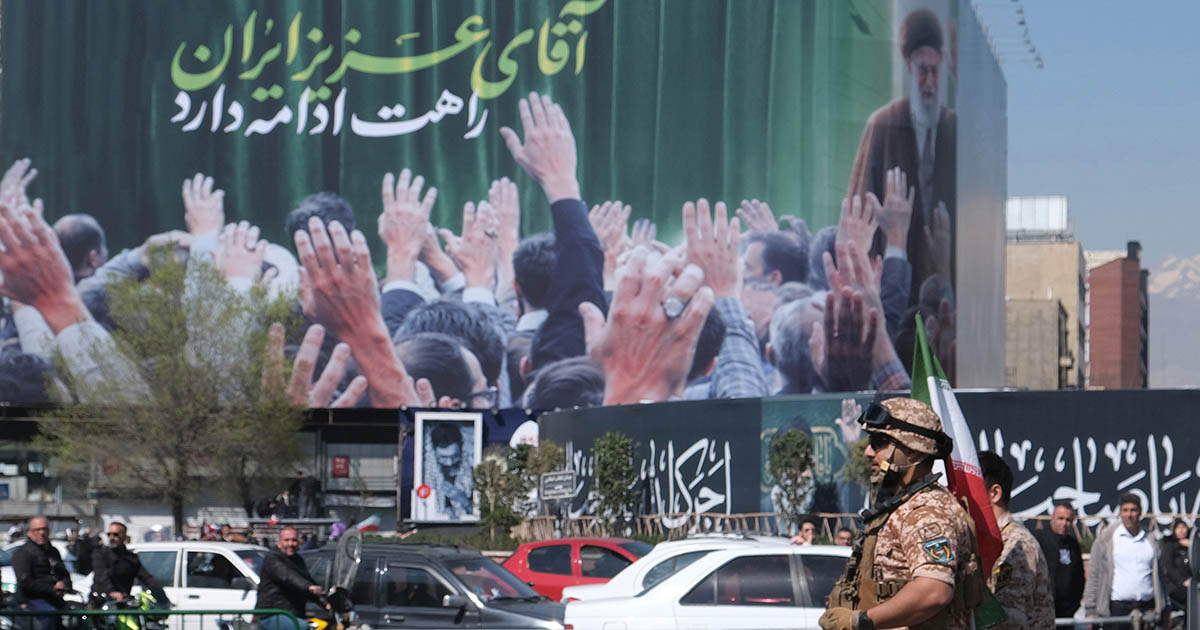
Trump’s False Promise of Liberation
The war with Iran will not produce a freer or more democratic country.
On February 28, 2026, while announcing a joint U.S.-Israeli military campaign against Iran, Donald Trump told the Iranian people: “When we are finished, take over your government. It will be yours to take.”
It has now been more than five weeks since the start of a war that has consumed years’ worth of U.S. munitions stockpiles. As of this writing, there have been more than 10,000 U.S. strikes on Iran, and over 15,000 Israeli bombs dropped. The Iranian government has not updated the official civilian casualty figures since the first week, but according to the U.S.-based Human Rights Activists News Agency, the number of civilian casualties totals more than 1,500. At least 244 children have been killed in the airstrikes. Iran’s densely populated cities lack a shelter network. As the campaign expands to target civilian infrastructure, casualties will inevitably mount among a population increasingly aware they have nowhere safe to hide. Yet according to the U.S. Director of National Intelligence, there is no sign that any of this destruction has brought the regime near collapse. Indeed, it appears stronger than before—a predictable outcome, given its history and war strategy.
It is true that the government in Iran is widely unpopular. It is in its weakest economic state since its founding and has lost much of its legitimacy through the brutal repression of its own people. Hardliners in the regime have demonstrated repeatedly that they are resistant to reform and have suppressed the formation of any organized civil opposition. Many Iranians have concluded that the only path to democracy runs through the removal of the regime. Given the leadership’s unconstrained tendency to violently repress protests, many believe this is only possible with foreign intervention. Consequently, a number of Iranians in the diaspora and some within Iran initially cheered the recent U.S.-Israeli military campaign against their country. From their perspective, opposition to the war demonstrates, at best, a lack of concern for the plight of the Iranian people, and, at worst, direct support for the regime itself.
However, a myopic and emotionally driven focus on government atrocities has obscured the realities that will dictate the outcome of this war. An analysis of recent history of projects for regime change, alongside a sober analysis of the interests and capacities of the parties involved in this conflict, suggests that a democratic and free Iran is a very unlikely outcome of the war. Much more likely are a protracted civil war that results in a failed state, the continuation of an oppressive state apparatus that partially submits to U.S. demands, or a survivalist regime locked into cycles of conflict. None of these outcomes will facilitate the emergence of sustainable democracy in Iran.
According to a recent investigation by the New York Times, Israeli intelligence argued in the lead-up to the war that the aerial bombardment of the repressive organs of the regime would weaken them to a degree that they would be vulnerable to a popular uprising. But while the Iranian government is extremely unpopular, it is a revolutionary regime. Such states do not survive on popularity; they survive because they transform their ideologies into well-maintained organizational structures and networks of supporters that can be mobilized during times of threat. In Iran, this network is strengthened by Shia religious symbolism, anti-imperialist ideology, and a long history of facing hostile sanctions.
Authoritarian regimes usually fall when their repressive forces defect. In recent years, Iran’s security forces have shown no signs of defection, even during the twelve-day war in 2025, when they were directly targeted by Israeli bombardment. This lack of defections is not surprising, given the ideological commitment of security personnel, and regime propaganda that presents both the wars and anti-regime protests as provoked by Mossad and the CIA.
The Iranian government has also amassed decades of know-how in asymmetric warfare. In addition to its experience in the Iran-Iraq War, the Islamic Revolutionary Guard Corps (IRGC) has operated more recently in Iraq, Syria, and southern Lebanon through its Quds Force. The goal of this form of warfare is long-term resistance and survival. Victory is not achieved by defeating the enemy in classic military battles, but by exhausting them through protracted guerrilla-style engagements. Decisions in asymmetric warfare are relegated to small units that maintain offensive capacities even when forced underground, as seen in Lebanon or Gaza, or into remote areas, as in Afghanistan. Compared to a conventional army, a force seasoned in asymmetric warfare is much less vulnerable to aerial bombardment. It is telling that despite heavy bombardment of police and security headquarters since the start of the war, non-civilian casualties remain relatively low. The Israeli air offensive appears to be targeting IRGC and other security centers that have, in many cases, already been evacuated.
Would the U.S. government go beyond aerial assaults and put enough “boots on the ground” to topple the regime? There are ample reasons to think the Trump administration cannot politically afford to deploy American soldiers, given strong domestic opposition, including within the MAGA movement. This political and legal calculus is part of why Republicans in the Senate have labeled the conflict an “operation” rather than a “war”—a semantic choice intended to bypass the need for congressional authorization and silence opponents of “forever wars.”
At first, the United States appeared to be encouraging Kurdish groups to open a new front in western Iran.,. Major Kurdish groups have rejected the invitation so far. But even if they were to submit to the plan, the most likely outcome of this scenario would be a fractured state characterized by the kind of sectarian violence observed in Syria and Libya. Encouraging other ethnic minorities such as Arabs in the southwest and Baluchis in the southeast would lead to a similar outcome.
Since the start of the war, Trump has offered contradictory visions of the its objectives, flip-flopping between a vision of an Iran liberated from the regime by its own people and a Venezuelan-style model, in which a change of leadership within the regime pushes it to submit to foreign demands. The latter is obviously unacceptable to Iranian hardliners. It cannot be ruled out as a potential outcome, but the recent election of Mojtaba Khamenei, the son of the previous Supreme Leader, and the appointment of retired IRGC official Mohammad Bagher Zolghadr as the new secretary of the Supreme National Security Council, suggest that hardliners who strongly oppose any form of surrender retain the upper hand. Both figures are widely regarded as having more hardline stances than their predecessors.
The survival strategy of the Islamic Republic appears to be to escalate the war in order to make it economically and politically unaffordable for its enemies. Actions such as closing the Strait of Hormuz, attacking the energy resources of Gulf states, and threatening their status as safe havens for foreign investment should be understood along these lines. The hope is that mounting global pressure—driven by rising oil and gas prices, political pushback from regional players, and growing opposition from within the MAGA movement—will eventually force the United States back to the negotiating table, perhaps even to offer Iran a better deal than before. While it is difficult to assess the likelihood of this outcome, it is highly unlikely to be acceptable to Israel, which views the Islamic regime as an existential threat. There is good reason to believe that this path will simply devolve into a protracted cycle of ceasefires and conflicts.
What is the alternative? The only viable path forward is to transform the regime rather than violently topple it. It is true that the hardliners in power oppose any form of reform or civil organization. But a period of security from external threats has the potential to enable more moderate elements within the government, which could create room for the formation of grassroots civil organizations and movements that are the only path toward a democratic Iran. It is understandably very difficult for those who have witnessed the extreme violence of the regime toward its own people to accept a gradualist solution. But if democracy is the goal, the first step must be a return to a sustainable diplomatic agreement, similar to the one reached during the Obama administration. Democracy in Iran requires a partner in the United States that is committed to peaceful diplomacy.
Farid Masrour is a professor of philosophy at University of Wisconsin-Madison.
Facts Only
On February 28, 2026, Donald Trump announced a joint U.S.-Israeli military campaign against Iran.
Over 10,000 U.S. strikes and 15,000 Israeli bombs have been dropped on Iran in the first five weeks of the war.
Civilian casualties exceed 1,500, with at least 244 children killed, according to the U.S.-based Human Rights Activists News Agency.
Iran has not updated official civilian casualty figures since the first week of the war.
The U.S. Director of National Intelligence reports no signs of the Iranian regime nearing collapse.
Mojtaba Khamenei was recently elected as a new leader in Iran, and Mohammad Bagher Zolghadr was appointed secretary of the Supreme National Security Council.
Israeli intelligence had argued that airstrikes would weaken the regime enough to make it vulnerable to a popular uprising.
Iran’s security forces have shown no signs of defection, even when directly targeted.
The U.S. has not deployed ground troops, citing strong domestic opposition.
Kurdish groups have rejected U.S. encouragement to open a new front in western Iran.
The Iranian regime has experience in asymmetric warfare, including operations in Iraq, Syria, and Lebanon.
The regime’s survival strategy includes escalating the war to make it unaffordable for its enemies, such as closing the Strait of Hormuz.
Executive Summary
Full Take
The strongest version of this narrative highlights the futility of violent regime change in Iran, emphasizing the regime’s resilience despite economic and political weaknesses. It credits the analysis of Iran’s revolutionary structure, ideological commitment, and asymmetric warfare capabilities, which have allowed it to withstand heavy bombardment without collapse. The argument that democracy is more likely to emerge through diplomatic engagement rather than military intervention is well-supported by historical examples of failed regime-change projects.
However, the narrative leans heavily on emotional appeals—highlighting civilian casualties and the suffering of children—to underscore the moral costs of war. While these facts are undeniable, the framing risks weaponizing empathy to dismiss alternative perspectives, such as the legitimate desire of some Iranians for foreign intervention to overthrow an oppressive regime. The article also presents a false binary: either violent regime change or gradual internal reform, without fully exploring other potential pathways, such as targeted sanctions or support for civil society.
The root cause of this narrative is a paradigm that assumes external military intervention is inherently destabilizing and counterproductive, echoing historical patterns like the Iraq War. This assumption may underestimate the agency of Iranian civil society or the possibility of hybrid approaches that combine pressure with diplomacy. The implications are significant: if the U.S. and Israel continue this campaign, the most likely outcomes are a failed state, a hardened authoritarian regime, or protracted conflict—none of which serve the Iranian people.
Bridge questions: What role could international support for Iranian civil society play in fostering democracy without military intervention? How might the regime’s internal dynamics shift if external threats were reduced? What historical examples of successful democratic transitions in authoritarian states could inform this debate?
Counterstrike scan: A coordinated influence campaign pushing this narrative would emphasize civilian suffering to delegitimize military action while downplaying the regime’s repression. It might also frame diplomacy as the only moral option, ignoring the risks of appeasement. The actual content aligns with this pattern to some degree, particularly in its emotional framing and dismissal of interventionist arguments. However, it also provides substantive analysis of Iran’s resilience, which balances the appeal.
Patterns detected: ARC-0024 Ambiguity (false binary between war and diplomacy), ARC-0043 Motte-and-Bailey (moral appeal to civilian suffering as a shield against critique of the regime’s actions).
Sentinel — Human
The text appears to be written by a human. It shows variance in sentence length, displays idiosyncratic phrasing and personal perspective, and does not contain fabricated historical references.