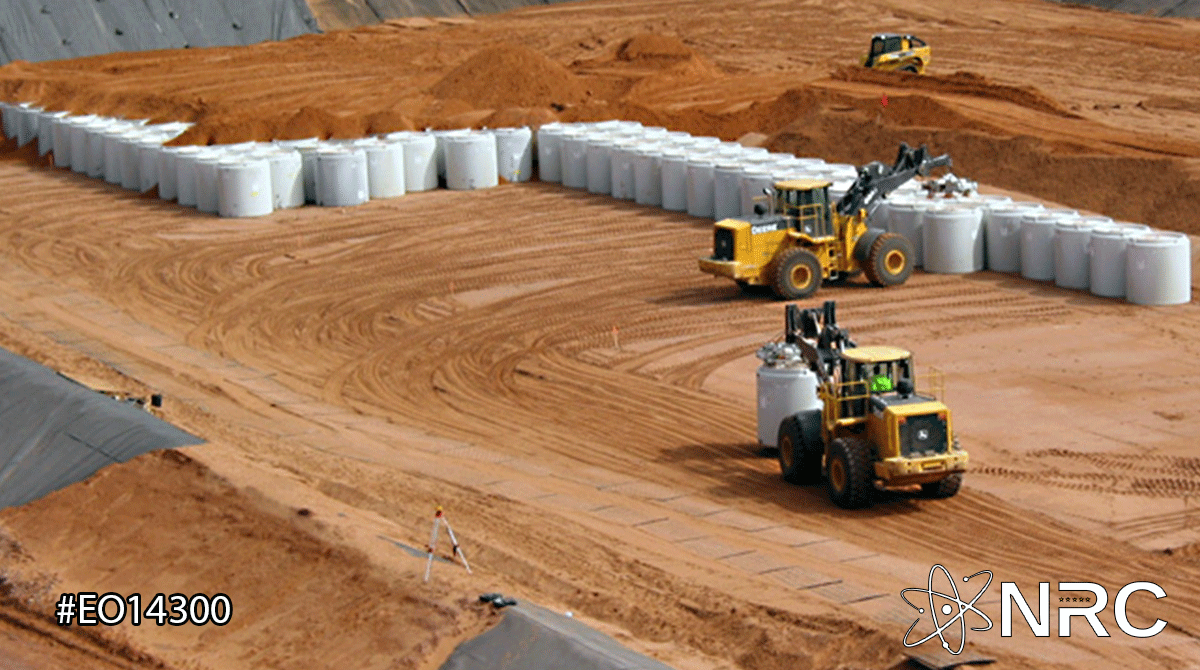
For decades, the most radioactive category of low-level waste in the U.S. has had a disposal plan that exists only on paper: a deep geologic repository that was never built. Late last week, the Nuclear Regulatory Commission (NRC) moved to replace that plan with one that can actually be licensed.
The agency proposed a sweeping update to its Part 61 regulations that would, for the first time, establish a clear regulatory pathway for disposing of Greater-Than-Class-C (GTCC) waste—higher-activity material generated by commercial nuclear operations, medical procedures, and industrial uses that is currently stranded at reactor sites, sealed-source facilities, and Department of Energy (DOE) locations across the country. “The existing Part 61 framework directs it to a deep geologic repository that does not currently exist, and this current framework that we have is a regulatory dead end. It’s not a disposal pathway,” NRC Chairman Ho Nieh told reporters during a virtual roundtable held on June 25, the same day the proposal was released. “This is the problem that this Part 61 draft rule is solving.”
At the technical core of the proposal is a shift in how the NRC decides what can be disposed of and where. Rather than classifying waste by its origin, the proposed rule would scale disposal requirements to the actual radiological hazard of the material, using site-specific, risk-informed analyses to match waste streams to appropriate disposal depths and engineered barriers. Nieh said the agency has built the technical basis for that approach over several years and concluded that nearly 80% of the GTCC inventory by volume is potentially suitable for near-surface disposal, given site-specific analyses and appropriate safety controls.
“We’re proposing a risk-informed framework that scales requirements to the actual hazards of the waste, not where it came from,” Nieh said. He was emphatic on one point that has dogged previous waste debates: the rule does not reclassify high-level waste. “This rule is not reclassifying waste, it is not relabeling high-level waste as Greater-Than-Class-C. What it is doing, it’s creating a previously unavailable disposal pathway for an array of Greater-Than-Class-C waste streams,” he said.
What GTCC Waste Actually Is—and Where It Sits Now
For an industry that has spent years focused on spent fuel and high-level waste, GTCC occupies an unfamiliar middle ground. It is a small slice of the nation’s low-level waste by volume but an outsized share of its radioactivity. “The vast majority of low-level waste in this country is Class A and B waste, so it’s a small percentage,” said Andrea Kock, director of the NRC’s Office of Nuclear Material Safety and Safeguards. “When you look at the activity, though, it’s most of the activity of the waste in this country.”
The material itself is varied. Nieh pointed to irradiated reactor components such as control rod blades—hardware that has picked up long-lived radionuclides but is not spent fuel. Kock added high-activity resins that can cross the threshold into GTCC, along with sealed radioactive sources used in medical and industrial settings. Some of the higher-activity sources used in cancer treatment fall into the GTCC category and currently sit in storage at hospitals with no disposal route.
Today that waste stays where it was generated. At reactor sites, that means storing material in locations not originally designed for the purpose. “These facilities were not designed to be waste storage facilities, so if you’re storing this stuff at an operating reactor facility, a licensee incurs all the operational, maintenance, and security burdens that are associated with that,” Nieh said.
Pressed on whether the buildup is constraining plant operations, the NRC officials stopped short of describing a crisis but acknowledged that there is a practical limit. “There’s a finite amount of space to store these types of things,” for example, on an Independent Spent Fuel Storage Installation (ISFSI) pad or in portions of a spent fuel pool, Nieh said. Waste that occupies those areas could eventually become an operational constraint. “This pathway would provide relief for when that time comes,” said Nieh.
How the Rule Would Work
Under the proposal, an applicant could tailor a disposal facility to the specific radionuclide content of the waste, with disposal depth scaled to concentration. Lower-activity material could be placed nearer the surface; higher-activity waste would go deeper, behind engineered barriers.
“The new piece is this piece about opening up a pathway for Greater-Than-Class-C waste into a specialized disposal facility,” Kock said. “A facility that’s deeper and has engineered barriers, so that it’s safe. So, that is the only new portion.” The broader risk-informed structure, she added, lets operators dispose of low-level waste according to its actual hazard “rather than having a more prescriptive framework.”
Kock argued the approach is also safer than the status quo of dispersed, indefinite storage. Sealed sources sitting at hospitals and industrial sites, reactor components held on-site, high-activity resins—all of it is currently scattered across the country. “I would argue it’s safer to have them all in a disposal facility,” she said.
The NRC was careful to note the limits of what it can do alone. A disposal site would still have to be developed with the support of a host state before any application could move forward. The rule does not site a facility; it creates the licensing pathway that would govern one, if and when the private sector and a host state agree to build it.
A Back End for the Fuel Cycle
The proposal arrives as part of a broader rulemaking push the NRC launched after an executive order issued in May 2025, and Nieh framed the waste rule as a deliberate piece of national nuclear strategy rather than a standalone fix. He tied it directly to the DOE’s Nuclear Lifecycle Innovation Campus concept, which envisions integrated regional hubs that span the entire nuclear fuel cycle, from enrichment, fabrication, and reprocessing on the front end to advanced reactor deployment and waste disposition on the back end.
“Closing the lifecycle really requires both ends to work,” Nieh said. A predictable NRC disposal pathway for GTCC waste, in his framing, is the back-end licensing piece needed to pair DOE’s economic and infrastructure investments with safety frameworks that are “credible, predictable, and timely.”
Asked whether DOE had helped shape the rule, Nieh said the proposal drew on both interagency coordination and the NRC’s own multiyear technical work, including analyses from the Center for Nuclear Waste Regulatory Analyses and technical input dating back to at least 2019. The two agencies operate in separate lanes, Nieh said—DOE promoting and investing in technology, the NRC developing independent safety licensing—“but heading toward the same destination, which is America leading the world again in nuclear energy.”
The rule is also built with newer technologies in mind. New reactor designs will generate new waste streams, and commercial interest in reprocessing is growing. Kock noted the NRC recently issued a separate proposed rule under its Part 70 licenses, out for comment, that would establish a reprocessing framework. “If we should get such an application, we’ll be prepared to review that and make sure it’s done safely,” she said.
The proposed rule will be open for public comment for 45 days after it publishes in the Federal Register, under Docket ID NRC-2011-0012, and the agency plans to hold a public meeting on it. For waste that has spent years with no place to go, the comment period is the first step toward a destination that, until now, existed only in regulation.
—Aaron Larson is POWER’s executive editor.
Sentinel — Human
The analysis is grounded in specific regulatory facts and incorporates nuanced expert commentary, suggesting human journalistic input focused on navigating complex policy details.