March 23, 2026
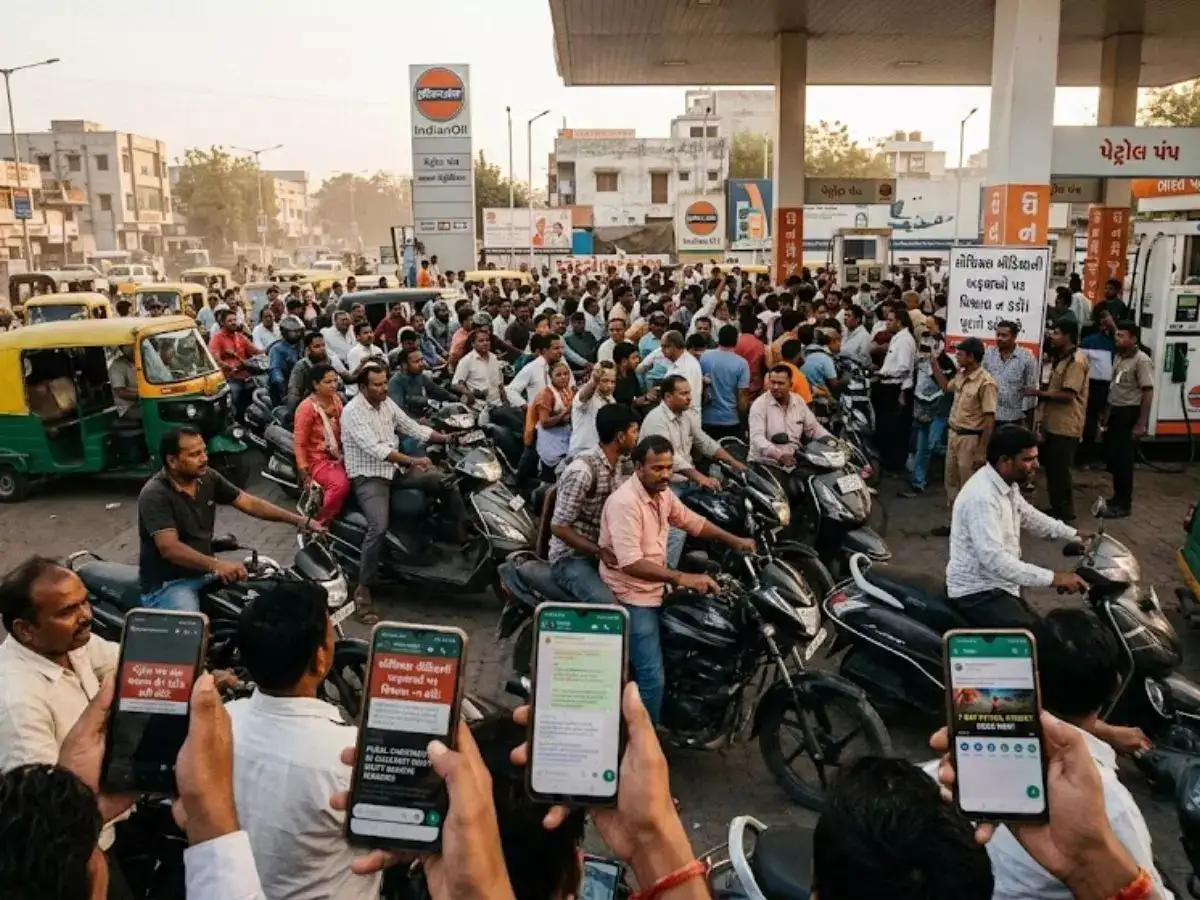
Japan K Pathak, Gandhinagar: While the government and oil company officials deny any oil supply constraints, the petrol pump owners and dealers have said that there have been supply issues since last Friday and they cumulatively resulted into dry outs at several pumps, resulting into widespread local media coverage and panic among public.
The dealers who made representation before the Surat district collector told what the dealers in various parts of Gujarat have been facing since Friday.
‘Amid the war situation and rising crude prices, oil companies introduced an advance payment system. Dealers even started paying in advance, but due to losses to oil companies linked to increasing crude oil prices and depreciation of Rupees against U.S. Dollar, they curtailed supply. They would send one tanker when we demanded two. They would delay supply. When a holiday is coming, supply is needed more a day before, but they would not provide it,’ a dealer association office bearer said.
‘Earlier, without orders, they would send stock overwhelmingly and we would buy. Today, we pay in advance, but they don’t send timely supply. Dealers are ready to sell if they get stock from the company. If dry-out happes to a petrol pump, the dealers should not be blamed for it.’
‘If supply is curtailed, what should we do? We seek guidelines from the government. There has to be clarity regarding indent process and supply,’ another dealer said.
‘On Saturday at 5 pm, the oil company’s supply depot shut and Sunday was a holiday. Many petrol pumps did not get petrol or diesel even when orders were made on Saturday. At many pumps on Monday, there is no petrol or diesel and there is pending load. Today, with additional load, when the depot is closed, more pumps will be affected, and people would think there is a shortage and start stocking,’ he added.
‘Till now, people were not in panic and they believed in the government. However, the situation now is that companies conveyed on Friday evening that dealers would need to make advance payment to get stock. Those who couldn’t make payment on Saturday and Sunday sold Friday-procured stock, and some pumps also ran dry on Sunday. Now on Monday, when people have made payment in advance, the stock is not loaded. People then think that there is a shortage.’
A dealer from Rajkot speaking about “dry outs” at several fuel stations in the city, stated that it was a result of logistical and banking delays rather than a genuine supply shortage.
According to him, the primary reason some pumps ran out of stock was the Saturday-Sunday weekend(Saturday was public holiday for Eid), during which many dealers were unable to process payments to oil companies. This led to a backlog where orders could not be placed or fulfilled in time. He further noted a significant shift in industry practice: where dealers previously operated on credit—receiving fuel in the morning and paying in the evening—the system has now moved toward mandatory advance payments, complicating the procurement process for some.
The President highlighted that the current delays are also tied to a massive spike in demand that has overwhelmed delivery capacities.
In some instances, he said, orders for 70 trucks were placed when the daily fulfillment capacity was only 35 trucks. A shortage of rental trucks also hindered the movement of fuel, though dealers who own their own transport vehiclesfaced fewer disruptions.
He noted that while some pumps receive fuel daily, others are waiting two days, creating an inconsistent flow.
It’s worth noting that Indian oil marketing companies (OMCs) are facing mounting pressure as a sharp rise in crude oil prices, coupled with a weakening rupee, impacts their margins. However, despite these challenges, retail fuel prices have remained stable, offering relief to consumers.
Crude oil prices have surged significantly amid tensions in West Asia. The Indian crude basket averaged $69.01 per barrel in February 2026, rising sharply to around $117.09 per barrel in March. Similarly, global Brent crude has climbed to about $112 per barrel, marking a steep increase over a short period.
At the same time, the Indian rupee has depreciated against the US dollar, touching 93.49 on March 21, compared to 91.07 on February 28, further increasing the cost of imports.
Industry estimates suggest that every $1 increase in crude prices raises India’s annual oil import bill by around ₹16,000 crore, amplifying financial pressure on oil companies.
Reports indicate that the combined impact of higher crude prices and currency depreciation has led to rising input and transportation costs. During the period between August 2025 and February 2026, when crude prices ranged between $62 and $69 per barrel, companies reportedly earned healthy margins—approximately ₹5–10 per litre on petrol and ₹8–15 per litre on diesel. However, the recent surge has reversed the situation. Current estimates suggest under-recoveries of around ₹20 per litre on petrol and up to ₹40 per litre on diesel, significantly affecting profitability.
To partially offset costs, oil companies have increased prices of premium petrol (by about ₹2 per litre) and bulk diesel (by around ₹22 per litre), while keeping retail pump prices unchanged.
Despite rising costs, petrol and diesel prices for consumers have remained unchanged since February 2022. In Delhi, petrol continues to be priced at ₹94.77 per litre and diesel at ₹87.67 per litre. The government, it is learnt is not going to hike prices untill barrel price touches 130 USD.
This stability has provided relief to consumers but has shifted the burden onto oil marketing companies. Additional factors such as higher freight, insurance, and war-risk premiums have further increased operational costs.
Brokerage firms have flagged potential financial stress if high crude prices persist. Reports suggest that if Brent crude remains above $100 per barrel, HPCL could slip into losses, while profits of Indian Oil and BPCL may decline significantly.
A prolonged period of under-recoveries could impact cash flows, increase debt levels, and potentially necessitate policy interventions such as subsidy adjustments or duty cuts. DeshGujarat
Leave a Reply
Related Stories
Reports on Closure of Few Petrol Pumps Unconfirmed and will be Verified: Officials
Two More Indian LPG Tankers Cross Strait of Hormuz; Progressing to Reach Gujarat Ports
No Fuel Shortage; Rajkot Dealers Association Chief Cites New Payment System, Logistic Hurdles
Rising Crude, Falling Rupee Put Pressure on Oil Marketing Companies
Petrol Pump Association Chief Debunks Fuel Shortage Rumors Amid Panic Buying Queues
Panic Queues at Petrol Pumps after Very Few Outlets Found Shut Due to Supply Constraints
Recent Stories
- Rahul Gandhi Visits Vadodara, Attends Adivasi Adhikar Samvidhan Sammelan
- Residents Allege Disturbed Areas Act Violation in OP Road Societies in Vadodara; Submit Memorandum to Collector
- Land Acquisition Speeds Up for Four-Laning of Ankleshwar-Burhanpur Highway
- Rush for LPG to PNG switch: AMC issues hundreds of new permits for pipeline laying
- Reports on Closure of Few Petrol Pumps Unconfirmed and will be Verified: Officials
Facts Only
Petrol pumps in Gujarat ran dry on Monday, March 23, 2026, causing panic among consumers.
Dealers reported supply issues starting Friday, March 20, 2026, due to oil companies' advance payment system.
Oil companies introduced mandatory advance payments, replacing the previous credit-based system.
Some dealers could not process payments over the weekend (Saturday-Sunday holiday), leading to stock shortages.
Dealers in Surat and Rajkot cited delayed or reduced tanker supplies from oil companies.
The Indian crude basket price surged from $69.01 per barrel in February 2026 to $117.09 in March 2026.
The Indian rupee depreciated from 91.07 to 93.49 against the US dollar between February 28 and March 21, 2026.
Oil companies face under-recoveries of ₹20 per litre on petrol and up to ₹40 per litre on diesel.
Retail fuel prices in Delhi remain unchanged at ₹94.77 per litre for petrol and ₹87.67 per litre for diesel since February 2022.
The government is reportedly unwilling to hike fuel prices until crude reaches $130 per barrel.
Some dealers own transport vehicles, reducing disruptions, while others rely on rental trucks, facing shortages.
Industry estimates suggest HPCL could incur losses if Brent crude remains above $100 per barrel.
Executive Summary
Petrol pumps in Gujarat experienced dry-outs on Monday, March 23, 2026, leading to panic among consumers. Dealers reported supply disruptions since Friday, attributing them to oil companies' advance payment system and logistical delays. Oil companies, facing financial strain due to surging crude prices and a weakening rupee, introduced mandatory advance payments, complicating procurement for dealers. Some pumps ran dry due to weekend closures and payment processing delays, while others faced inconsistent supply due to high demand overwhelming delivery capacities. Despite these challenges, retail fuel prices remained stable, with the government reportedly unwilling to hike prices until crude reaches $130 per barrel. Industry estimates suggest oil companies are now facing under-recoveries of ₹20 per litre on petrol and up to ₹40 per litre on diesel, raising concerns about financial stress if high crude prices persist. Dealers and officials offered conflicting explanations, with some citing logistical issues and others denying any shortage.
The situation highlights broader economic pressures, including rising crude prices—from $69.01 in February to $117.09 in March—and a depreciating rupee, which has increased import costs. While consumers benefit from stable fuel prices, oil marketing companies face mounting financial strain, potentially impacting their operations and profitability. The government's stance on price stability contrasts with the operational challenges faced by dealers and oil companies, creating a complex dynamic between supply chain logistics, financial viability, and public perception.
Full Take
The strongest version of this narrative highlights a systemic strain in India's fuel supply chain, where rising crude prices and currency depreciation have forced oil companies to shift to advance payments, disrupting the traditional credit-based procurement system. Dealers' inability to process payments over the weekend exacerbated shortages, while oil companies' financial pressures—under-recoveries of ₹20-40 per litre—underscore the fragility of the current pricing stability. The government's refusal to hike retail prices, despite mounting costs, reflects a political calculation to shield consumers from inflationary pressures, even as it risks squeezing oil marketing companies' profitability.
Patterns detected: ARC-0024 Ambiguity (conflicting explanations from dealers vs. officials), ARC-0043 Motte-and-Bailey (denials of shortage while acknowledging logistical delays).
Root cause: The narrative echoes historical cycles of energy market volatility, where geopolitical tensions (West Asia) and macroeconomic factors (currency depreciation) disrupt supply chains. The unstated assumption is that price stability is sustainable indefinitely, despite financial strain on oil companies—a paradigm that may collapse if crude prices remain elevated.
Implications: Consumers benefit from stable prices, but oil companies face cash flow crises, potential debt increases, and operational disruptions. Second-order consequences include possible fuel rationing, delayed infrastructure investments, or government interventions like subsidies or duty cuts, which could strain public finances.
Bridge questions: How long can oil companies sustain under-recoveries without passing costs to consumers? What contingency plans exist for prolonged supply chain disruptions? Would a gradual price hike mitigate panic better than abrupt adjustments?
Counterstrike scan: A coordinated influence campaign might exploit public panic to pressure the government into price hikes or subsidies, amplifying dealer grievances while downplaying oil companies' financial risks. The actual content does not match this pattern, as it presents multiple perspectives and acknowledges uncertainty.
Sentinel — Human
The article shows strong signs of human authorship, with regional nuances, natural language inconsistencies, and specific attributions that are unlikely to be AI-generated.