A former CIA officer is suing his former employer over its bungling on Iraq’s phantom nuclear, biological and chemical weapons
Jerry Watson wasn’t always at war with the CIA.
His home office is lined with accolades and honors from a 31-year CIA career running clandestine operations and producing analysis for policymakers: a DNI national intelligence award, an exceptional service medallion, intelligence commendation medal, exceptional performance awards, even a medal for an injury in Iraq.
Watson served as a CIA operations officer for 21 years, and an analyst for 10. He led two branches at the National Counterterrorism Center, and served in an alphabet soup of other divisions and centers.
His career cratered in the WMD debacle in Iraq, however. He backed CIA misjudgments before the 2003 invasion, but his relentless post-war effort to force a reckoning for the infamous Curveball case—in which the agency swallowed the tale of an Iraqi refugee who claimed Saddam Hussein had mobile biological warfare labs—made him a pariah at Langley. In the end, he was banished to a desk in a storage room among cardboard boxes and file cabinets, and was never promoted again.
“They treated him like shit,” Larry Fox, who spent 33 years at the CIA, mostly as a senior analyst, told me. “I’d never seen that happen before. Never, ever. The problem was, Jerry was very good, and very tenacious. He didn’t give up. And he pissed them off.”
More than two decades later, Watson still hasn’t given up. He sued the CIA last December so that he can publish Absence of Evidence, his 850-page narrative of the Curveball disaster, assuming he can find a publisher.
The CIA is trying to get the lawsuit tossed out until it can determine if the massive manuscript contains classified information. Watson argues that any offending material should be immediately declassified. After all, the CIA declared Curveball, codename for the source, a fabricator back in 2004 and withdrew all WMD reports based on his information.
“I agreed to ‘protect sources and methods,’ not help hide incriminating intelligence of the agency’s incompetence, fraud and mismanagement,” Watson told me.
Why revisit the WMD fiasco now? Because the internal fighting, inter-service squabbling, political toadying and shoddy analysis were worse than we knew. Because the CIA is still hiding details from one of the worst failures in its history. And because we owe it to those who try, even belatedly, to bring truth to power.
Watson calls himself a whistle blower. His critics see him as more of a gadfly, saying he didn’t recant on Curveball until it was too late. “He never stood up when it counted,” said a former CIA officer who fought unsuccessfully to block the bad intel before the war. “He got it completely wrong when it mattered.”
Now 68 and retired, William Gerald (his parents nicknamed him Jerry and it stuck) Watson grew up in a large family in Tustin, a Los Angeles suburb near the beaches of southern California. He grew long hair and a beard, loved surfing, and graduated from UCLA in 1984 with a Bachelor’s degree in political science.
At loose ends, he fired off job letters to the FBI, DEA, Secret Service and other agencies. When his father, an attorney, tore a CIA ad out of a newspaper, he applied to Langley as well. The CIA recruiter was impressed by Watson’s initiative during a gap year, when he had backpacked around Europe and Morocco, and passed him up the line.
Watson joined the CIA in April 1986, although he didn’t tell his father about his true employment for years. After espionage and language training, he deployed as a case officer under diplomatic cover in the U.S. embassy in Mexico City. His tour was cut short after two years when a secretary in the CIA station leaked his name to Cuban intelligence, and he returned to Washington.
His wife, DeNeige, had joined the CIA as an analyst a year before he began, and they met in a training exercise at a mock diplomatic cocktail party. They married in 1988 (a practice now so common that the CIA website has a page dedicated to “Love at Langley”) and went to Mexico City together.
Denny, as she is known, not only supported her husband’s undercover work. She joined in at times.
“We did a number of operations together,” Watson told me recently from their home outside Denver. “That’ll test your marriage.”
She would spend 27 years in the CIA and became one of the few CIA officers to present the President’s Daily Brief under both Democratic and Republican presidents. She delivered the highly-classified briefing to Vice President Al Gore in the Bill Clinton administration and Defense Secretary Donald Rumsfeld in the George W. Bush administration.
“There were times when I was working late into the night helping to write the PDB, and my wife had to get up at dawn to give the PDB briefing, and we would literally pass in the kitchen” in their then-home in Sterling, Va., Watson said.
After Mexico, Watson moved to Domestic Collections, now called National Resources, the division that debriefs Americans who travel overseas and may have access to useful information. That soon morphed into tougher work: chasing down foreigners the CIA wanted to recruit.
Armed with four passports under different names, Watson traveled the Middle East and elsewhere under commercial cover as a businessman from 1992 to 1994, seeking sources on nuclear proliferation. Among them was a former Soviet physicist whom he flipped during a boat ride off Istanbul.
Watson’s cover was blown again by Harold James Nicholson, an instructor at The Farm, the wooded CIA training camp in Tidewater Virginia. Nicholson was convicted of espionage in 1997 for selling the identities of case officers, and other classified material, to Russian intelligence. (In 2011, he was convicted of continuing to spy for Moscow while in prison, a dubious first for the CIA.)
Watson’s double outing made it more difficult to work overseas. So he shifted from operations to analysis, one of relatively few to cross the divide at the time. The two directorates were even housed in separate wings of the original headquarters building.
He was issued a new alias, and new State Department cover, and became a liaison with the United Nations weapons inspectors who were scouring Iraq for illicit chemical, biological and nuclear weapons or programs after the 1991 Gulf War.
Every few days he’d go up to New York to give U.S. intelligence to UNSCOM, as the inspectors’ group was known. It was famously riddled with spies, as well as scientists and subject experts, from around the world. He enjoyed the work and fit right in.
He first visited Iraq in 1996 as part of a U.N. inspection team focused on surface-to-air missiles. He returned in 1998 to investigate UAVs, unmanned aerial vehicles. Inspectors worried that the Iraqis had modified a small trainer plane in order to spray chemical or biological poisons.
“We assumed they were doing this for WMD. It wasn’t until much later that I realized we were wrong,” he said.
In December 1998, Clinton ordered four days of air strikes, arguing that Saddam had violated U.N. resolutions and illegally blocked the U.N. inspections. When the bombing ended, Saddam refused to allow the inspectors back into Iraq.
The move proved disastrous for the CIA.
“At that point the intelligence community was heavily dependent on UNSCOM information,” Watson recalled, echoing other assessments. “So we were basically blind when it was kicked out.”
UNSCOM was disbanded in late 1999, but not before it had posted on the internet a 463-page compendium that detailed what it found in its 250 inspections, as well as what it didn’t find. Those were categorized as unresolved WMD issues.
Buried in them was a question as to whether Iraqi engineers had modified trailer trucks to secretly brew deadly germs, viruses and other bio-warfare, or BW, agents. A single Iraqi document from before the 1991 war had raised the issue, but no evidence of the so-called mobile labs was ever found.
Among those who read the U.N. report was an Iraqi chemical engineer named Rafid Ahmed Alwan al-Janabi. He fled Saddam’s Iraq for Germany in 1999, and while at the Zirndorf refugee processing camp near Nuremberg, he was debriefed by officers from the BND, the German foreign intelligence service.
Al-Janabi told them he had supervised a mobile lab project starting in 1995, and that it began production in 1997. He appeared to confirm the suspected BW program, although his details changed so often that his BND handler gave him a copy of Perry’s Chemical Engineers’ Handbook, known as the engineers’ Bible, to jog his memory and polish the reports.
The BND did not vet al-Janabi’s background, vouch for his reliability, or confirm his information. But it shared its cleaned-up reports with the Munich branch of the U.S. Defense Intelligence Agency.
The DIA’s Defense Humint Service ultimately put 95 reports based on the BND information into U.S. intelligence streams, and the CIA filed six.
Britain’s Secret Intelligence Service, or MI6, did its own reports and they issued the Iraqi informant, who was then known only by the crypt RED followed by six numbers, his infamous codename: CURVE BALL, usually shortened to one word.
The BND furnished him with a German visa and a cheap apartment in Erlangen, near Nuremberg. When he complained he was lonely, they moved his girlfriend, Karima, up from Morocco to live with him. But he struggled to hold an ordinary job. He bounced from the Princess-Garden Chinese restaurant to an all-night pretzel bakery, and then to a Burger King.
He began demanding more money, and showed up for interviews drunk, hung over, or not at all. On Sept. 8, 2001, the BND cut ties with their troublesome source due to doubts about his credibility.
Hinge Moment
Three days later the world changed when terrorists flew four hijacked passenger jets into the World Trade Center in New York, the Pentagon and a Pennsylvania field. After the horrors of 9/11, the Bush White House oddly focused on Iraq as the immediate terror threat. The CIA refuted White House assertions that Saddam had backed Osama bin Laden. But it issued increasingly dire reports of Iraq’s secret WMD stockpiles and programs.
The strongest apparent evidence came from Curveball, post-war U.S. investigations found. Indeed, the unverified reports from the German source of anthrax-brewing, smallpox-spewing trucks became the linchpin of the Bush administration’s case for war.
“So policymakers think he’s still a credible source and nothing could be further from the truth,” Watson said. “This guy is the centerpiece of the WMD assessment on Iraq and he’s working at Burger King. I’m still amazed when I think about it.”
After the 9/11 attacks, Watson was given a BW brief at a newly formed CIA center called WINPAC that focused on foreign weapons threats. He soon read the Defense Humint reports on Curveball. His senior colleague, Beth Kinney, believed in the source wholeheartedly, and Watson did too. At no point did he raise any objections about the material.
He began to doubt other intelligence, however. In September 2002, he flew to Australia because an Iraqi agent had tried to buy flight planning software which, the CIA feared, a UAV could use to launch a biological or chemical attack on the United States.
“We looked at all his emails and realized it was inadvertent,” Watson said. “He didn’t know what he was buying. It was just a link on a website for something else.”
Watson was overruled when he tried to get the false CIA report on the UAVs pulled from a speech that Bush gave in Cincinnati that October, as well as from the National Intelligence Estimate sent to Congress later that month.
“I was furious,” Watson said. His superiors said they wouldn’t “flip flop” on their warnings to the White House.
By then, the British were getting nervous about Curveball. Two top officials in the engineering center where al-Janabi had worked were SIS sources, codenamed Red River and North Pole. Both had already fled Iraq, and both adamantly denied any mobile BW program. A CIA officer had even offered $50,000 to Red River to confirm their existence. He refused.
Inside the CIA, bitter infighting broke out when Margaret Henoch, a senior operations officer in the European Division, discovered glaring gaps in Curveball’s account and confronted WINPAC analysts over their unfettered embrace of an unvetted source. Henoch also challenged the intelligence in high-level meetings, but was overruled.
The White House was not informed of the growing doubts. “We know that Iraq, in the late 1990s, had several mobile biological weapons labs,” Bush said in his State of the Union address on Jan. 28, 2003.
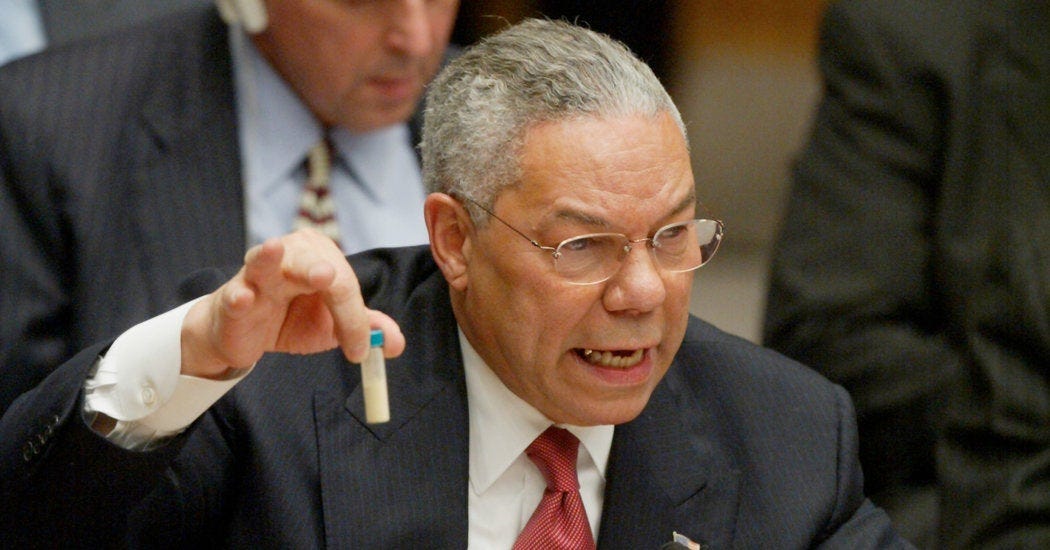
A week later, Secretary of State Colin Powell warned the U.N. Security Council that “one of the most worrisome things” in Iraq were mobile BW production facilities. The source, he asserted, was “an eyewitness, an Iraqi chemical engineer who supervised one of these facilities.” And so on.
George Tenet, the director of Central Intelligence, sat behind Powell during the speech. Tenet did not tell him that the CIA had never interviewed the supposed eyewitness.
U.S.-led forces invaded Iraq a month later and toppled Saddam. Military searches for WMD proved fruitless, so Tenet hired David Kay, a former U.N. weapons inspector from Texas, to head the hunt in Iraq.
Watson still believed in the mobile labs, and when two suspect trucks were found in Iraq, he co-authored a classified White Paper in May 2003 that called them “strikingly similar” to those Curveball had described. The White House, thrilled that supposed evidence of WMD finally had been found, ordered the paper released to the public.
“We know that Iraq, in the late 1990s, had several mobile biological weapons labs,” Bush said in his State of the Union address on Jan. 28, 2003.
The DIA separately sent a team of engineers and other experts to examine the trucks. They concluded the fermentors and other equipment could not brew biological agents.
“And I said, ‘Oh shit, we can’t publish the White Paper,’” Watson recalled. “And I was told, ‘We’re publishing.’ I’m like, ‘This is crazy. This is going to be a major embarrassment for everyone.’ I said ‘I have to go to Iraq.’
“So I went over and when I looked at the trailers, a Navy captain I knew from the Naval Medical Research Institute was there and he told me ‘Some idiot in Washington wrote a paper saying these were the BW trailers.’ And he showed me why that was impossible, and it took me only five minutes to realize we were absolutely wrong. But the paper was published anyway.”
A few weeks later, Watson’s face was cut badly when his Humvee was rammed in an insurgent attack. Afterward, he extended his stay in Iraq.
“I wanted to get to the bottom of the BW issue. And I wanted to heal before my wife saw me,” he said.
Going Deeper
He began detaining Iraqi officials who Curveball had said worked in the BW program. To Watson’s surprise, the source’s story quickly began to unravel. Curveball didn’t know, for example, that the engineering center where he supposedly worked until 1999 had changed its name in 1997.
Watson returned to Langley that summer and read deeper into the case. He found British and German cables and reports in the files warning that Curveball might be a fabricator.
“And I just gasped. This was the first time I’d seen this… I was a believer of Curveball before the war, and didn’t know anything was wrong.” he said. “But then I became a disbeliever.” ###
Next, in Part 2: Jerry Watson returns to Iraq, intent on getting to ground truth on Iraqi WMDs, and discovers the real facts of Curveball’s origins and spotty work history.
Pulitzer Prize winner Bob Drogin spent 38 years at the Los Angeles Times, where he was a national, foreign and Washington correspondent. He helped break the Curveball story in 2004, and is the author of Curveball: Spies, Lies and the Conman who Caused a War, published in 2007 by Random House.
Timely, very timely.
Love to see top-notch reporters like Bob Drogin find a new home on SpyTalk.
Facts Only
Jerry Watson, a former CIA officer with 31 years of service, is suing the CIA to publish his manuscript, *Absence of Evidence*, about the Curveball case.
Watson initially supported the CIA's assessment of Curveball, an Iraqi chemical engineer who claimed Saddam Hussein had mobile biological weapons labs.
Curveball, later identified as Rafid Ahmed Alwan al-Janabi, provided intelligence to German intelligence (BND), which was shared with U.S. agencies.
The BND did not vet Curveball's background or confirm his claims, yet his reports were used in U.S. intelligence assessments.
Curveball's credibility was questionable; he changed his story frequently, was unemployed, and was eventually cut off by the BND in September 2001.
Despite doubts, Curveball's claims became central to the Bush administration's case for the 2003 Iraq War.
Watson later discovered inconsistencies in Curveball's story and attempted to expose the flaws, leading to his marginalization within the CIA.
Watson was reassigned to a storage room and never promoted again after challenging the agency's handling of the Curveball case.
The CIA is resisting the publication of Watson's manuscript, citing potential classified material, though Watson argues it should be declassified.
Watson's lawsuit highlights ongoing disputes over accountability for the CIA's intelligence failures leading to the Iraq War.
The article details Watson's career, including his work as a CIA operations officer, analyst, and liaison with U.N. weapons inspectors.
Watson's post-war investigations in Iraq confirmed that Curveball's claims were fabricated, but his efforts to correct the record were resisted by superiors.
Executive Summary
Jerry Watson, a former CIA officer with 31 years of service, is suing the agency to publish his 850-page manuscript, *Absence of Evidence*, detailing the CIA's handling of the Curveball case—a key source in the flawed intelligence leading to the 2003 Iraq War. Watson, who initially supported the CIA's assessment of Curveball's claims about Iraqi mobile biological weapons labs, later became a critic after discovering inconsistencies in the source's story. Curveball, an Iraqi chemical engineer named Rafid Ahmed Alwan al-Janabi, provided unverified intelligence to German intelligence (BND), which was then shared with U.S. agencies. Despite doubts about Curveball's credibility—including his erratic behavior and changing accounts—his claims became central to the Bush administration's justification for war. Watson's efforts to expose the flaws in the intelligence led to his marginalization within the CIA, culminating in his reassignment to a storage room. The CIA is now resisting the publication of Watson's manuscript, citing potential classified material, though Watson argues that the information should be declassified, as Curveball was discredited in 2004. The case highlights ongoing tensions over accountability for one of the CIA's most significant intelligence failures.
The article also explores Watson's career, from his early operations in Mexico to his role as a liaison with U.N. weapons inspectors in Iraq. His post-war investigations revealed that Curveball's claims were fabricated, and he faced resistance from superiors when attempting to correct the record. The broader context includes the CIA's reliance on flawed intelligence, inter-agency disputes, and political pressures that shaped the lead-up to the Iraq War. Watson's lawsuit underscores unresolved questions about transparency and the CIA's willingness to confront its past mistakes.
Full Take
The strongest version of this narrative is that Jerry Watson represents a rare insider attempting to hold the CIA accountable for one of its most consequential failures—the flawed intelligence used to justify the Iraq War. His lawsuit to publish *Absence of Evidence* is framed as a fight for transparency, with Watson arguing that the CIA is suppressing embarrassing details rather than protecting legitimate secrets. The article gives Watson credit for his persistence, even as it acknowledges his initial role in supporting the Curveball intelligence. The broader pattern here is one of institutional resistance to accountability, where whistleblowers or critics are sidelined rather than engaged. The CIA's response—delaying publication under the guise of classification review—fits a familiar script of bureaucratic stonewalling.
Patterns detected: ARC-0024 Ambiguity (CIA's use of classification to obscure embarrassment), ARC-0043 Motte-and-Bailey (shifting from "protecting sources" to hiding incompetence).
The root cause of this narrative is the tension between institutional self-preservation and public accountability. The CIA's handling of the Curveball case reflects a paradigm where admitting failure is seen as more damaging than the failure itself. The assumptions here are that transparency would undermine trust in the agency and that internal critiques are best contained. Historically, this echoes other intelligence failures—like the Bay of Pigs or Vietnam—where institutional inertia and political pressures led to disastrous outcomes.
The implications for human agency are significant. Watson's story suggests that even well-intentioned insiders face steep barriers when challenging powerful institutions. The costs are borne by those who seek truth, while the benefits accrue to those who maintain the status quo. Second-order consequences include eroded public trust in intelligence agencies and a chilling effect on future whistleblowers.
Bridge questions: What would it take for the CIA to meaningfully reckon with its past failures? How might Watson's manuscript change the public's understanding of the Iraq War if published? What structural reforms could prevent similar intelligence failures in the future?
Counterstrike scan: If this were part of a coordinated influence campaign, the playbook would involve framing Watson as a heroic truth-teller while portraying the CIA as a monolithic, unaccountable entity. The actual content aligns with this pattern but does not appear to be part of a broader manipulation effort. The article's focus on Watson's personal story and the CIA's bureaucratic resistance is consistent with legitimate investigative journalism rather than a coordinated attack.