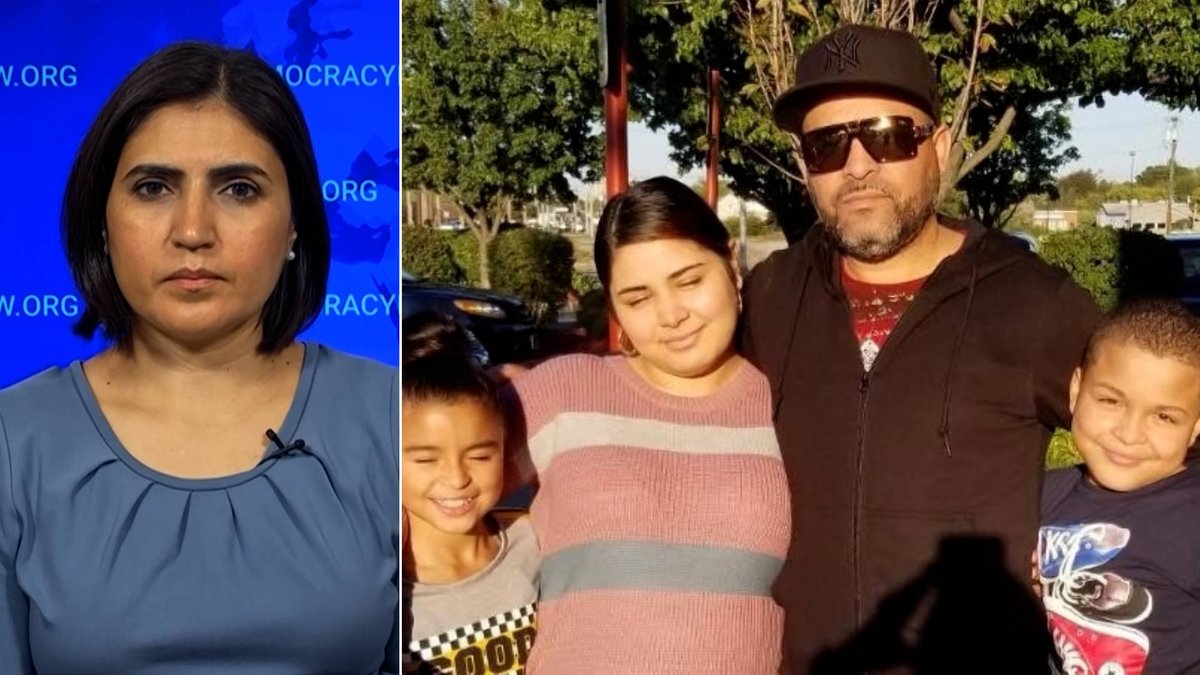
The family of Geraldo Lunas Campos is suing over the 55-year-old Cuban immigrant’s death at an ICE detention center in Texas earlier this year, with a local coroner ruling his death a homicide from asphyxia. The Department of Homeland Security said Lunas Campos had attempted suicide, but witnesses said he died after being restrained by multiple guards. The family’s lawsuit names four guards and multiple private companies overseeing the jail.
Perla Trevizo, a reporter with the ProPublica-Texas Tribune investigative unit, says Lunas Campos had a history of mental health issues and that he had complained before his death about lack of access to his medication.
“Witnesses say that they believe he was shackled. There were several guards. They took him down,” Trevizo says.
Transcript
AMY GOODMAN: This is Democracy Now!, democracynow.org. I’m Amy Goodman.
As we continue on the issue of immigration enforcement, we’re going to talk to the — about the family of Geraldo Lunas Campos. He was a 55-year-old Cuban immigrant whose death in ICE custody was ruled a likely homicide. The family is suing four guards and the companies that oversaw Camp East Montana — a sprawling immigration detention tent camp at the Fort Bliss military base in El Paso, Texas — at the time of Campos’s death. The Washington Post reports his family is seeking more than a million dollars in damages from Acquisition Logistics, the company that oversaw Camp East Montana when Campos was killed; Akima, which employed the guards accused of killing Campos; and NANA Regional Corporation, Akima’s parent company.
Earlier this year, an autopsy report released by El Paso County Medical Examiner’s Office concluded Campos died from asphyxia caused by neck and torso compression, ruling his death a homicide. Before his death, Campos had complained of not getting the right dosage of medication to treat his bipolar disorder and anxiety. He had also expressed having suicidal thoughts. But instead of receiving proper care, Campos was placed in solitary confinement, where guards shackled and handcuffed him, repeatedly putting pressure on his neck and chest until his body went limp.
For more, we go to Philadelphia, where we’re joined by Perla Trevizo, reporter with the ProPublica-Texas Tribune investigative unit, her recent piece headlined “'He Didn't Need to Die.’ How an Immigration Detention Center Repeatedly Failed to Address a Mental Health Crisis.”
Perla, thank you so much for joining us. Tell us what you know.
PERLA TREVIZO: Yeah, so, we — thank you for having me, first of all.
We’ve reviewed nearly 300 pages of an extended medical examiner report that has not been published, or had not been published before. And in it, you know, as you mentioned, we had heard that Geraldo had continued to ask for his medication. That’s actually what led to the altercation, according to witnesses, the day he died. But for the first time, we can see in writing how — you know, we counted at least eight times, from the day he entered Camp East Montana in September to the day he died, he had requested medication that was helping him, you know, with his anxiety, with depression, that would help him sleep better, and yet he was not getting it, including in one of the medical notes, a medical provider notes that it’s on November 10th, and he hadn’t received his medication since November 6th.
We also see that there was a previous suicide attempt in October. And we include more details in the story, but, basically, you know, he had been put in segregation. He had tied a bed sheet to his — you know, wrapped it around his neck, and they were able to talk him out of it. And one of the medical experts we talked to said that, you know, he — based on the notes, it seems that that case was minimized instead of taken as seriously as it should have.
AMY GOODMAN: So, the coroner found homicide by asphyxiation. Explain how Geraldo Lunas Campos died.
PERLA TREVIZO: Yeah, so, what we know — again, the FBI is actually investigating the case, so, you know, there’s still a lot of details that are — you know, that should be coming out. But what we know from witness statements and what has been reported is that he was brought into the segregation unit. They say that he grew combative. You know, once they were about to go in, he refused. Witnesses say that they believe he was shackled. There were several guards. They took him down. And as you said, asphyxia, so it means, like, they put some pressure on his chest, and he stopped breathing. Then medical providers were called. Nurses arrived. Eventually, they call 911. 911 came, and they tried to do CPR and revive him. But at that point, it was too late.
AMY GOODMAN: If you can talk about the medical providers who work there, and now who the family is suing, the levels of responsibility here, and what they’re suing for?
PERLA TREVIZO: So, they’re suing the guards, that you mention, and the companies. I think, you know, it’s been very hard to get information from people who work at the facility. And you have the main contractor that you mentioned, Acquisition, who’s no longer — who has been since replaced, and then contractors under them that, you know, take care of cleaning, food, medical. We’ve tried to reach, you know, for months, to people who either work there or worked there. They’ve been signing nondisclosure agreements. We weren’t able to reach most of them. We were able to talk to one medical provider who used to work at the facility, as well to a current government official.
And I think, you know, one of the biggest takeaways for us is that from the very beginning, you could see that there were concerns about mental health and suicides. Very early on, you start getting calls to 911 talking about people who try to commit suicide. And, you know, the workers, they’re not — the medical providers are not part of the lawsuit, but, you know, our understanding is that they were complaining about, based on these calls, that sometimes they didn’t have oxygen, they didn’t have EKG paper, that they were having minimum resources. So, we know from the beginning that the facility was not fully equipped to deal with the issues that it was facing.
AMY GOODMAN: Talk about the companies that are being sued, all the different levels of this sprawling detention camp.
PERLA TREVIZO: So, Acquisition — I mean, most of the companies have not had prior experience dealing with detention centers. So, this was a Department of Defense, or War, contract. Acquisition was the one that was hired. It was a small company out of Virginia, I think, I believe, veteran-owned, had gotten the main contract. Akima is a company that mostly is known for guard services, so they were providing the guard services for Camp East Montana, as well as other detention centers. Loyal Source is not part of the lawsuit, but Loyal Source is a company that was providing the medical care.
And so, yes, I think you — the issue with private detentions, that you have multiple players that each play a role in, and in this case, the family has decided to sue some of them, including the main contractor and, as you mentioned, the guards that we know were directly involved with the moment he died.
AMY GOODMAN: Perla, we’re going to link to your piece. Perla Trevizo is a reporter with the ProPublica-Texas Tribune investigative unit, her recent piece headlined “'He Didn't Need to Die.’ How an Immigration Detention Center Repeatedly Failed to Address a Mental Health Crisis,” joining us from Philadelphia.
This is Democracy Now!, democracynow.org. Could the Albanian government fall over massive protests that are taking place there, called the Flamingo Revolution, over a deal the Albanian government made with Jared Kushner and Ivanka Trump for a luxury resort on an Albanian island? Stay with us.
[break]
AMY GOODMAN: That was Joan Baez singing “Joe Hill” in 2005 at Camp Casey in Crawford, Texas.
Media Options
Sentinel — Human
The text appears to be sourced from a transcribed news interview regarding a legal case, exhibiting the flow and specific detail characteristic of human-authored investigative reporting.