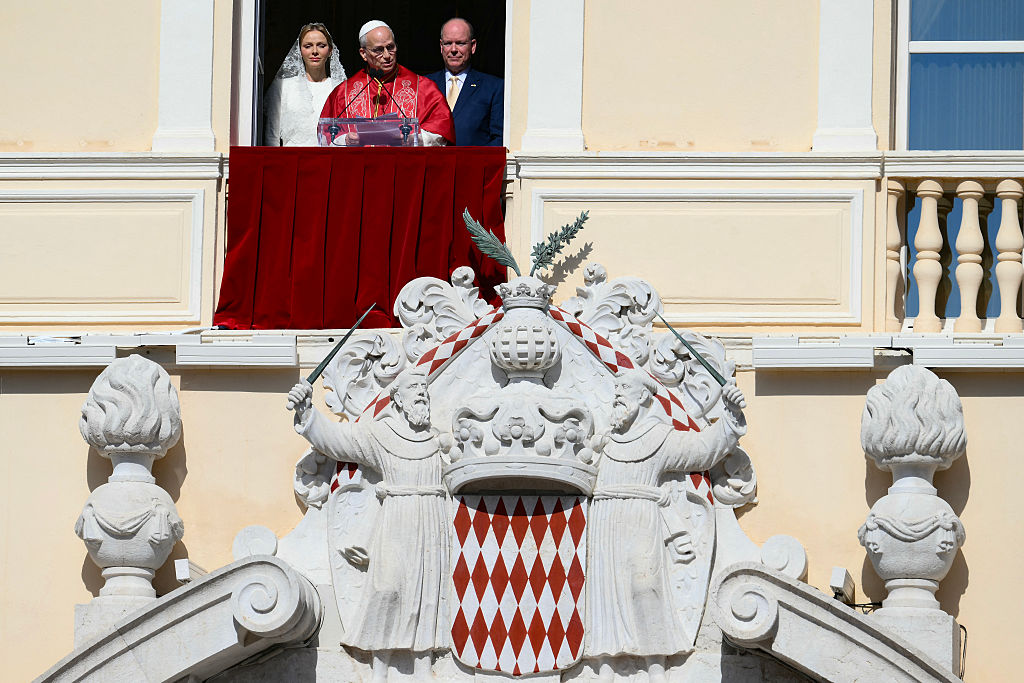
Pope Leo XIV addressed Monaco at the outset of his brief one-day visit there on March 28, telling the tiny micro-state that the “gift of smallness” and a “living spiritual heritage” lets the country “serve the cause of law and justice.”
The Holy Father touched down in the city-state at 9 a.m. The brief journey to Monaco was undertaken by helicopter to ensure the pope would not have to set foot on French soil, thereby absolving him of the institutional obligation to pay a visit to the president of the French Republic.
The pope was welcomed by Prince Albert II and Princess Charlotte; the prince had extended the invitation for the pope to visit the country following a private audience held on Feb. 17th.
Upon the popeʼs arrival a cannon fired a twenty-one-gun salute, church bells pealed in celebration, and the Vatican flag was raised.
In an address from the Palace of Monaco, Leo XIV said the country should be particularly attentive to the need for justice “at a historical juncture when the ostentation of force and the logic of domination harm the world and jeopardize peace.”
"In the Bible, as you know, it is the small who make history!” the pope said.
The Holy Father told the country that “the Catholic faith — which yours is among the few nations in the world to hold as its state religion — places us before the sovereignty of Jesus, a sovereignty that calls upon Christians to become, within the world, a kingdom of brothers and sisters.”
Monaco is the last nation in Europe where Catholicism remains the official state religion. In November of 2025, Prince Albert declined to promulgate an abortion law that would have broadened the grounds for terminating a pregnancy within the principality.
After the meeting between Leo XIV and the prince, there was a meeting with both the prince and princess in the Salon de Famille, followed by an exchange of gifts, the signing of the Book of Honor, and a papal introduction to the royal family.
At the conclusion of the ceremonies, Leo XIV and the prince joined together in prayer.
This story was first published by ACI Stampa, the Italian-language sister service of EWTN News. It has been translated and adapted by EWTN News English.
LIVE UPDATES
LIVE UPDATES
Leo is the first pope to visit the tiny country in nearly half a millennium.
Facts Only
Pope Leo XIV visited Monaco on March 28 for a one-day trip.
The visit was the first papal trip to Monaco in nearly 500 years.
The pope arrived by helicopter at 9 a.m. to avoid setting foot on French soil.
Prince Albert II and Princess Charlotte welcomed the pope upon arrival.
A 21-gun salute, church bells, and the raising of the Vatican flag marked the pope’s arrival.
The pope delivered an address from the Palace of Monaco, emphasizing justice and the "gift of smallness."
Monaco is the last European nation with Catholicism as its official state religion.
In November 2025, Prince Albert declined to promulgate an expanded abortion law.
The pope met privately with the prince and princess, exchanged gifts, and signed the Book of Honor.
The visit concluded with joint prayers between the pope and Prince Albert.
The invitation for the visit followed a private audience between the pope and prince on February 17.
The story was first published by ACI Stampa and adapted by EWTN News.
Executive Summary
Pope Leo XIV made a historic one-day visit to Monaco on March 28, marking the first papal visit to the micro-state in nearly 500 years. The trip was carefully orchestrated to avoid French soil, with the pope arriving by helicopter to bypass diplomatic obligations. Upon arrival, he was greeted by Prince Albert II and Princess Charlotte, who had invited him following a private audience in February. The visit included a 21-gun salute, church bells, and the raising of the Vatican flag. In his address, the pope emphasized Monaco’s "gift of smallness" and its Catholic heritage, urging the nation to champion justice amid global tensions. He highlighted Catholicism’s role as Monaco’s state religion, framing it as a call to brotherhood. The visit also included private meetings, gift exchanges, and joint prayers with the royal family. Notably, Monaco remains the last European nation with Catholicism as its official state religion, and Prince Albert had previously rejected a 2025 abortion law expansion.
The visit underscores Monaco’s unique religious and political identity, blending ceremonial tradition with contemporary moral debates. The pope’s focus on justice and sovereignty reflects broader Vatican priorities, while the logistical avoidance of France hints at diplomatic sensitivities. The event’s symbolism—small nations as moral actors—contrasts with Monaco’s reputation for wealth and exclusivity, inviting reflection on how size and faith intersect with global influence.
Full Take
**Steelman:** The narrative presents Pope Leo XIV’s visit to Monaco as a symbolic affirmation of small nations’ moral agency, leveraging the principality’s Catholic identity to advocate for justice in a fractured world. The logistical care to avoid French soil underscores diplomatic nuance, while the emphasis on Monaco’s state religion highlights its unique role in Europe. The pope’s rhetoric—"the small who make history"—frames the visit as a counterpoint to global power dynamics, appealing to shared values over geopolitical might.
**Pattern Scan:** The framing leans into symbolic contrast—smallness vs. domination, faith vs. secularism—without interrogating Monaco’s own contradictions (e.g., wealth inequality, historical neutrality). The avoidance of French soil, while pragmatically explained, could be read as a subtle diplomatic slight, though the article doesn’t exploit this for emotional effect. The focus on abortion (via Prince Albert’s 2025 decision) introduces a polarizing issue but stops short of moral panic, presenting it as factual context.
**Root Cause:** The narrative assumes that state religion and moral leadership are inherently linked, echoing the Vatican’s longstanding strategy of positioning Catholicism as a unifying force amid secularization. The "gift of smallness" trope taps into a broader romanticization of micro-states as moral exemplars, eliding their complex realities.
**Implications:** For human agency, the visit elevates Monaco’s voice on justice but risks overshadowing its internal debates (e.g., abortion, social equity). The pope’s framing could embolden other small nations to assert moral authority, but it also risks instrumentalizing faith for political ends. Second-order effects may include strained Franco-Vatican relations or renewed scrutiny of Monaco’s Catholic exceptionalism.
**Bridge Questions:**
How does Monaco’s wealth and exclusivity complicate its portrayal as a model of justice?
What tensions arise when a state religion’s moral claims conflict with pluralistic governance?
If smallness is a "gift," how do we reconcile that with the need for systemic global solutions?
**Counterstrike Scan:** A coordinated influence campaign might amplify the "small vs. powerful" framing to stoke anti-establishment sentiment or use the abortion reference to polarize audiences. However, the article’s restrained tone and factual focus don’t align with such manipulation. The content remains within expected diplomatic reporting, without signs of orchestrated distortion.
**Patterns detected:** None.
Sentinel — Human
This analysis suggests that the text is likely to be human-written, as it shows signs of idiosyncratic emphasis and personal voice, which are uncommon in machine-generated content. However, it's important to note that the analysis is probabilistic, and there's always a small chance that the article was produced by an AI.