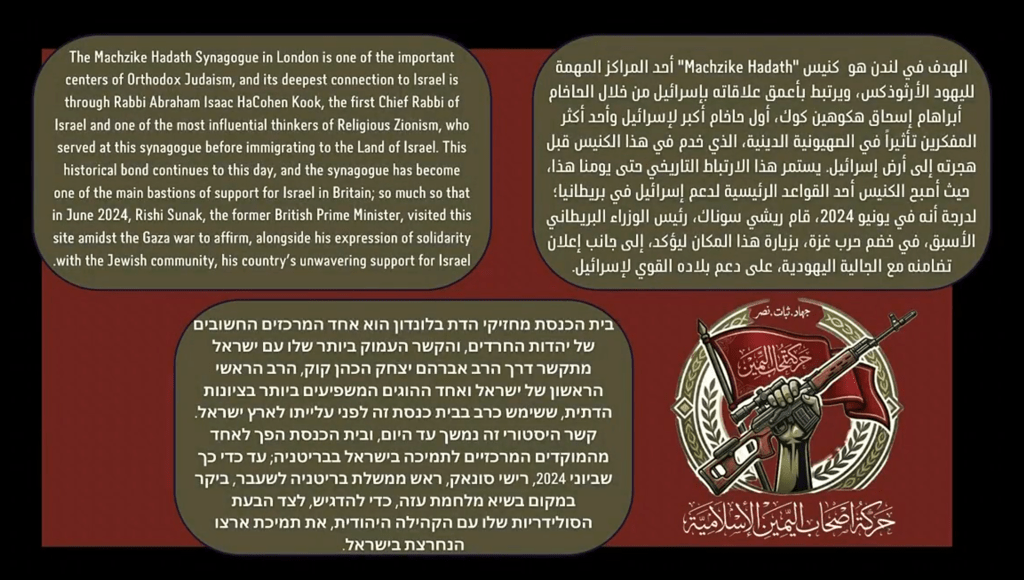
Claims that an Iran-backed group is carrying out attacks in European cities raise questions about why they’re not targeting countries directly involved in the US-Israeli war, and why they appear to communicate like Israelis.
Strangely, suspects arrested in the attacks have been released on bail.
A specter is haunting Europe – the specter of Ashab al-Yamin. Officially known as “Harakat Ashab al-Yamin al-Islamia (HAYI),” or the “Islamic Movement of the Companions of the Right,” the group mysteriously appeared in early March, and, according to mainstream media, it’s taking the continent by storm.
But a closer look at the supposedly Iran-backed terror organization suggests that it does not exist in any concrete form, and may be a confection of Israeli intelligence.
Though the nebulous HAYI claimed credit for torching ambulances belonging to a Jewish community organization in London on March 23, two suspects in the attack have been released on bail, and are not charged with any terror-related crimes. What’s more, London Metropolitan Police have so far refused to release the men’s names, raising questions about their identities. Were they even Muslim?
HAYI’s first public mention in the West came on March 11, when the previously non-existent organization released a video showing an explosive device detonating outside a synagogue in Liege, Belgium, alongside a statement taking credit for the attack.
The materials were circulated on social media by Joe Truzman, a self-described “Senior Research analyst examining Palestinian armed groups and Iranian proxy organizations” at the Foundation for the Defense of Democracies (FDD), a neoconservative DC-based think tank founded in 2001 with the stated goal of working to “enhance Israel’s image.” As The Grayzone reported, the Trump White House plagiarized its public justification for attacking Iran word-for-word from an FDD paper.
Though Truzman declined to state where he’d found the materials, he wrote that “Telegram channels linked to the Axis of Resistance… widely disseminated the publications,” using a reference to a variety of resistance factions sympathetic to Iran and Palestine throughout the greater Middle East. The group he linked to, a popular Telegram channel called Sabereen News, made it clear they were reposting the video, which they said was the work of a group calling themselves “the companions.”
Almost immediately, Truzman began asserting that these “companions” were all but guaranteed to be a Tehran-linked cutout. For starters, he told British media, “their logo with the wording is a sign of a classic Iranian front organization.” And Iran had already threatened to carry out just such a wave of attacks, Truzman claimed. After all, he wrote, “On March 8, Majid Takht-Ravanchi, Iran’s deputy-foreign minister, warned that if a European country joined the US and Israel in the current war against the Islamic Republic, it would be a ‘legitimate’ target ‘for Iranian retaliation.’”
Over the next two weeks, the shadowy group would go on to take credit for burning a vehicle in a Jewish neighborhood in Antwerp, arson at a synagogue in Rotterdam, explosions near a Jewish school and financial office building in Amsterdam, firebombing Jewish-dedicated ambulances in London, and an unspecified attack in Greece.
So far, the only media outlet to have interviewed a member of HAYI is CBS News, which was recently purchased by David Ellison, the ultra-Zionist billionaire son of the largest individual donor to Israel’s military, Larry Ellison, who happens to be a close friend of Israeli Prime Minister Benjamin Netanyahu. Bari Weiss, the editor-in-chief installed by Ellison at CBS, is a self-described “Zionist fanatic.”
Perfectly timed to set off another wave of security state theatrics and hysteria over rising antisemitism and Iranian infiltration, Israeli assets leaped on the narrative that a trans-continental IRGC sleeper cell had been unleashed upon the Old World. Yossi Kuperwasser, the former head of the IDF’s intelligence research division, was quoted in one British outlet as confirming that Iran “has dormant cells that could try and carry out terror attacks.” He added, “they are probably working to wake them up now.”
For those with their critical faculties still intact, the strange wave of attacks raised red flags – and acute suspicions of false flags.
Cui bono?
Among the oddest qualities of the attacks supposedly carried out by HAYI were the targets. The countries in which the attacks occurred did not correspond with those Iran would likely single out for retaliation.
Belgium, the second-most targeted country, has explicitly and repeatedly ruled out joining the US-Israeli war, which it describes as contrary to international law. Most of the strange explosions have been concentrated in the Netherlands, which sent a single frigate to the eastern Mediterranean. However, its involvement pales in comparison to a country like France, which has not been hit by HAYI once despite sending an aircraft carrier and several other military assets.
Strikes by Iran on these countries would therefore serve little political purpose. After all, if the attackers hoped to deter states from further involvement in the war, they would likely focus on the leading European participants, such as France, Britain, and Italy. Yet just one of those countries has experienced a purported HAYI attack, and only on a single occasion.
The actions by various European police agencies do not match up with the details of the alleged crimes, either. Following an attack on Hatzalah Jewish charity ambulances in London on March 23, police simply allowed the perpetrators to walk free on bail, demonstrating a level of leniency unlikely to be extended to a suspected Iranian spy. For Hatzalah, the incident was a blessing in disguise; the British government has since pledged to replace their damaged ambulances with four brand-new vehicles for free, and the organization has already exploited the situation to rake in over 2 million pounds in donations.
At the time of publication, London Metropolitan Police have yet to release the names of the two suspects in the attack, and the British press has seemingly moved on from the incident.
On the same evening as the ambulance attack in London, two minors were arrested for burning a car in Antwerp, Belgium. Though the crime occurred in a Jewish neighborhood, the victim was reported to be a Moroccan woman named Fatia. Her vehicle, she told a Belgian outlet, had been the subject of a smash-and-grab by vandals who wanted the jewels she’d been keeping in the car.
“Whether they were actually targeting Jewish people doesn’t matter,” she stated.
For many experts, HAYI’s written messages raised serious questions as well. As a Dutch professor who specializes in transnational militant Shiite groups told a national outlet, “The fact that this group clearly cannot read or write Arabic fluently like a native speaker means that I do not entirely regard them as a seriously organized radicalized sleeper cell.”
In the group’s materials, the logo changes significantly from one message to another, strongly suggesting they were hastily created with AI. The communiques also contain highly questionable language, beginning with a March 20th statement which referenced the “nation of Israel.” A post several days later claiming credit for burning ambulances in London referred four times in English and Arabic to “Israel” or “the Land of Israel.” The Hebrew translation of the statement raised even more questions, as it referred to a rabbi’s move to the country as “making aliyah to the Land of Israel” – a phrase employed almost exclusively by Zionists.
Official Iranian broadcasts, like those of virtually every Islamic resistance group on the planet, generally refrain from using such language, which they view as legitimizing the apartheid state, and they tend to prefer terms like “Zionist regime” and “occupied Palestine” instead. The language used in the communique by the supposed Iran-linked group is far more characteristic of Israeli speech patterns.
From Iraq to Australia, Israel’s dark record raises questions
There is, of course, an alternative explanation for why someone would want to carry out a series of low-impact, relatively harmless bombings of Jewish sites. The same strategy was allegedly employed by Zionist spies in Iraq in the early 1950s following Israel’s creation, when at least five bombings targeting Jewish locations were carried out. Israeli historian Avi Shlaim later uncovered extensive evidence that Israeli intelligence perpetrated a majority of the attacks in an effort to encourage a Jewish exodus to Israel.
Yaakov Karkoukli, a member of the Iraqi Zionist underground who worked closely with convicted Israeli spy Yusef Basri at the time, told Shlaim that this was a deliberate strategy “to terrorize and not to kill” Jews in the region and force their resettlement.
If that was the case, the strategy worked to perfection. Within several years, over 95% of Iraq’s Jews had migrated.
There’s a major possibility a similar plan was set in motion in Australia much more recently. When a wave of attacks on Jewish communities quickly followed Australian Prime Minister Antony Albanese’s decision to recognize a Palestinian state in 2025, the media there immediately pinned the blame on Iran. This belief, it turned out, was also based on Israeli influence.
As The Grayzone reported at the time, Australia’s Sky News revealed that Israel originally provided Australia’s intelligence agency, ASIO, with a “tip off, or lead, in relation to one of the firebombings” which indicated that a spate of attacks “was orchestrated by Iran.”
In December, when a pair of ISIS sympathizers attacked a Hanukkah ceremony on Bondi Beach in Sydney, Australia, Israeli Prime Minister Netanyahu immediately blamed an unspecified “Iranian-backed foreign terror cell,” prompting Canberra to expel Iran’s ambassador. He also singled out Australia’s Prime Minister Anthony Albanese, accusing him of inspiring the attack by recognizing a Palestinian state.
Two months later, Israeli President Isaac Herzog flew into Canberra to promote Israel’s planned assault on Iran. During his trip, Herzog held an unprecedented secret meeting with ASIO Director General Mike Burgess.
“The president met with the Director-General of Security, and was briefed by ASIO’s counter-terrorism team on their work following the Bondi attack,” an ASIO spokesperson claimed after the meeting was revealed.
Facts Only
A group called Harakat Ashab al-Yamin al-Islamia (HAYI) emerged in early March, claiming responsibility for attacks on Jewish sites in Europe.
HAYI took credit for an explosive device detonating outside a synagogue in Liege, Belgium, on March 11.
Joe Truzman, a researcher at the Foundation for the Defense of Democracies (FDD), circulated HAYI’s materials on social media.
Attacks attributed to HAYI include arson at a synagogue in Rotterdam, explosions near a Jewish school in Amsterdam, and firebombing ambulances in London.
Two suspects in the London ambulance attack were released on bail without terror-related charges.
London Metropolitan Police have not released the names of the suspects.
A Dutch professor noted that HAYI’s communications contained non-native Arabic and Zionist-aligned language.
HAYI’s logo varied significantly between messages, suggesting possible AI generation.
Historical precedents include Israeli intelligence operations in Iraq in the 1950s, where bombings targeted Jewish sites to encourage migration to Israel.
CBS News, owned by a Zionist billionaire, interviewed a HAYI member.
Israeli officials, including Yossi Kuperwasser, have suggested Iran is activating sleeper cells in Europe.
The targeted countries (Belgium, Netherlands) have minimal involvement in the US-Israeli conflict, while major participants like France have not been attacked.
Executive Summary
Full Take
The strongest version of this narrative suggests that HAYI is either an Iranian-backed group with unusually poor operational security or a fabricated entity designed to stoke fear and justify escalation. The inconsistencies—non-native Arabic, Zionist phrasing, and the release of suspects—raise serious doubts about the group’s authenticity. The pattern of targeting low-impact sites in countries with minimal involvement in the conflict aligns poorly with Iranian strategic interests but fits a historical playbook of false-flag operations to manipulate public perception.
Patterns detected: ARC-0024 Ambiguity (vague sourcing, unnamed suspects), ARC-0043 Motte-and-Bailey (shifting between "Iranian threat" and "possible false flag"), ARC-0012 Emotional Exploitation (leveraging antisemitism fears).
Root cause: The narrative thrives on the paradigm of perpetual conflict, where ambiguity and fear are weaponized to justify security state expansion. The unstated assumption is that Iran is the only plausible actor, ignoring Israel’s history of covert operations to shape migration or policy.
Implications: If HAYI is a false flag, it risks escalating tensions between Europe and Iran while eroding trust in institutions. If real, it signals a bizarrely ineffective Iranian strategy. Either way, the primary beneficiaries are security agencies and pro-Israel lobby groups, while Jewish communities bear the brunt of fear and backlash.
Bridge questions: What evidence would definitively prove HAYI’s ties to Iran or Israel? How might European intelligence agencies verify these claims independently? What historical precedents should inform skepticism about such narratives?
Counterstrike scan: A coordinated influence campaign would amplify the "Iranian threat" narrative through aligned media (e.g., CBS, FDD), suppress skepticism, and pressure governments into preemptive action. The actual content partially matches this—selective amplification, unnamed sources, and emotional framing—but lacks the full structural alignment of a state-level operation. The inconsistencies suggest either sloppy execution or deliberate obfuscation.