President Javier Milei announced Tuesday that his administration is drafting legislation to introduce a United States-style government shutdown mechanism in Argentina as part of a broader package of economic reforms it plans to send to Congress.
In the U.S., a government shutdown occurs when Congress fails to pass funding legislation before the start of a new fiscal year, forcing non-essential parts of the federal government to suspend operations until a budget is approved.
Milei said he wants to create a similar mechanism that would automatically curb public spending once the budget’s authorized funds are exhausted.
Under Argentina’s current system, if Congress fails to approve a budget for the following fiscal year, the most recently approved budget remains in force.
That happened in both 2024 and 2025 — Milei’s two first years in office — when the national government operated under the 2023 budget.
In both cases, the president authorized additional spending through emergency budget reallocations to cover increased funding needs across different areas of the state.
New rules
Under Milei’s proposal, if Congress fails to approve a new budget, the government would no longer roll over the previous one or authorize additional spending. Instead, government operations would cease once the available funds are depleted.
“When the budget runs out, you can’t spend any more money, and the state shuts down,” Milei said during an interview with streaming channel Neura on Tuesday.
In a post on X, Milei said his administration was finalizing what he described as “the foundations of a new golden age.”
Alongside the proposed government shutdown mechanism, the package includes changes to the Central Bank’s charter, a new capital markets law and deregulation of the insurance sector.
“Take note. A series of reforms is coming that will allow us to emerge from more than 90 years of decline caused by the caste and its delusional monetary and fiscal policies,” Milei wrote, using his usual term for Argentina’s traditional political establishment.
During the interview, the president also said the government would submit a new version of the fiscal innocence law passed in late 2025, which allows Argentines to use previously undeclared U.S. dollars under a presumption of innocence before the tax authority.
Central Bank reform
A key element of the reform package is a proposal to amend the Central Bank’s charter, which defines the institution’s mandate, powers and responsibilities.
Milei said the changes would explicitly ban the Central Bank from financing the national treasury, calling the practice “a fraud” and an economic policy tool with “no objective.”
“Violating the Central Bank’s independence by financing the treasury will be explicitly prohibited and subject to criminal penalties,” he said. “Fraud and counterfeiting are criminal offenses. We can even use provisions already contained in the Criminal Code.”
Since taking office, Milei has made achieving a zero fiscal deficit the cornerstone of his economic agenda. He has repeatedly argued that Argentina’s chronic economic problems stem from persistently high inflation, caused by governments spending beyond their means.
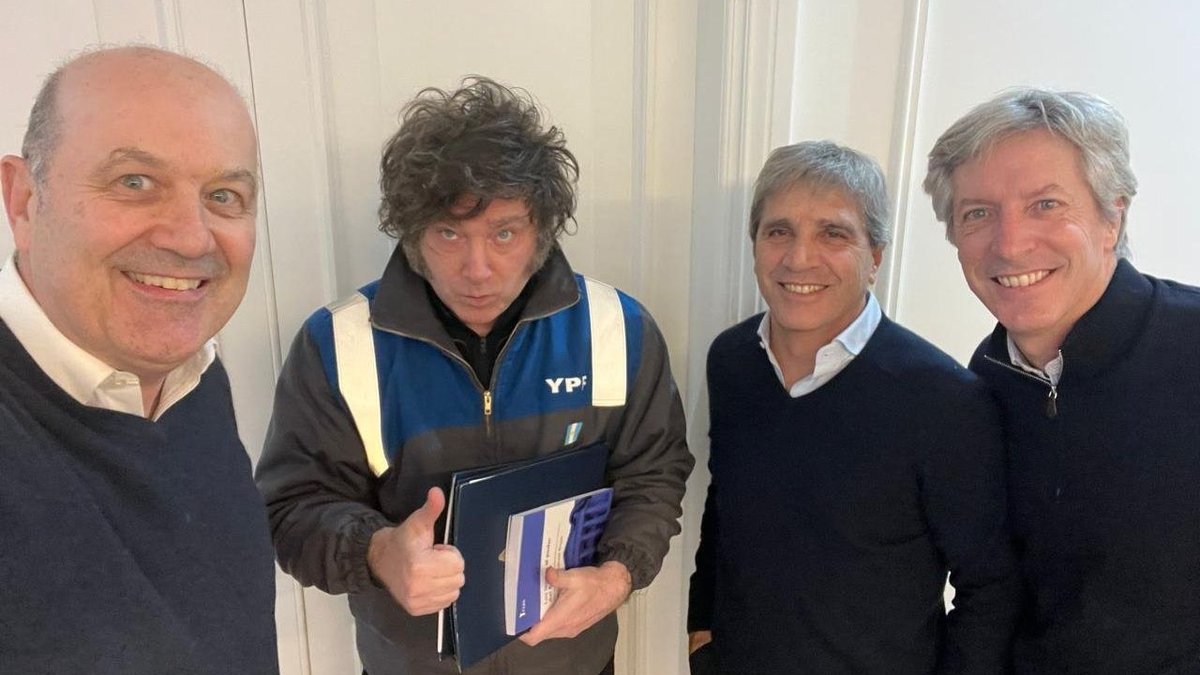
After the interview, Milei met with Economy Minister Luis Caputo, Deregulation Minister Federico Sturzenegger and Central Bank Governor Santiago Bausili to discuss the proposals. The government did not release further details of the planned bills.
Sentinel — Human
The text reads like a factual summary of a political announcement and interview, supported by specific details regarding proposed legislation and policy goals.