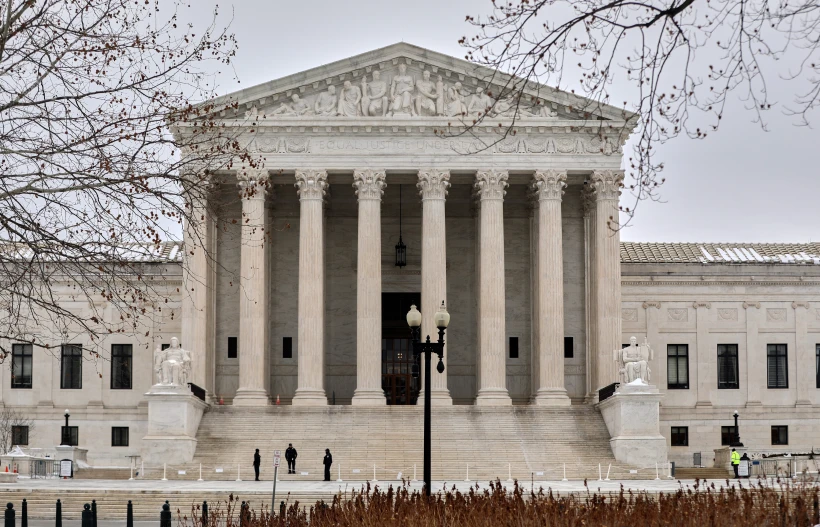
WASHINGTON — The Supreme Court on Friday revived a lawsuit from an evangelical Christian barred from demonstrating in Mississippi after authorities say he shouted insults at people over a loudspeaker.
The high court unanimously ruled in the case of Gabriel Olivier, who says his religious and free speech rights were violated when he was arrested for refusing to move his preaching away from a suburban amphitheater. The city said he had shouted insults like “whores,” “Jezebel,” and “nasty” at people, sometimes holding signs showing aborted fetuses.
Olivier wanted to challenge the law as an unconstitutional restriction on free speech, but lower courts stopped him from suing because he’d been convicted of breaking it. A Supreme Court case from the 1990s found people can’t use civil lawsuits to undermine criminal convictions.
But the justices found that doesn’t stop Olivier from suing because he only wants to block future enforcement.
“Given that Olivier asked for only a forward-looking remedy—an injunction stopping officials from enforcing the city ordinance in the future—his suit can proceed, notwithstanding his prior conviction,” Justice Elena Kagan wrote for the court.
Olivier’s lawyers said he was demonstrating peacefully when he was arrested for refusing to move to a designated “protest zone.” The legal principle, they argued, affects free-speech cases across the political spectrum.
“This is not only a win for the right to share your faith in public, but also a win for every American’s right to have their day in court when their First Amendment rights are violated,” said Kelly Shackelford, president and CEO of the conservative nonprofit First Liberty Institute.
The decision clears a path for him to file a civil-rights lawsuit, though it doesn’t guarantee an eventual win. Local governments have said that a ruling for Olivier could have wide repercussions by allowing a rush of new lawsuits against cities and towns.
The city of Brandon has said the restrictions weren’t about religion, and he had plenty of other legal avenues to challenge the law. The ordinance restricting Olivier to a designated “protest zone” has already survived another lawsuit, city attorneys said.
Facts Only
The Supreme Court unanimously ruled in favor of Gabriel Olivier, an evangelical Christian.
Olivier was arrested in Mississippi for refusing to move his preaching away from a suburban amphitheater.
Authorities claimed Olivier shouted insults such as “whores,” “Jezebel,” and “nasty” at people.
Olivier sometimes held signs showing aborted fetuses during his demonstrations.
Lower courts had blocked Olivier’s lawsuit, citing a 1990s Supreme Court precedent.
The Supreme Court ruled that Olivier could proceed with his lawsuit because he sought only to block future enforcement of the ordinance.
Justice Elena Kagan wrote the opinion for the court.
Olivier’s lawyers argued that he was demonstrating peacefully and that the case affects free-speech rights broadly.
The city of Brandon stated that the restrictions were not about religion and that Olivier had other legal avenues to challenge the law.
The ordinance restricting Olivier to a designated “protest zone” had previously survived another lawsuit.
Conservative legal groups, including the First Liberty Institute, celebrated the ruling as a victory for free speech.
Local governments expressed concern about potential lawsuits challenging similar ordinances.
Executive Summary
The Supreme Court unanimously ruled in favor of Gabriel Olivier, an evangelical Christian who was arrested in Mississippi for refusing to move his preaching away from a suburban amphitheater. Authorities claimed Olivier shouted insults like “whores,” “Jezebel,” and “nasty” at people, sometimes displaying signs of aborted fetuses. Lower courts had previously blocked Olivier’s lawsuit, citing a 1990s Supreme Court precedent that prevents civil lawsuits from undermining criminal convictions. However, the justices determined that Olivier could proceed with his case because he sought only to prevent future enforcement of the ordinance, not to challenge his prior conviction. The decision allows Olivier to file a civil-rights lawsuit, though it does not guarantee success. The city of Brandon argued that the restrictions were not religiously motivated and that Olivier had other legal avenues to challenge the law. Conservative legal groups hailed the ruling as a victory for free speech, while local governments expressed concern about potential lawsuits challenging similar ordinances.
The case highlights tensions between free speech rights and local regulations on public demonstrations. Olivier’s lawyers framed the issue as a broader First Amendment concern, while the city maintained that its ordinance was content-neutral and had already withstood legal scrutiny. The Supreme Court’s decision clarifies that individuals can challenge laws prospectively, even after a conviction, if they seek to prevent future enforcement rather than overturn past rulings. The broader implications for free speech and public protest remain uncertain, as the ruling does not address the constitutionality of the ordinance itself.
Full Take
The Supreme Court’s decision in Olivier’s case is a textbook example of procedural clarity—it doesn’t endorse his speech or the city’s ordinance but simply affirms his right to challenge the law’s future enforcement. This is a win for the principle that convictions don’t forever silence legal challenges, a nuance often lost in polarized debates about free speech. The strongest version of this narrative is that it reinforces the First Amendment’s protective role, ensuring that even unpopular or provocative speech can be defended in court without being preemptively dismissed due to prior convictions.
However, the case also reveals deeper tensions. Olivier’s use of inflammatory language and graphic imagery is legally protected but socially divisive, raising questions about the limits of civil discourse. The city’s argument—that the ordinance is content-neutral and already upheld—highlights how local governments balance public order with free expression. The pattern here isn’t manipulation but a classic clash of rights: the right to speak versus the right to regulate public spaces. No obvious distortion or bad faith is present, but the framing by Olivier’s legal team as a broad free-speech victory could be seen as a motte-and-bailey tactic, where the narrow legal win (procedural standing) is expanded into a sweeping endorsement of his methods.
Root cause: This case echoes historical struggles over public protest zones, from civil rights marches to anti-abortion demonstrations. The assumption that free speech must tolerate even offensive expression is foundational to U.S. jurisprudence, but the social cost—alienation, hostility, and potential escalation—is often borne by bystanders. The implications for human dignity are mixed: Olivier’s agency is upheld, but the dignity of those he targeted is left unaddressed by the legal system.
Bridge questions: How should communities balance the right to provoke with the right to peace? If Olivier’s speech is protected, what recourse do those offended have beyond legal remedies? Would the public reaction differ if the speech were political rather than religious?
Counterstrike scan: A bad actor pushing this narrative might amplify the free-speech angle while downplaying the offensive nature of Olivier’s speech, framing it as pure persecution to stoke outrage. The actual content doesn’t match this pattern—it presents both sides and focuses on legal procedure—but the potential for exploitation exists in how the ruling is framed by partisan groups.
Patterns detected: none