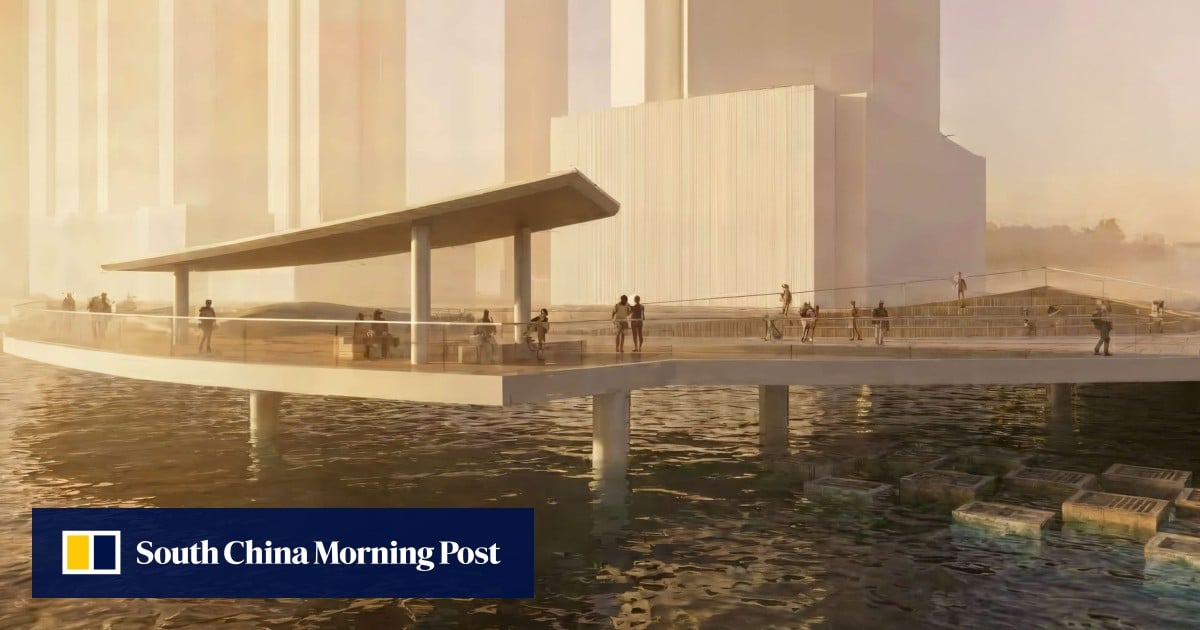
‘Kennedy Town is an old district of Hong Kong, and its buildings … have gone through a long history,’ Harbourfront Commission head says
The head of Hong Kong’s Harbourfront Commission has called for improvements to the proposal to reclaim land for a popular tourist selfie spot in Kennedy Town, saying the current design failed to fit the neighbourhood’s ambience.
Ivan Ho Man-yiu, the advisory body’s chairman, said on Monday that the design of a proposed offshore walkway at Kennedy Town Praya should reflect the “city mood” of the district.
“On its design, commission members have raised a lot of suggestions, and one of the biggest concerns was that some members said the design was inconsistent with the ambience of Kennedy Town, which I agree with,” he told a radio show.
“Kennedy Town is an old district of Hong Kong, and its buildings, as well as other social media hotspots, have gone through a long history, … but the government’s preliminary design has failed to reflect the mood.”
On Thursday last week, the commission discussed the feasibility of the project, which is expected to measure 200 metres in length and 10 metres in width.
The proposal, which will involve the reclamation of 0.25 hectares, also aims to improve pedestrian connections between Cadogan Street and Smithfield.
Facts Only
* The Harbourfront Commission head called for improvements to a proposal to reclaim land in Kennedy Town.
* Commission members raised concerns that the design was inconsistent with the ambience of Kennedy Town.
* Ivan Ho Man-yiu stated that the government’s preliminary design failed to reflect the mood of the district.
* The proposed project involves an offshore walkway expected to be 200 meters in length and 10 meters in width.
* The proposal involves the reclamation of 0.25 hectares.
* The project aims to improve pedestrian connections between Cadogan Street and Smithfield.
* Kennedy Town is described as an old district of Hong Kong with a long history of buildings.
* The commission discussed the feasibility of the project on Thursday last week.
Executive Summary
Full Take
The conflict presented in this situation lies at the intersection of historical preservation, public space development, and commercial tourism. The central tension is between the functional objective of large-scale reclamation (creating a tourist spot and improving pedestrian flow) and the qualitative value of preserving local historical ambience and cultural identity. The critique that the design fails to reflect the "city mood" moves the debate from mere architectural preference to socio-historical responsibility; it implies that development must be contextualized within the existing historical narrative rather than imposed upon it.
This dynamic echoes a pattern where large infrastructure projects, often driven by economic or tourist interests, are prioritized over localized cultural memory and heritage. The government's preliminary design acts as an example of a top-down approach, suggesting that functional metrics (length, width, area) are weighted more heavily than qualitative social and historical context when planning public space in historic districts. This setup creates a potential locus for conflict where local stakeholders must resist the perceived erasure of established character in favor of modern, functional tourism infrastructure.
The critical question is: who defines "mood," and whose history is prioritized during the process of land reclamation? The pursuit of efficiency risks generating a scenario where historical significance becomes merely aesthetic decoration rather than an integral part of the lived environment. What are the long-term implications for cognitive sovereignty when development narratives consistently subordinate local, deep-seated context to external, measurable, and often transient interests?
Sentinel — Human
The text exhibits the structure and focus typical of human journalistic reporting based on official commission discussions, with no discernible signs of machine manipulation.