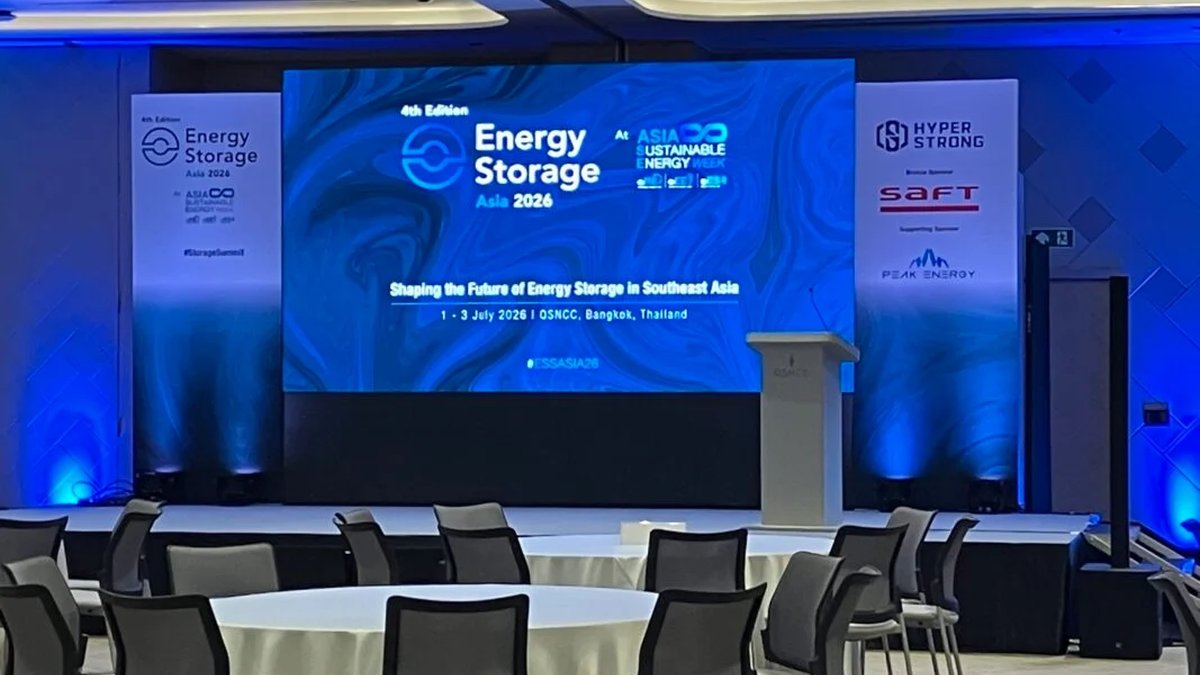
Developers must use all the tools at their disposal and be aware of the frontline climate risks that battery storage projects in Southeast Asia will be subject to.
That was one of the key takeaways in a panel discussion, ‘Risk & resilience in project delivery: Permitting, climate and local conditions,’ which took place at last week’s Energy Storage Summit Asia 2026, hosted by our publisher Solar Media (part of the Informa Group).
“Climate risk is no longer an abstract concept to us anymore. It is a daily operational reality that really has fundamentally reshaped how we approach different phases of a project,” Alan Yau, CEO of Verdant Energy, said.
Yau’s company has developed renewable energy projects in Thailand, Vietnam and the Philippines and has turned its attention to battery energy storage system (BESS) assets. He said that Verdant Energy looks at climate risk from the onset of development, through location selection, siting and permitting, project design and technology procurement.
Try Premium for just $1
- Full premium access for the first month at only $1
- Converts to an annual rate after 30 days unless cancelled
- Cancel anytime during the trial period
Premium Benefits
- Expert industry analysis and interviews
- Digital access to PV Tech Power journal
- Exclusive event discounts
Or get the full Premium subscription right away
Or continue reading this article for free
“We have reviewed our technical specifications to make sure we cater to more extreme weather, which is now becoming more and more common during the construction and commissioning phase,” with Verdant working to international standards to ensure project bankability and using AI-enabled asset management systems to optimise operation and plant performance.
Alan Yau participated alongside fellow developer Ruth Briones, chair, president & CEO of Greenergy Solutions, lawyer Samata Masagee from Clyde & Co, and climatologist Brendan Larson, co-founder and CEO of climate risk consultancy AbsoluteClimo. The panel was moderated by me, Energy-Storage.news editor Andy Colthorpe.
Briones, whose firm has deployed solar PV projects in the Philippines and is now developing a 2GW portfolio of hybrid solar-plus-storage in the ASEAN country, noted that even during the worst disasters, none of Greenergy’s assets has been “affected or destroyed.”
Nonetheless, the Greenergy CEO said, risk assessment and mitigation planning for BESS should be done as early as possible and run in parallel with environmental impact assessments.
With projects in Southeast Asia subject to demanding climate conditions, including high heat and humidity, when it comes to Capex and Opex modelling, Verdant Energy, which is also an investor in its projects, tries to “build upfront resilient investment,” Alan Yau said.
“We try to cater for more extreme conditions based on specific site conditions and data. For example, we want to have enhanced thermal management for our BESS. We want to make sure that our foundations are [suitably] designed for typhoon-prone areas and things like that,” Yau said.
“Cost of maintenance and replacement is that important, especially as we’re talking about battery storage; extreme high temperature will actually accelerate your replacement schedule. How do you then cater for that? Make sure you build enough buffer for replacement Capex and budget. Then, when you are doing revenue modelling, your availability and downtime have to be scrutinised and validated by independent advisors to make sure that it reflects the reality and conditions. Finally, you look at the performance issues by using AI asset management to do a more accurate prediction of what’s going to happen, so that it can help us to be more responsive.”
Briones agreed and emphasised the importance of negotiating very good warranties and guarantees with suppliers.
Black Swans and the changing climate
Climatologist Brendan Larson said that ‘Black Swan’ events or tail risks, in other words, less-frequent but high-impact risks, are increasingly important to factor in.
“The climate system is a nonlinear system. It’s not a mathematical statistical average. Climate is changing, it’s dynamic,” Larson said, citing the example of the Maui wildfires in Hawaii of August 2023 that caught utility Hawaiian Electric (HECO) off-guard.
“Hawaiian Electric was caught so off guard that they didn’t have enough liability insurance to cover that, so they ended up having to do an asset divestiture. They had to sell their bank to help cover the liability costs of that event,” which fell outside of the utility’s recognition of tropical storms and floods that might have been more typical of the region until then.
At the same time, climate “drives the energy” in an increasingly renewable energy-based system. Yet climate change scenarios are often more about “what ifs” relating to global temperature change, while the proper modelling of how things like oceanic atmospheric flows affect weather is lacking, according to Larson.
“So, when it comes to the revenue generating projection of the future, the forecasting of the revenue, you can’t just go to the engineers and say, ‘well, here’s a site and in the past, the wind has blown like this, so this is basically the past data, so we expect for the power purchase agreement (PPA), for the next 15-20 years, it should be like this,” the climatologist said.
As the disclaimers on investment prospectuses read: past performance is not indicative of future results.
Samata Masagee, Clyde & Co partner, works with project sponsors, developers and financial institutions “to bring energy and energy storage projects to life,” with the lawyer’s own experiences in ASEAN largely focused on Thailand and neighbouring countries.
Masagee said it is essential for project documentations: PPAs, long-term service agreements (LTSAs) and so on, to be flexible to cater for changes, from climate to regulatory, to ensure the long-term viability of projects.
For example, during construction, Clyde & Co’s documentation is moving away from generic definitions of force majeure events to more site-specific definitions that are customised and can be based on research from expert sources such as climatologists.
Likewise, contracts that cover a project once it goes into operation should also tie back into the risks identified in the development phase. Meanwhile, supplier warranties should always factor in worst-case scenarios that account for the long term, Masagee said.
Insurance is increasingly moving away from generic and generalised terms
Insurance should stand behind warranties in those worst-case instances, for example, if an equipment supplier goes out of business. This, of course, comes with an internal premium on the cost of insurance, Masagee said before elaborating on project insurance considerations.
“The trend that we’ve seen across the market is pretty clear: that BESS, or energy storage insurance, is relatively more expensive than other insurance products for the renewable market,” Masagee said.
This is not because of a lack of appetite to insure these projects, but instead there is a lack of long-term data that insurers can look to and assess how to price the product accordingly, the lawyer said.
Additionally, there is still a “concentration” of relatively few speciality brokers willing to underwrite BESS projects. The advice, again, is to get into the process as early as possible.
Meanwhile, bankable technology makes insurers more willing to insure projects, if, for example, the equipment to be used has passed fire safety standards.
Verdant Energy’s Alan Yau said that technology solutions such as battery data analytics are examples of “AI-enabled operational decision-making” that are key to securing better insurance terms and project bankability.
“The moment you include the battery [in the project], then it becomes a lot more complicated,” Yau said.
“We have now incorporated insurance premiums as a variable cost that is indexed to site-specific conditions. It used to be just one line item that developers would just input an amount from historical experience, but now it’s a variable cost that every site is specific, so we make sure that we cater for it.”
The wide-ranging discussion also covered permitting, community engagement, and regulatory considerations, as well as audience questions on sustainability and equipment recycling.
Facts Only
* Developers must use all available tools and be aware of frontline climate risks for battery storage projects in Southeast Asia.
* Alan Yau, CEO of Verdant Energy, views climate risk as a daily operational reality reshaping project phases.
* Verdant Energy looks at climate risk from the onset of development through location selection, siting, permitting, design, and technology procurement.
* Verdant reviewed technical specifications to cater to more extreme weather during construction and commissioning.
* Verdant uses AI-enabled asset management systems to optimize operation and plant performance.
* Greenergy Solutions’ assets in the Philippines were not affected or destroyed during worst disasters.
* Risk assessment and mitigation planning for BESS should occur early, running parallel with environmental impact assessments.
* Cost of maintenance and replacement is critical; extreme heat accelerates battery replacement schedules.
* The trend is moving toward site-specific insurance premiums indexed to site conditions based on variable costs.
* Project documentation, including PPAs and LTSAs, must be flexible to cater for climate or regulatory changes.
Executive Summary
Full Take
The narrative presents a necessary shift from treating climate risk as an abstract concern to integrating it directly into the technical, financial, and legal fabric of energy infrastructure development. The core tension lies between historical, generalized risk models and the dynamic, non-linear reality of climate change, particularly when applied to long-term asset viability. The emphasis on incorporating 'Black Swan' event thinking—acknowledging low-frequency, high-impact risks like extreme weather—suggests a move away from purely statistical forecasting toward scenario-based resilience planning.
A critical pattern emerging is the push for granular data integration: moving beyond generalized risk assessments to site-specific thermal management, foundation design, and tailored insurance premiums based on local conditions. This implies that achieving "project bankability" requires embedding climate knowledge directly into asset economics, rather than treating environmental compliance as a separate add-on. The development of AI-enabled operational systems acts as a bridge, allowing entities to process this complex, variable data (like temperature acceleration of replacement cycles) into actionable performance predictions, which in turn feeds back into insurance and contract negotiations.
The implication for human agency is that resilience is not achieved through passive compliance but through proactive, deeply integrated risk modeling across the entire project lifecycle. The debate around insurance pricing highlights a structural gap where market data scarcity results in high insurance costs, creating an additional barrier to deployment. Future analysis should focus on developing standardized methodologies for quantifying climate-driven depreciation and replacement schedules across diverse geopolitical contexts, ensuring that adaptation mechanisms are equitable and enforceable rather than remaining optional extensions of standard contract law.
Bridge Questions: How can regulatory bodies establish baseline, defensible site-specific climate risk metrics that industry actors can reliably use? What governance structures are necessary to ensure that variable cost adjustments related to climate resilience (like insurance premiums) are factored into standard financing mechanisms for emerging markets? What frameworks are needed to reconcile dynamic climate modeling with the static requirements of long-term infrastructure contracts?
Sentinel — Human
The text functions as a high-level summary of an expert panel discussion, characterized by the integration of specific industry perspectives on climate risk and resilience in Southeast Asian energy storage projects.