The Uses and Abuses of the “Worst of the Worst”
While the “worst of the worst” was already part of the lexicon of immigration enforcement before Donald Trump, his administration has routinely wielded it as a tool for advancing a radical, white-nationalist agenda.
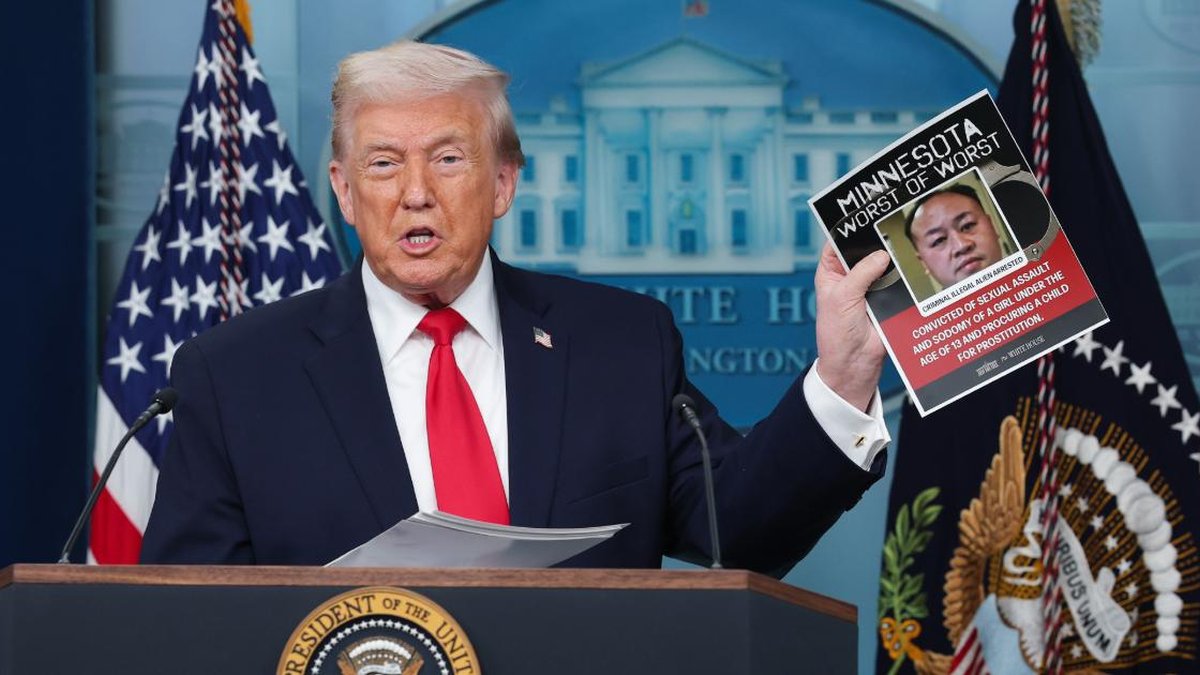
“They’re apprehending murderers and drug dealers and a lot of bad people,” President Donald Trump said during Operation Metro Surge as thousands of federal immigration enforcement agents were deployed to Minneapolis–Saint Paul. At the January 2026 press briefing, Trump brandished photographs labeled “Minnesota Worst of the Worst,” insisting they depicted “vicious” criminals. The Department of Homeland Security’s website has amplified his rhetoric, hosting a gallery of mugshots titled “Arrested: Worst of the Worst,” while right-wing media figures routinely argue that mass deportation is necessary to rid the country of such “criminal aliens.”
It’s tempting to tune out this denigrating speech, focusing only on the Trump administration’s policies and practices. But that would be a mistake. In our research as scholars of law and punishment, we have seen how activists, legislators, and public officials have used the concept of the “worst of the worst” to advance draconian penal systems, build inhumane carceral institutions, and justify state violence. Influential actors have used the phrase to define common understandings about the targets of criminal legal policies, insisting that individuals who engage in destructive, even heinous, acts are not outliers but typical representatives of whole groups.
The “worst of the worst” is a tool of political demonology, evoking a sense of crisis to justify a state of exception. It operates much like other terms of condemnation, such as the “welfare queen” stereotype so devastatingly deployed as a stand-in for all recipients of public assistance. When monsters are among us, conventional policy responses simply will not suffice. To save the innocent, legislators, jurists, and other policymakers suspend the normal rules, ignore procedural requirements, skirt democratic deliberation, and push aside expert analysis about human and other costs. That’s why we must reject the “worst of the worst” framing to organize and justify immigration policy—or any policy, for that matter.
We first encountered the “worst of the worst” while studying the punitive turn in the United States that began in the 1970s, picked up steam in the 1980s, and reached full speed in the 1990s. We saw how activists and public officials used the term to advance and defend ultra-punitive sentencing laws for both adults and juveniles; build and fill security housing units (SHUs), prisons-within-prisons that subject people to solitary confinement and sensory deprivation for years at a time; and establish gang and sex offender registries. Policymakers used the “worst of the worst” to tie these new punitive policies to specific stories and faces.
Prison officials, legislators, and governors moved seamlessly from outlier cases to sweeping generalizations about broad categories of offenders, including “juvenile superpredators,” “career criminals,” and “sexually violent predators.” These alleged groups are invoked as if they are armies responsible for street crime, prison violence, and urban disorder; they are often portrayed as Black or brown and poor, fueling divisive notions among more advantaged groups and justifying escalating punitive policies.
Take California’s notoriously harsh and expansive “Three Strikes” law. In 1992, two men with extensive criminal histories tried to rob eighteen-year-old Kimber Reynolds in Fresno. When Reynolds resisted, one of the men shot and killed her. Her father, Mike Reynolds, led a campaign to get the legislature to pass Three Strikes. The proposed legislation mandated sentences of twenty-five years to life for “third strikers”—people convicted of two serious or violent crimes and any third felony, including theft—and doubled the sentences for second strikers—those with a record of one “serious” or “violent” offense who committed any additional felony. California’s legislature refused to adopt the measure, and its prospects seemed dim. Then Richard Allen Davis, a burly parolee with a long rap sheet, kidnapped and murdered a white girl named Polly Klaas.
Proponents of Three Strikes insisted that Kimber’s and Polly’s murders represented a larger problem—the state’s refusal to incapacitate the “worst” repeat offenders. Promoting fear and panic, Reynolds and his supporters (including the governor and conservative talk radio hosts) declared that California was in crisis, and that Californians had to act quickly and forcefully. Rather than take the legislative route—and subject Three Strikes to scrutiny from legislative analysts, public administrators, and academics—Reynolds and his collaborators used the ballot initiative process to approve the law, which passed with more than 70 percent of the vote in 1994. Reynolds published a book proudly declaring that Californians had “defied the experts and voted for common sense and justice.” A decade later, another ballot initiative would have dulled the sharp edges of the law, yet the mayor of Oakland, Democrat Jerry Brown, explained his opposition to the proposed changes by invoking the “worst of the worst,” pointing to a “guy who raped his mother” and another who “tried to burn his own kid.”
The “worst of the worst” was invoked again in 1989 when prison officials opened the state-of-the-art Pelican Bay State Prison and began filling hundreds of solitary confinement cells with alleged gang leaders. George Jackson, a radical author and revolutionary leader within the Black Power movement, had been killed in a purported escape attempt at San Quentin Prison in 1971, but prison officials were still pointing to him eighteen years later as a dangerous gang leader whose followers required nothing less than total physical and social isolation in a new, hyper-secure facility (one that defied a century of evidence about the harms of solitary confinement).
Prison officials, not criminologists or judges or legislators, designed and promoted Pelican Bay as a solution to the rising power of prison gangs and the problem of prison violence. Like Reynolds circumventing the legislature, officials pursued exceptions to fund the facility through privatized lease-revenue bonds, exceptions to environmental compliance reviews, exceptions to procedural rules about who could be sent to solitary, and exceptions to presumptions that prisoners would be treated like humans, not animals. By 2011, more than 500 people had spent more than ten years each in solitary confinement in Pelican Bay.
Highlighting the “worst of the worst” implies targeted judiciousness. Champions of Three Strikes laws, long-term solitary confinement, and other hyper-punitive initiatives all claim to construct mechanisms for excising only the most despicable and dangerous from our society. But these extreme measures tend to sweep up equally extreme numbers of people.
The Pelican Bay SHU, ostensibly built to incapacitate dangerous gang leaders, ended up subjecting a large, diverse group of men to long periods of isolation and sensory deprivation. Of the hundreds who spent at least a decade in solitary, few had broken any specific prison rule. Many had been thrown in the SHU based on flimsy evidence that they were a gang “affiliate” (not even a member), such as possessing an incriminating tattoo or a forbidden book.
California’s Three Strikes law allegedly was designed to target rapists and murders, but it led to exceptionally long prison sentences for people with low-level triggering offenses. In 2005, the state’s Legislative Analyst’s Office reported that over half of people sentenced under the law were convicted of nonserious or nonviolent offenses. Three Strikes is now an archetype, not an anomaly: “The broad use of long-term and life sentences for nonhomicide crimes despite claims that these sentences are reserved for the worst of the worst is troubling,” reads a report from the Sentencing Project. Nationally, “more than 17,000 lifers have been convicted of nonviolent crimes, and nearly 12,000 people serving life sentences were juveniles at the time of their crime.”
The rhetoric of the “worst of the worst” seeped into penal organizations, shaping how managers and front-line workers understand and execute their duties. Penal professionals get swept up in horror stories and feel anxious to protect society from these lurking threats. Expecting that parolees convicted of sexual violence “will and must reoffend,” parole agents focus exclusively on surveillance and control. When prison staff come to see their role as managing the “worst of the worst,” they approach their job with fear and animosity, fueling a culture of harm.
At Pelican Bay, this culture led to systematic abuse. In 1995, Federal Judge Thelton Henderson condemned the pervasive, brutal beatings that had become common in the prison’s isolation cells. But Henderson continued to agree with prison officials that “these are some bad people,” the kind of people who “stab staff and stab other inmates,” as the then-director of the California prison system claimed. Though Henderson spent years overseeing litigation and monitoring of conditions at Pelican Bay, he never asked for evidence proving all those locked in the SHU were actually “bad people.” The idea that the prison had locked up the “worst of the worst” kept officials from ever considering the possibility that they might have been wrong.
Before Trump, the “worst of the worst” was already part of the lexicon of immigration enforcement. During Barack Obama’s administration, the president oversaw a deepening criminalization of immigration policy and increased the nation’s capacity for immigrant detention. In the first five years of his presidency, Obama deported about 2 million people and gained the nickname “Deporter-in-Chief.” Roughly two-thirds had either committed low-level offenses (including traffic violations) or hadn’t been convicted of anything at all.
But Trump’s White House has only supercharged this development, routinely highlighting sensational cases to form overgeneralized claims about entire groups. People like Jose Antonio Ibarra, a man from Venezuela who murdered nursing student Laken Riley in Georgia, are made to stand in for all undocumented immigrants from Latin American countries—who, we’re told, are likely affiliated with notorious gangs, such as Tren de Aragua and MS-13. Trump fabricates stories about “Somali gangs” in Minnesota that allegedly cause unspeakable violence and defraud the government, suggesting that all East African immigrants are driven to crime. During the 2024 election, Vice President J.D. Vance and others depicted Haitian immigrants as coyote-like figures who feast on family pets.
Predictably, the specter of the “worst of the worst” immigrants feeds into a crisis narrative. In May 2025, Trump announced that the United States “has been INVADED by 21,000,000 Illegal Aliens, many of whom are Murderers and Criminals of the Highest Order. . . . If we aren’t allowed to remove them . . . the USA will quickly and violently become a CRIME RIDDEN THIRD WORLD NATION, NEVER TO SEE GREATNESS AGAIN.”
As in the criminal-legal context, public officials use this crisis rhetoric to build support for exceptional immigration enforcement measures, disregarding evidence of high costs and safety risks and overriding procedural protections. In July 2025, Congress increased the budget for Immigration and Customs Enforcement by more than 700 percent, from around $10 billion to $75 billion. This June, lawmakers approved an additional $69.5 billion for immigration enforcement. With this war chest, the government can build the infrastructure—including the workforce, detention facilities, and tracking systems—to combat an alleged influx of “murders and criminals of the highest order.”
The “worst of the worst” narrative justifies unconstitutional searches of homes to find and arrest immigrants, racial profiling, the detention of citizens, the denial of bond hearings, third-country deportation, the shipping of immigrants to Guantanamo Bay, the detention of thousands of children, and family separation. It warrants torture in foreign prisons (such as CECOT in El Salvador), deaths in U.S.-based immigrant detention centers, medical neglect of detainees, and the shackling migrants for forty-hour plane rides.
The alleged national emergency also justifies stigmatizing, criminalizing, and killing those who resist, as opponents of the administration’s mass deportation policies are considered enemies of the country. White House Deputy Chief of Staff for Policy Stephen Miller accused politicians in Minnesota of waging an “insurgency” because they characterized ICE and CBP as an “occupying force.” And when federal agents killed Renee Good and Alex Pretti in Minneapolis, government officials labeled the victims “domestic terrorists.”
Critics have sought to undermine the right’s crisis rhetoric through fact-checking and debunking. They point to ICE’s own statistics, which show that the majority of immigrant detainees arrested during the mass raids in December and January were not convicted of crimes, and that many of those who have criminal records committed low-level offenses, often long ago. Others highlight research demonstrating that immigrants, both documented and undocumented, commit less crime than U.S.-born citizens.
These arguments are useful for educating the public and potentially convincing them to oppose the government’s immigration policies—as well as the politicians who promote them—but they will not move the administration, which uses “worst of the worst” as a political tool for advancing a radical, white-nationalist agenda. Trump and his fellow immigration hardliners, following the “Great Replacement” theory, believe that Black and brown immigrants from “shithole countries” leech off the government, commit crimes, and refuse to assimilate, which makes them appropriate targets for mass deportation.
Liberal and conservative critics alike have complained that the government has targeted the wrong people. In January, New York Times columnist David French lamented that ICE and CBP haven’t limited “their aggression to criminal illegal immigrants, the ‘worst of the worst.’ They’re detaining people who have been granted lawful status, they’ve swept up citizens in the dragnet.”
But rightsizing harsh immigration enforcement is bound to fail. We know this from the politics of punishment. Efforts to reform penal policy often focus on the “non-non-nons”—people convicted of non-serious, nonviolent, and non-sex related crimes—while reserving harsher sanctions for the “worst of the worst.” As Marie Gottschalk argued in her 2016 book Caught, this firm divide “has contributed to the further demonization of people convicted of sex offenses or violent crimes in the public imagination and in policy debates. It has impeded the enactment of more comprehensive changes in sentencing policies and parole practices.”
The “worst of the worst” framework, in other words, is a key reason why America’s penal state remains exceptionally large, punitive, and injurious. Continuing to frame immigration policy in these terms will only fuel further criminalization and militarization—as it has done with criminal punishment—and crop inclusionary policies out of the picture. When the country is on war footing, it makes little sense to talk about naturalizing “dreamers,” creating realistic paths to citizenship, or providing driver’s licenses, medical care, and educational opportunities to undocumented residents.
For these reasons, we must confront and reject the “worst of the worst.” This means denying it as a legitimate framing in immigration or crime. Of course, some immigrants will commit crimes, and they should be accountable for their actions (and treated with dignity). But they should not be held up as a monolith, nor used as a tool for advancing destructive political projects like mass deportation. It also means beginning from the premise that immigrants come to the United States to build better lives for themselves and their children. They are neighbors, like any others, worthy of care and protection.
Joshua Page is the Beverly and Richard Fink Professor of Sociology, Law, and Public Affairs at the University of Minnesota. He is the author of The Toughest Beat: Politics, Punishment, and the Prison Officers Union in California and co-author of Breaking the Pendulum: The Long Struggle Over Criminal Justice and Legal Plunder: The Predatory Dimensions of Criminal Justice.
Keramet Reiter is Professor of Criminology, Law & Society at the University of California, Irvine and the author of two books: 23/7: Pelican Bay Prison and the Rise of Long-Term Solitary Confinement and Mass Incarceration. She directs LIFTED, a program to offer University of California bachelor’s degrees to incarcerated students.
Sentinel — Human
The text exhibits the characteristic complexity, layered argumentation, and specific contextual grounding typical of expert human writing rather than generic machine generation.