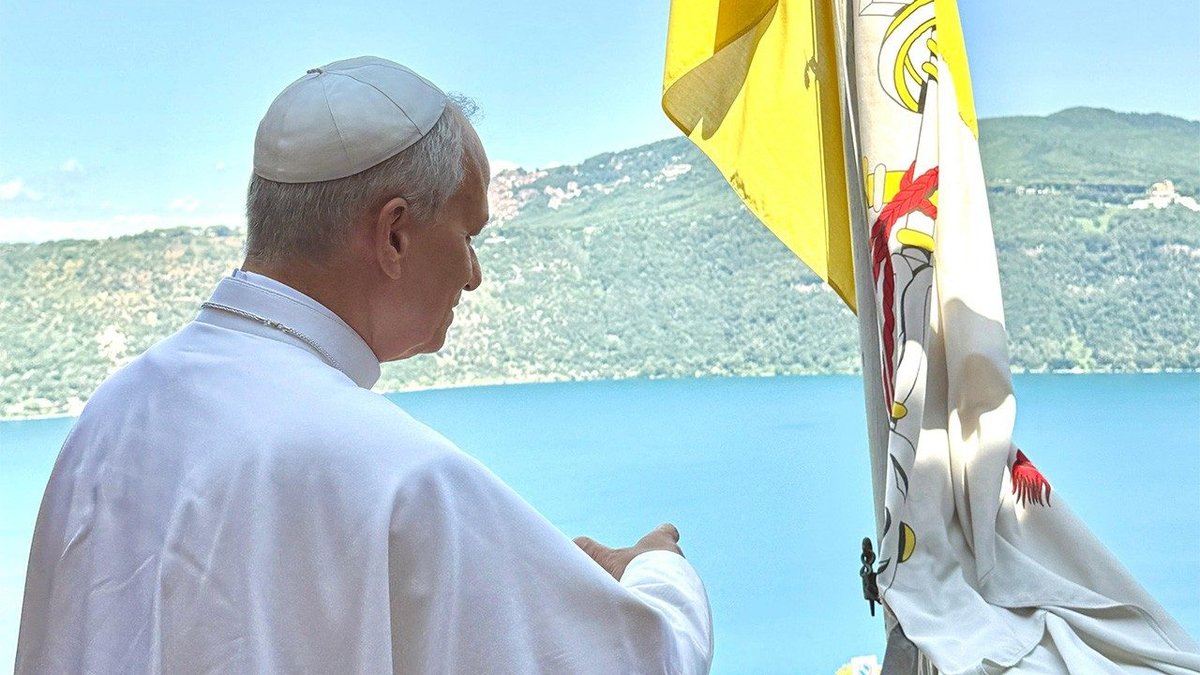
Last weekend Americans celebrated the 250th anniversary of the founding of the United States, and Pope Leo XIV offered a special message for the occasion with an assurance of his prayers.
He also delivered a video address live from Rome to an interfaith audience gathered in Philadelphia at the National Constitution Center, which awarded him the 2026 Liberty Medal. The Holy Father also visited the U.S. ambassador to the Holy See in Rome on July 4.
Capping the weekend in Philadelphia was the conclusion of the National Eucharistic Pilgrimage at the Cathedral Basilica of SS. Peter and Paul on Sunday, July 5, where the capacity congregation heard a video message from Pope Leo.
Meanwhile in Italy on July 4, the Holy Father visited the southern island of Lampedusa, where many migrants face hardships and death in hopes of a better life in Europe. Pope Leo celebrated Mass on the island and condemned the brutal treatment of migrants and refugees and the loss of life at sea, urging the world to concretely and compassionately respond to the “enormity of suffering.”
Aid, Prayers Flow into Venezuela After Severe Earthquakes
The Catholic aid and relief organization Caritas Venezuela reported that more than 14,700 tons of aid has been received from a global response to devastating earthquakes in the country on June 24 that left more than 3,900 people dead and thousands more displaced.
The aid as of July 6 has assisted some 40,000 people with life-saving supplies administered by more than 3,000 volunteers.
Pope Leo remembered the victims of the earthquake in his prayers during his Angelus address, along with a Vietnamese martyr who was beatified last week.
Christian Village at West Bank Threatened by New Israeli Settlements
The parish priest of the last Christian Palestinian village in the West Bank of Israel called for action to preserve the Christian presence in the region, which is threatened by possible construction of a new outpost for Israeli settlers.
Pope Leo emphasized in a letter to an Italian bishop that only God’s mercy can fill hearts with genuine solidarity and “enable enemies to extend a hand to one another.”
Residents of Cameroon, Haiti See Inhumane Conditions in Prisons, City Streets
An archbishop in Cameroon, Africa wrote a pastoral letter concerning inhumane prison conditions and corruption in the country including “systematic injustices” such as forced disappearances and arbitrary and secret detention of persons.
In Haiti, the security situation and living conditions continue to deteriorate as 1.5 million Haitians have been displaced from their homes and 1,600 people killed in just the last three months. A United Nations envoy blamed the chaos on criminal gangs that control up to 75 percent of the capital, Port-au-Prince.
With average inflation at 28.3 percent, nearly half of the population lives in extreme poverty and survives on less than three euros a day, according to the World Bank.
Vatican to Host Meeting on ‘Amoris Laetitia,’ Family Life, in October
The Vatican published a preparatory document ahead of a meeting in October in Rome concerning “Amoris Laetitia,” marking the 10th anniversary of that letter by Pope Francis.
Acknowledging the profound changes that continue to affect families, Pope Leo expressed his desire “to proceed, in mutual listening, to a synodal discernment on the steps to be taken in order to proclaim the Gospel to families today, in light of Amoris Laetitia and taking into account what is currently being done in the local Churches.”
Links to Governance of Artificial Intelligence, Slavery Noted in Europe, Africa
At a conference in Geneva, Switzerland on artificial intelligence, a representative of the Holy See called for robust governance of emerging AI to promote human dignity, serve humanity, and ensure accountability and responsibility.
Pope Leo sent a message to the “AI for Good Global Summit” stating: “As you are convening to reflect upon AI, which raises some of the major questions of our time regarding the future of humanity, the Holy Father would like to assure you of the Holy See’s presence and openness to dialogue, especially in this epochal turning point.”
A bishop in Tanzania observed that the publication of Pope Leo’s encyclical “Magnifica Humanitas” coincided with Africa Day. Bishop Method Kilaini, also a Church historian, expressed gratitude that the encyclical included the first papal apology for the Holy See’s role in legitimizing the transatlantic slave trade as well as failing to condemn the forced enslavement of an estimated 10 to 12 million Africans across the Atlantic to the Americas where they labored on plantations under brutal conditions.
The bishop hoped “Magnifica Humanitas” would protect Africans “from new forms of slavery and domination by a few people who may not necessarily have a good conscience,” he said.
Pope Leo Begins Summer Vacation Outside Rome
Pope Leo began his two-week summer vacation at Castel Gandolfo outside Rome. The pope told local residents who greeted him warmly that he was “very happy to be here among you and to spend the next few weeks with a little rest, a little prayer, a little reading, and, hopefully, a little sport here in Castel Gandolfo!”
While in the town on July 11, he will host a lunch with 200 poor people from Rome at the Borgo Laudato si’, located within the Pontifical Gardens of Castel Gandolfo. Their visit will include a Mass with the pope, a tour of the gardens and a meal with the Holy Father.
Share this story
Facts Only
* Americans celebrated the 250th anniversary of the founding of the United States.
* Pope Leo offered a message and prayers for this occasion.
* Pope Leo delivered a video address live from Rome to an interfaith audience in Philadelphia.
* The National Constitution Center awarded Pope Leo the 2026 Liberty Medal.
* Pope Leo visited the U.S. ambassador to the Holy See in Rome on July 4th.
* The National Eucharistic Pilgrimage concluded in Philadelphia on Sunday, July 5th.
* Pope Leo visited Lampedusa on July 4th.
* Pope Leo celebrated Mass on Lampedusa and condemned brutal treatment of migrants and refugees.
* Caritas Venezuela reported receiving more than 14,700 tons of aid for earthquake relief in Venezuela on June 24th.
* Aid as of July 6th assisted some 40,000 people with life-saving supplies administered by over 3,000 volunteers.
* Pope Leo remembered earthquake victims and a Vietnamese martyr in his Angelus address.
* A priest in the West Bank called for action to preserve the Christian presence against potential Israeli outpost construction.
* An archbishop in Cameroon reported inhumane prison conditions and corruption, including forced disappearances.
* In Haiti, 1.5 million Haitians were displaced and 1,600 people were killed in three months.
* World Bank data shows average inflation at 28.3 percent in Haiti, with nearly half the population living in extreme poverty.
* The Vatican published a preparatory document for an October meeting on "Amoris Laetitia."
* A representative called for robust governance of emerging AI to promote human dignity in Geneva.
* A bishop noted Pope Leo's encyclical "Magnifica Humanitas" included an apology for the Holy See’s role in legitimizing the transatlantic slave trade.
Executive Summary
Full Take
The narrative juxtaposes high-level spiritual and geopolitical engagement with stark realities of global suffering and systemic injustice. The sequence links papal pronouncements on human dignity and migration directly to tangible crises—earthquakes, migrant suffering in the Mediterranean, and internal repression in various nations like Cameroon, Haiti, and the Israeli-Palestinian context. This layering suggests a pattern where moral advocacy operates within established political and humanitarian frameworks, seeking intervention for those most marginalized by structural forces.
The focus on the Holocaust echoes across contexts: the historical acknowledgment of the transatlantic slave trade through "Magnifica Humanitas" is set against contemporary concerns regarding modern forms of domination (slavery in prisons, refugee crises, and AI governance). This establishes a lineage where recognition of historical wrongs fuels present-day calls for compassionate response. The juxtaposition between the spiritual focus on family life ("Amoris Laetitia") and material realities (poverty statistics in Haiti) forces an examination of how abstract theological concepts translate—or fail to translate—into effective social change.
The pattern emerging is the deployment of high moral authority to address multifaceted suffering, whether environmental disaster or political oppression. The framing avoids presenting a singular cause for suffering, instead mapping disparate crises onto a common theme of systemic failure and the imperative for shared humanity. This strategy risks turning complex, localized struggles into symbolic affirmations within a global discourse, requiring scrutiny of whose voices are amplified and whose needs remain peripheral to the stated response.
Bridge Questions: How do the specific geopolitical contexts—from Venezuela's earthquakes to Israeli settlements or Haitian instability—interact with, or resist, the universal calls for compassion articulated by religious leaders? What mechanisms exist for translating high-level moral appeals regarding AI governance or historical slavery into enforceable policies addressing immediate humanitarian crises? If global recognition of suffering is achieved, where does the responsibility for implementing tangible change ultimately reside?
Sentinel — Human
This text appears to be a human-authored journalistic synthesis that deliberately connects religious figures and humanitarian crises across different continents to frame a broad moral argument.