23.03.2026 - 13:06
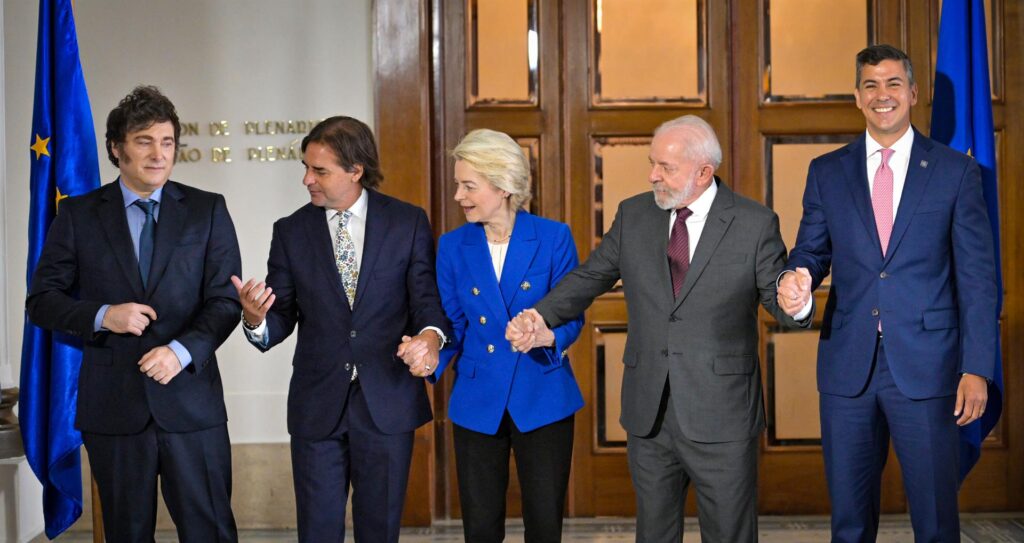
La Unió Europea començarà a aplicar provisionalment l’acord comercial amb Mercosur l’1 de maig. Ho ha anunciat la Comissió Europea, que diu que ha completat el procés necessari per posar en marxa el pacte. L’acord estableix l’eliminació gradual dels aranzels sobre el 91% de les exportacions europees als països de Mercosur (l’Argentina, el Brasil, el Paraguai i l’Uruguai) i sobre el 92% de les exportacions de Mercosur a la Unió Europea.
Brussel·les ha tirat endavant l’aplicació provisional sense l’aval del Parlament Europeu, que al gener va votar a favor de portar l’acord al Tribunal de Justícia de la UE (TJUE). Segons el comissari europeu de Comerç, Maros Sefcovic, l’acord “és un pas important per demostrar la credibilitat europea com a gran soci comercial”. Ha afegit: “La prioritat ara és convertir aquest acord UE-Mercosur en resultats concrets i oferir als exportadors europeus la plataforma que necessiten per aprofitar noves oportunitats de comerç, creixement i feina. L’aplicació provisional ens permetrà començar a complir aquesta promesa.”
L’anunci ha arribat després que l’Argentina, el Brasil i l’Uruguai hagin notificat a la UE que han ratificat l’acord. El Paraguai l’ha ratificat recentment i, segons la Comissió Europea, “s’espera que enviï la seva notificació aviat”.
La part comercial de l’acord que s’aplicarà és competència exclusiva de la UE. Els estats de la Unió hi van donar suport el desembre passat, tot i l’oposició de França i Polònia. La votació al Parlament Europeu no s’ha fet, perquè els eurodiputats van aprovar per la mínima portar el pacte al TJUE a conseqüència de les protestes del sector agrari i la necessitat d’avaluar si l’acord s’ajusta als tractats comunitaris.
Aplicació provisional sense votació de l’Eurocambra
Els tractats de la Unió permeten que la Comissió Europea, amb el vistiplau del Consell de la UE –que reuneix els estats membres–, apliqui provisionalment la part que fa referència exclusiva a les competències europees sense votació de l’Eurocambra. Tot i que la majoria de forces parlamentàries confiaven que la Comissió no activaria l’acord sense l’aval del Parlament, Ursula von der Leyen ha decidit tirar endavant la seva aplicació provisional.
Amb això, el pacte de lliure comerç amb Mercosur podrà començar-se a aplicar, però continuarà el seu recorregut al TJUE. El tribunal de Luxemburg pot trigar més d’un any a emetre una opinió. Si la resolució és favorable, l’acord podrà continuar el tràmit parlamentari i passar a votació del ple.
“L’aplicació provisional és, per la seva naturalesa, provisional. Ja ho diu el nom. D’acord amb els tractats de la UE, l’acord només es podrà concloure plenament un cop el Parlament Europeu hi doni el consentiment”, ha dit la presidenta de la Comissió quan ha anunciat l’aplicació provisional de l’acord.
Què inclou l’acord?
L’entrada en vigor de l’acord suposarà l’eliminació gradual dels aranzels sobre el 91% de les exportacions de la UE al Mercosur i el 92% de les exportacions del Mercosur a la Unió. Això ha de beneficiar sectors europeus com l’automoció, la maquinària, la indústria farmacèutica, el tèxtil i productors d’oli d’oliva o vi, que sovint exporten a Sud-amèrica amb aranzels de fins al 35%. Pel que fa al Mercosur, l’acord facilitarà l’entrada de productes com la carn, el sucre, l’arròs o la soja al bloc europeu. L’executiu europeu calcula que més de 60.000 empreses s’estalviaran aranzels per un total de 4.000 milions d’euros anuals.
Pel que fa al sector agroalimentari, Brussel·les sosté que el pacte permetrà “un accés sense precedents” a Mercosur per als agricultors europeus. La Comissió calcula que la liberalització comercial incrementarà les exportacions agroalimentàries de la UE al Mercosur d’un 50%. El text garanteix la protecció de 344 indicacions geogràfiques europees.
El pacte també vol facilitar el comerç de serveis, obrir la contractació pública i “millorar l’accés” a matèries primeres essencials per a l’economia europea reduint o eliminant taxes i restriccions d’exportació.
Controls i límits a la importació de productes sensibles
Per apaivagar el malestar d’agricultors i ramaders, Brussel·les ha introduït canvis en l’acord, fins a l’últim moment, i ha promès més ajudes europees al sector. L’acord conté limitacions a la importació de productes “sensibles” per als europeus, com la carn de vedella, l’etanol, la carn de porc, la mel, el sucre o l’aviram. Per exemple, es preveu una quota de 180.000 tones d’aviram sense aranzels i de 99.000 tones de carn de boví amb un aranzel del 7,5%.
També s’han inclòs clàusules de salvaguarda per protegir el sector agroalimentari d’un impacte negatiu d’un increment d’importacions procedents de Mercosur. La Comissió podrà obrir una investigació si detecta “pertorbacions” en el preu o el volum d’importacions de productes definits com a “sensibles”, com la carn de boví, el pollastre, els ous o el sucre.
Brussel·les podrà investigar si el preu d’importació és un 5% més baix que l’europeu equivalent, si hi ha un augment mínim del 5% en el volum d’importacions anuals respecte de la mitjana dels darrers tres anys, o si el preu de les importacions cau un 5%.
Per aconseguir l’acord, Von der Leyen es va comprometre a donar ajudes addicionals al sector agrari per mitjà de l’anticipació de 45.000 milions d’euros del proper pressupost de la política agrària comuna (PAC).
Facts Only
The EU will provisionally apply the Mercosur trade agreement starting May 1, 2026.
The agreement eliminates tariffs on 91% of EU exports to Mercosur and 92% of Mercosur exports to the EU.
Mercosur consists of Argentina, Brazil, Paraguay, and Uruguay.
The European Commission announced the decision, bypassing the European Parliament’s approval.
The European Parliament voted in January 2026 to refer the agreement to the EU Court of Justice (TJUE).
The Commission claims provisional application is permitted under EU treaties for trade-related matters.
Argentina, Brazil, and Uruguay have ratified the agreement; Paraguay recently ratified and is expected to notify the EU soon.
The EU Council of Member States supported the agreement in December 2025, despite opposition from France and Poland.
Safeguards include quotas on sensitive products: 180,000 tons of poultry and 99,000 tons of beef with reduced tariffs.
The Commission can investigate market disruptions if import prices drop 5% below EU equivalents or volumes rise 5% annually.
The EU has committed to advancing €45 billion in agricultural subsidies to address sector concerns.
The TJUE review may take over a year; a favorable ruling would allow the agreement to proceed to a full parliamentary vote.
The deal protects 344 European geographical indications and aims to improve access to raw materials.
Executive Summary
The European Union will provisionally implement its trade agreement with Mercosur starting May 1, 2026, following ratification by Argentina, Brazil, Uruguay, and Paraguay. The deal eliminates tariffs on 91% of EU exports to Mercosur and 92% of Mercosur exports to the EU, benefiting sectors like automotive, pharmaceuticals, and agriculture. The European Commission proceeded without the European Parliament’s approval, which had voted to refer the agreement to the EU Court of Justice (TJUE) due to concerns from the agricultural sector and legal scrutiny. The Commission argues the provisional application is legally permissible for trade-related provisions under EU treaties, though full ratification requires parliamentary consent. Safeguards have been added to protect sensitive EU agricultural products, including quotas on beef and poultry imports, alongside emergency measures to address market disruptions. The agreement also includes protections for 344 European geographical indications and aims to improve access to raw materials. The TJUE’s review may take over a year, and its decision will determine the pact’s future.
Critics, including French and Polish governments and EU farmers, oppose the deal, fearing market distortions and insufficient protections. The Commission has pledged additional agricultural subsidies to mitigate concerns. The provisional implementation reflects a strategic push by Brussels to assert the EU’s role as a global trade partner, despite internal divisions and pending legal challenges.
Full Take
**Steelman:** The EU’s provisional implementation of the Mercosur trade deal is a calculated move to reinforce its global trade credibility, leveraging legal mechanisms to bypass parliamentary gridlock. The Commission’s argument—that provisional application is permissible for trade-specific provisions—holds weight under EU treaties, and the inclusion of safeguards for sensitive sectors demonstrates responsiveness to domestic concerns. The deal’s potential to boost EU exports by €4 billion annually and protect geographical indications is a tangible economic upside.
**Pattern Scan:** The narrative exhibits elements of **ARC-0024 Ambiguity**—the provisional application frames the agreement as a fait accompli while its legal fate remains unresolved at the TJUE. The Commission’s emphasis on "credibility" and "opportunities" leans into **ARC-0043 Motte-and-Bailey**, where the broad principle of free trade (motte) is used to justify bypassing democratic scrutiny (bailey). The late-stage addition of agricultural safeguards and subsidies could be read as **ARC-0012 Preemptive Concession**, deflecting criticism by offering compensatory measures without addressing structural concerns.
**Root Cause:** The paradigm here is the tension between technocratic efficiency and democratic legitimacy in EU trade policy. The unstated assumption is that economic integration must outpace political deliberation to remain competitive—a recurring pattern in EU governance, echoing past controversies like TTIP or CETA. The agricultural sector’s opposition reflects deeper anxieties about globalized supply chains undermining local livelihoods, a conflict often framed as "progress vs. protectionism" but rooted in unequal risk distribution.
**Implications:** For human agency, the provisional application sets a precedent where executive bodies can advance major agreements despite parliamentary resistance, eroding accountability. The beneficiaries are multinational exporters and Mercosur agribusiness, while EU farmers and smaller producers bear the costs of increased competition. Second-order consequences may include further politicization of trade policy, emboldening populist backlash against "Brussels overreach."
**Bridge Questions:**
1. If the TJUE strikes down the agreement, what does that reveal about the limits of the Commission’s authority—and how might it reshape future trade negotiations?
2. The deal’s safeguards rely on reactive measures (e.g., investigating price drops). Could proactive structural adjustments (e.g., supply chain diversification) better address farmers’ concerns without resorting to protectionism?
3. How does the EU’s framing of "credibility" as a trade partner interact with its democratic deficit? Is this a necessary trade-off, or a symptom of institutional overreach?
**Counterstrike Scan:** A coordinated influence campaign would exploit the ambiguity of provisional application to create a sense of inevitability ("the train has left the station"), while downplaying legal risks and amplifying economic benefits to manufacture consent. The actual content aligns partially—Brussels’ messaging emphasizes urgency and opportunity—but stops short of outright deception. The inclusion of safeguards and parliamentary acknowledgment of the TJUE process mitigates the most manipulative aspects. No clear structural alignment with a bad-faith playbook, though the strategy risks normalizing executive overreach under the guise of pragmatism.
**Patterns detected:** ARC-0024 Ambiguity, ARC-0043 Motte-and-Bailey, ARC-0012 Preemptive Concession
Sentinel — Human
The article shows strong signs of human authorship, with natural language variation, specific policy details, and direct quotes from named officials. Minimal stylometric or coordination red flags suggest low probability of synthetic origin.