June 16, 2026 | Policy Brief
Deploying Syrian Troops in Lebanon Would Help, Not Hurt, Hezbollah
June 16, 2026 | Policy Brief
Deploying Syrian Troops in Lebanon Would Help, Not Hurt, Hezbollah
“I told Israel it should let Syria handle Hezbollah because, frankly, I think Syria would do a better job,” President Donald Trump said during the G7 summit in Paris.
Trump’s comment was the second time this month that he suggested a broader Syrian role in confronting Iran’s terrorist proxy in Lebanon. On June 7, he declared that Syria could help enable more “surgical strikes” on Hezbollah.
Yet Syrian officials have continued to signal their reluctance to become involved in Lebanon. Syrian President Ahmad al-Sharaa dismissed reports of a Syrian intervention, stating, “what is being circulated about Syria entering Lebanon is unfounded.” His adviser, Muwaffaq Zeidan, reinforced that position, saying that Damascus had “refused to intervene in Lebanon despite an American proposal.”
Since the overthrow of former dictator Bashar al-Assad, Syria’s new rulers have had strong reasons to confront Hezbollah, which supported the former regime, used Syrian territory to move weapons, and sheltered Assad-era officials in Lebanon.
Yet a Syrian intervention in Lebanon could hand Hezbollah a lifeline. It would allow the group to recast its weapons as protection against foreign intervention rather than a challenge to the sovereignty of the Lebanese state. It would also revive memories of Syria’s decades-long occupation of Lebanon and rally communities that otherwise oppose Hezbollah.
Syrian Intervention Would Strengthen Hezbollah
Hezbollah’s late Secretary-General Hassan Nasrallah consistently argued that the “weapons of the resistance” existed to “protect Lebanon and all Lebanese.” At a time when domestic critics increasingly pressure Hezbollah to explain why its weapons should remain outside state control, any Syrian intervention would allow it to claim more credibly that Lebanon faces an external threat. Whereas many Lebanese question Hezbollah’s claims that it is protecting Lebanon from Israel, there would likely be greater agreement that a Syrian incursion merits resistance.
Hezbollah can also use a Syrian incursion as a rally-around-the-flag moment. Nasrallah’s successor, Naim Qassem, has described the authorities in Damascus as “takfiri [apostasy] groups,” while a Lebanese historian noted that Hezbollah is seeking to “frighten” the public with “a jihadi threat represented by Sharaa’s forces.” In a country where sectarian memories are deeply rooted, this messaging will resonate with many Lebanese, even those who oppose Hezbollah. Instead, many Lebanese would view it through the lens of Syria’s 29-year occupation of Lebanon, fueling concerns about a return of Syrian influence over the country.
Syrian Military’s Poor Track Record
The Syrian military does not have the capability and discipline to carry out a complex operation against Hezbollah. Its record under Sharaa raises concerns about its conduct, especially since many of its units remain poorly trained — a serious liability in a sensitive environment such as Lebanon.
The army’s actions during the March 2025 massacre in Syria’s Alawite areas and the July 2025 fighting in Suwayda demonstrate the government’s inability to manage sectarian tensions. Those episodes resulted in roughly 1,500 deaths in the Alawite massacres and around 1,700 deaths in Suwayda.
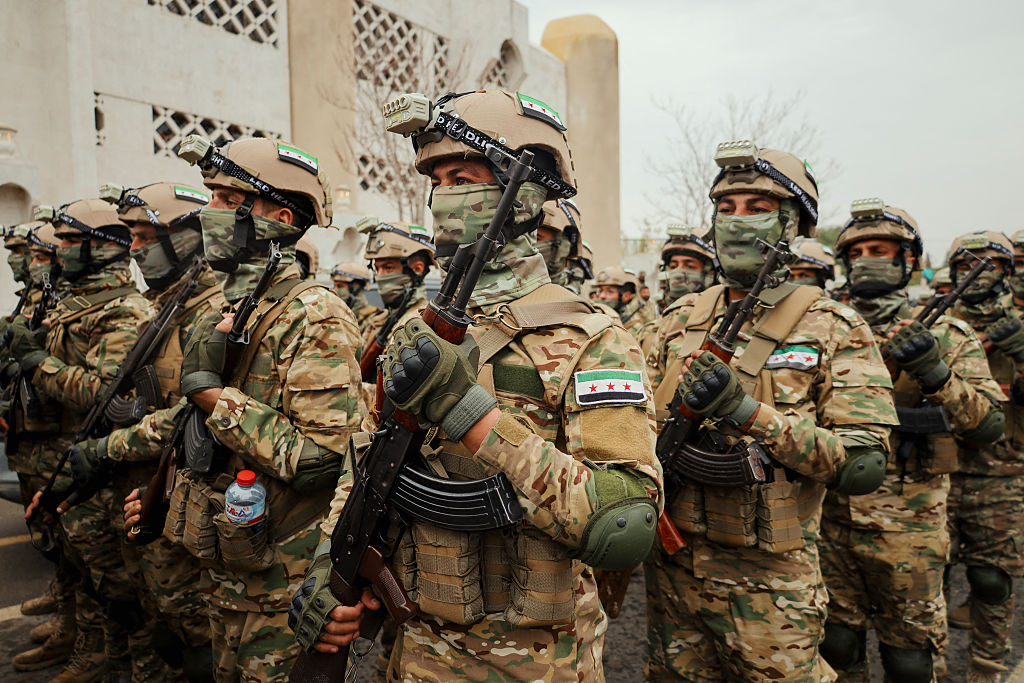
An expanded Syrian military presence in Lebanon could also create new concerns for Israel. Jerusalem has remained cautious toward Syria’s new rulers because of their jihadist background, roots in al-Qaeda, and the presence of foreign fighters in their ranks. Granting Damascus a larger military role in Lebanon would likely raise fears in Israel about the long-term implications of a stronger and more confident Syrian state operating on its border. These concerns are reinforced by the attitudes of elements within the Syrian military. In one recent military parade, Syrian soldiers chanted, “Gaza, we are with you until death” — an indication of the persistence of anti-Israel sentiment.
Syria Should Take On Hezbollah in Its Own Territory, Not Lebanon
Damascus has already proven useful against Hezbollah from its own territory, intercepting hundreds of rockets destined for the group. Washington should focus on strengthening this role rather than encouraging a Syrian intervention in Lebanon. Building on the emerging Syria-Israel security mechanism could facilitate intelligence sharing on Hezbollah smuggling networks and weapons transfers, helping Syria disrupt the group’s regeneration.
Ahmad Sharawi is a senior research analyst at the Foundation for Defense of Democracies (FDD). For more analysis from Ahmad and FDD, please subscribe HERE. Follow FDD on X @FDD. Follow Ahmad on X @AhmadA_Sharawi. FDD is a Washington, DC-based, nonpartisan research institute focusing on national security and foreign policy.
Facts Only
President Donald Trump suggested on June 7, 2026, that Syria could help enable "surgical strikes" on Hezbollah.
Trump reiterated this stance at the G7 summit in Paris, stating that Syria could handle Hezbollah better than Israel.
Syrian President Ahmad al-Sharaa dismissed reports of a Syrian intervention in Lebanon as "unfounded."
Syrian adviser Muwaffaq Zeidan stated that Damascus had "refused to intervene in Lebanon despite an American proposal."
Hezbollah supported the former regime of Bashar al-Assad and used Syrian territory to move weapons.
Hezbollah's late Secretary-General Hassan Nasrallah argued that the group's weapons existed to "protect Lebanon and all Lebanese."
Naim Qassem, Nasrallah's successor, has described Syrian authorities as "takfiri [apostasy] groups."
The Syrian military has been involved in sectarian violence, including the March 2025 Alawite massacres and July 2025 fighting in Suwayda, resulting in roughly 3,200 deaths.
Syrian soldiers chanted "Gaza, we are with you until death" during a recent military parade.
Syria has intercepted hundreds of rockets destined for Hezbollah within its own territory.
The article suggests strengthening Syria-Israel security cooperation to disrupt Hezbollah's weapons transfers.
Ahmad Sharawi is a senior research analyst at the Foundation for Defense of Democracies (FDD).
Executive Summary
Full Take
The strongest version of this narrative is that a Syrian intervention in Lebanon, while ostensibly aimed at weakening Hezbollah, could backfire by providing the group with a rallying cry against foreign occupation. The article effectively highlights the potential for Hezbollah to exploit sectarian memories and frame its weapons as a defense against Syrian interference, which could unite otherwise divided Lebanese communities. It also raises valid concerns about the Syrian military's capabilities and conduct, citing recent sectarian violence as evidence of its instability. However, the piece assumes that Hezbollah's primary vulnerability is its domestic legitimacy rather than its military or logistical infrastructure, which may not fully account for the group's resilience.
Patterns detected: ARC-0024 Ambiguity (the article frames Syrian intervention as both a potential solution and a risk without resolving the tension), ARC-0043 Motte-and-Bailey (the argument shifts between "Syria could help" and "Syria would hurt" without clear resolution).
The root cause of this narrative is the assumption that Hezbollah's power derives primarily from its ability to manipulate Lebanese public opinion rather than its material capabilities. This echoes historical patterns where external interventions in Lebanon have often strengthened rather than weakened local armed groups by providing them with a unifying enemy. The implications for human agency are significant: if Hezbollah can successfully frame Syrian intervention as an existential threat, it could consolidate power even as its military position weakens.
Bridge questions: What evidence exists that Hezbollah's domestic support is actually declining? How would a Syrian intervention differ from past foreign military presences in Lebanon, and what lessons can be drawn from those experiences? Would a Syria-Israel security mechanism be more effective than direct intervention, and what risks does it pose?
Counterstrike scan: If this were part of a coordinated influence campaign, the playbook would involve amplifying divisions between Lebanon and Syria while downplaying the risks of intervention. The actual content does not fully match this pattern, as it presents both sides of the argument and acknowledges the complexities of the situation. However, the framing leans toward caution, which could align with a narrative aimed at discouraging military action.
Sentinel — Human
The text exhibits strong human-authored characteristics, displaying complex rhetorical structure and specific geopolitical context, consistent with high-level policy analysis rather than generic synthetic content.