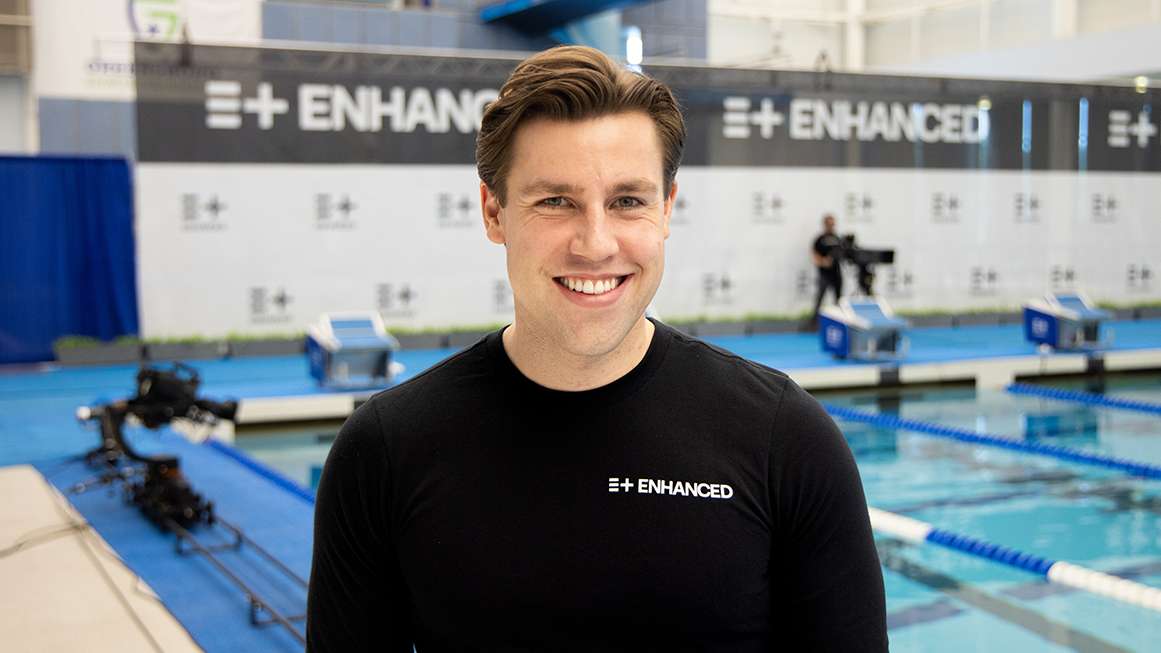
"Performance enhancements are actually, contrary to what many people think, not that dangerous," the Enhanced CEO tells Reason.
On May 24, the Enhanced Games aim to take athletic enhancement to the next level. Performance-enhancing substances are transparently allowed and encouraged at this event, and athletes work with a full-service medical team. The business positions itself as the smart version of enhancement, not meatheads juicing themselves indiscriminately. Organizers expect about 50 athletes in Las Vegas to compete in swimming, track and field, and weightlifting.
The performance-enhancing substances aren't just for the athletes, though. Enhanced wants to enhance you too. The company says a telehealth service is expected to be a larger share of its business than the sporting event itself—the company will sell tailored prescriptions for enhancement drugs such as testosterone replacement therapy and enclomiphene.
In January, Enhanced CEO Max Martin spoke with Jason Russell—who writes Free Agent, Reason's sports newsletter—about his goals for the Enhanced Games and the company—and who's trying to stop him.
Don't miss sports coverage from Jason Russell and Reason.
Q: What do you hope to accomplish with the Enhanced Games this year?
A: I hope we are one of the most watched sporting events of 2026 and establish ourselves on an equal level to the Super Bowl, the Monaco Grand Prix. I believe we will be able to showcase that performance enhancements are actually, contrary to what many people think, not that dangerous. But under the right clinical and medical supervision—that's very important for us—really something that can help athletes. And also not just athletes, but average people like myself, both for performance but also longevity and injury prevention.
Q: Is the goal of the games to showcase and normalize these treatments so that other sports leagues might start to allow them, or is it to, in the long term, try to replace other competitions?
A: First and foremost, we just want to build a great sporting event—that has merits on its own. I think of us as a new player on the map. I don't think of us being there to replace anyone. We've been compared to the Olympics, but I think we are very different in the offering we provide both to the athletes and fans.
We are showcasing—with a targeted, smaller group of athletes—what the human body is truly capable of. Science is our biggest asset that we've developed as a species. We let that biggest asset finally be a part of exploring what the body is capable of and helping humans [become] the best versions of ourselves. Performance enhancements have been misunderstood, have been much abused in the past. Once you take it out of the shadows and you put it out in the open, you put the right regulation around it, you can make it safe, and then explore the benefits.
Q: Are you worried about any government or regulatory crackdown that says this event is illegal, or that these treatments should be illegal?
A: I don't think it should be [illegal]. We're seeing a lot of lobbying by global organizations like the World Anti-Doping Agency, constantly calling the U.S. government to stop us, which is completely ridiculous because we are operating within the law. We are against some private institution taking a high stance on the law. If we have a problem with the law, we should change the law. But for now, we have the law, what is [Food and Drug Administration] approved, what can be prescribed to you by a doctor. I think as an individual, you should be able to do [it] because it's in the boundaries of the law.
And so, why should there be a private, mostly Swiss foundation that sits on top of that, that is governed by mostly elderly, white, overweight men that decides on what young athletes can put into their bodies?
This interview has been condensed and edited for style and clarity.
Facts Only
The Enhanced Games is an athletic event scheduled for May 24 in Las Vegas.
Performance-enhancing substances are transparently allowed and medically supervised at the event.
The event will feature around 50 athletes competing in swimming, track and field, and weightlifting.
Enhanced, the company behind the event, plans to expand into telehealth services offering prescriptions for enhancement drugs.
Enhanced CEO Max Martin aims for the Enhanced Games to become a major sporting event by 2026.
Martin argues that performance enhancements, under medical supervision, can be safe and beneficial.
The event positions itself as a regulated alternative to unsupervised enhancement practices.
Martin criticizes the World Anti-Doping Agency for lobbying against the event.
The company operates within existing FDA-approved regulations and prescriptions.
The event is framed as an exploration of human potential through science and medicine.
Executive Summary
Full Take
The Enhanced Games narrative presents a provocative challenge to traditional sports ethics, framing performance enhancement as a scientifically valid and medically supervised path to human potential. At its strongest, this argument leverages transparency and clinical oversight to counter the stigma around doping, positioning itself as a progressive alternative to shadowy, unregulated practices. It appeals to individual autonomy, questioning why private institutions like WADA should dictate what athletes can put in their bodies.
However, the narrative also employs subtle framing techniques. By contrasting "smart" enhancement with "meatheads juicing indiscriminately," it creates a false binary that dismisses legitimate concerns about health risks and fairness in sports. The critique of WADA as an "elderly, white, overweight" institution carries emotional weight but risks oversimplifying complex regulatory debates. The emphasis on legality ("operating within the law") sidesteps deeper ethical questions about whether current laws adequately address the long-term consequences of widespread enhancement.
Rooted in a libertarian paradigm of bodily autonomy and scientific progress, this narrative echoes historical debates over bioethics—from steroids in sports to gene editing. The implications are profound: if normalized, such events could redefine athletic competition, blur the line between therapy and enhancement, and shift public perception of doping from cheating to optimization. Yet, the second-order effects—such as pressure on young athletes to enhance or the commodification of human performance—remain underexplored.
Bridge questions: How might this shift affect athletes who choose not to enhance? What safeguards would prevent coercion or exploitation in a performance-driven culture? Could this model inadvertently reinforce inequalities, given unequal access to medical supervision?
Counterstrike scan: A coordinated influence campaign might weaponize the narrative of "scientific freedom" to erode trust in regulatory bodies, using emotional appeals about autonomy while downplaying risks. The actual content aligns partially with this pattern—criticizing WADA’s authority while emphasizing legality—but stops short of outright misinformation. The focus on medical supervision and transparency mitigates some concerns, though the long-term societal impact remains uncertain.
Patterns detected: ARC-0024 Ambiguity (false binary of "smart" vs. "indiscriminate" enhancement), ARC-0043 Motte-and-Bailey (retreat to legality when challenged on ethics)