Artists
In Chloe Wise’s ‘Extrasensory’ Basel Show, UFOs Meet Scripture
‘The Bible and religion sanitize and domesticate something that’s so wild,’ the artist said.
‘The Bible and religion sanitize and domesticate something that’s so wild,’ the artist said.
Gabi Vidal-Irizarry ShareShare This Article
The first room of Chloe Wise’s “Extrasensory” exhibition in Basel is a gift shop-slash botánica. The walls of the entrance of the Kulturstiftung Basel H. Geiger are powder blue and “busted on purpose,” Wise told me. She spent hours painting them to look moldy.
Crucifixes, rosaries, UFO keychains, branded lighters, tarot decks, and alien figurines occupy the same shelf. A menorah sits on top of a Sony monitor. Movie posters tacked up with yellow painter’s tape advertise films that don’t exist.
Some of the prayer candles bear the usual figures: Christ, the Virgin Mary, St. Anthony. But most depict the cast of PsyFi, Wise’s 34-minute, three-channel film, her longest video work to date. Among them are actor Steve Buscemi’s brother Michael, JT of the rap group City Girls, and the artist Martine Gutierrez.
Before you encounter these various actors, musicians, and downtown personalities in the film, two rooms later, you meet them as saints. (Even the artist’s Siamese cats receive the devotional treatment.)
I caught the Almine Rech–represented artist last month, on her 13th day in Basel.
“People walk in like, Where’s the show?” Wise told me inside her souvenir shop, laughing.
Just out of another interview and undercaffeinated, she was grateful, she told me, to speak with someone from New York. (The Tabi-clad artist, 36, is also based there.) We ventured to the nearest coffee shop, in the hospital across the street.
Wise is famous in a way most artists aren’t. She has a following outside the art world, she’s made songs with the comedian Eric Wareheim, and recently painted a vinyl cover for pop star Olivia Rodrigo.
Though I hadn’t met her before, I knew her work through the internet. In 2014, the artist came to attention for her hyperrealistic sculptures of bread bags and butter mounds. In recent years, she’s been better known for her portraits of New York personalities like Julia Fox‘s bestie, photographer Richie Shazam. In her glossy oil paintings, Baroque-lit subjects pose among self-help books, sometimes holding food. They have a seductive quality that makes them ripe for virality.
In her last show at Almine Rech in New York, “Myth Information,” this past fall, the artist began to explore what she calls “the phenomenon” through painting. Wise’s umbrella for “the phenomenon,” capital P, is wide: UFOs, angel contact experiences, divinity, telepathy, ghosts, the cosmos, quantum mechanics, and consciousness.
For the past seven years, she’s listened to audiobooks on those subjects while painting in her studio. She finds it absurd that anyone treats the existence of UFOs as a new question. “For me, it’s a natural place to get to if you’re interested in philosophy or any questions at all,” Wise said in between sips of a coffee slushie as we sat outside the Basel Standort Universitätsspital.
“Extrasensory,” her first institutional exhibition in Switzerland, revisits the subject through a different medium: an immersive installation, a book, and that three-channel film.
“It’s myopic to not even wonder,” Wise said of UFOs. “It’s such a funny cognitive dissonance where, since 2017, when the New York Times did that piece: Wait, so UFOs are real? Everyone’s like, Whoa. It’s like, hello?”
But her interest in the topic is ultimately aesthetic, not ontological.
She states this directly at the start of the show’s catalogue. “At stake here is not whether such phenomena exist,” she said, “but how they appear, how they enter experience, how they are felt, narrated, domesticated, or disavowed.”
Walter Benjamin understood the souvenir to be what remains after an experience has been translated into a commodity. The pilgrim leaves Lourdes with a plastic Virgin. The tourist leaves Paris with an Eiffel Tower keychain. The miracle becomes a tchotchke.
Past the gift shop is a green room, upholstered and mirrored, somewhere between a UFO that could take off and a dressing room; someone or something could be getting ready to step onto the stage. “There’s a Lynchian thing happening here,” she said.
And then you’re inside PsyFi, the centerpiece of the exhibition, written and directed by Wise and produced by Gummy Films.
The film runs on a rhythmic loop, cycling and glitching through visual archetypes of divinity, the supernatural, and pop culture. It opens and closes with the night sky, crickets, real UFO footage released by the U.S. government, and YouTube experiencers, an orb dancing low across the frame.
Kids watch a light in the dark, only to make way for Tiepolo– and Raphael–style angels (played by actor/model Bobbi Menuez and singer Moses Sumney) that morph into Victoria’s Secret Angels (artist Martine Syms and actor Sophia Lamar). Cut to Lucas Bravo of Emily in Paris as a red-dreadlocked shaman. Cut to Michael Buscemi’s devil, who looks like an Uncut Gems extra. Cut to an Anne Geddes-style photo shoot featuring an indie-sleaze-coded Miles Greenberg and Instagram comedian Delaney Rowe.
PsyFi‘s angels are where Wise’s argument lands. Visual language fails to represent the ineffable; the extrasensory is smoothened. A biblically accurate angel looks more like a UFO than a blonde baby with wings.
I asked her what one should look like. “Rotating disks, like Ezekiel’s wheel, multiple faces, hundreds of eyes, molten lava, fiery topaz,” she replied.
“The Bible and religion sanitize and domesticate something that’s actually so wild,” she said. As for what secular capitalist society did to angels: “We transformed it as a culture into hot women. We make these things more palatable.”
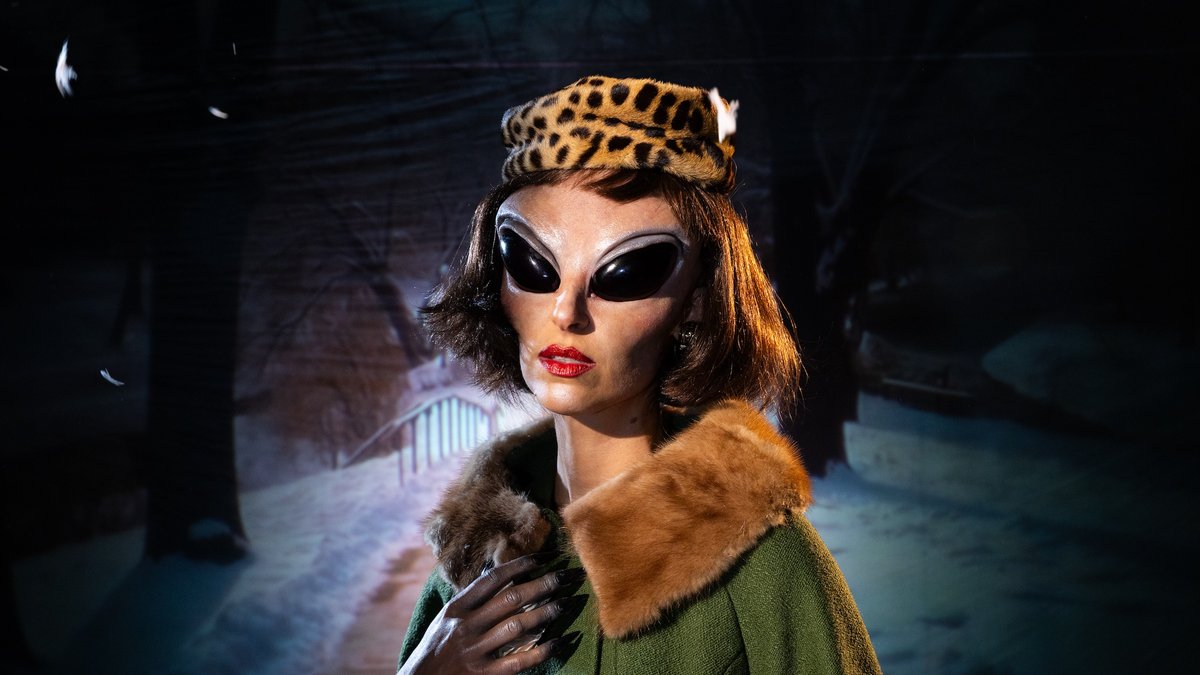
Walking back out through the green room and into the gift shop, I sat with the book. There is film still inside of it of Wise in alien prosthetics, a green fur-collared coat, and a leopard-print pillbox hat. It is hard not to think of Cindy Sherman.
Both artists star in their own work. Wise kept calling the film a painting, so I asked her about performance instead.
“I’m a performative person,” she said. “My paintings concern themselves with the aesthetics of artifice and performance: the uncanny, eerie feelings that can be both.” Then: “If the phenomenon itself is a performer—it steps onto the stage as an angel one day, and presents itself as a UFO to a farmer the next—what better way than to give it a stage performance?” Then: “I’m in it, too. I’m acting in it, too. I just can’t help myself.”
PsyFi, she said later, was a chance to make the most expensive painting she could.
Sherman’s work is the product of self-conscious debasement. She makes herself grotesque to the point of discomfort. Wise is luminous in every frame.
“Extrasensory” is on view at KBH.G, Spitalstrasse 18, Basel, Switzerland, through September 6.