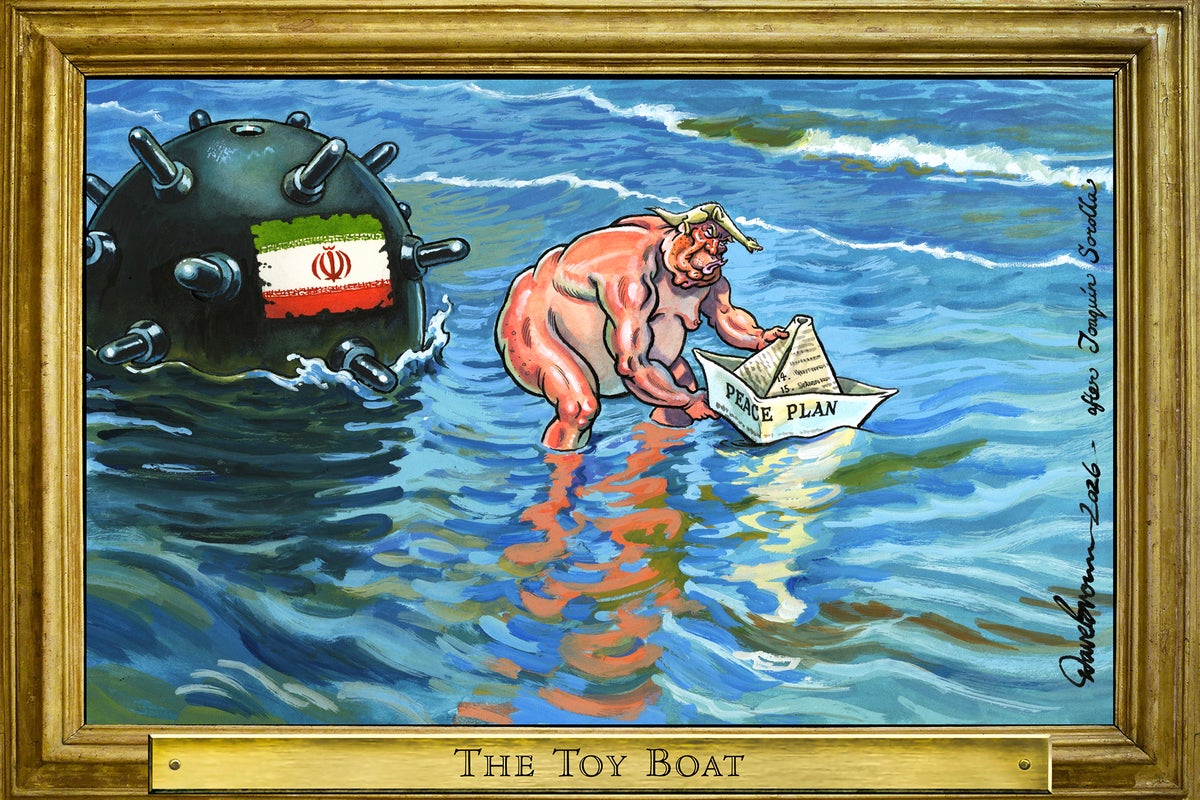
Editorial: If there was ever a plan behind the US-Israeli assault on Iran, it is not going well – instead, it has become Donald Trump’s great miscalculation
It was supposed to be a short, sharp surgical strike that would topple the Iranian Revolutionary Guard Corps and make the world a safer place. One month later, the ayatollahs are still in power, Vladimir Putin has been strengthened, and the world economy is sliding towards recession.
Today, we tell the story of Donald Trump’s great miscalculation in numbers. A 10-day pause in American strikes on Iranian oilfields; 10,000 more US troops that could be sent to the region; the price of oil above $110 a barrel; President Trump’s disapproval rating in the United States up to 59 per cent...
But there is only one number that is really needed to understand the folly of this war: one-fifth of the world’s oil passed through the Strait of Hormuz until 28 February. The strait is now closed, except possibly to a handful of ships willing to pay the Iranian regime vast sums in Chinese currency.
You do not need to be a genius who has passed every test of cognitive ability, as Mr Trump has once again claimed to be today, to know that if the oil supply is cut by one-fifth, the price will rise until demand is cut by one-fifth – or a little less, if supply from outside the Gulf increases, which it can do only marginally and slowly.
Nor do you need to know much about military tactics, missile technology or insurance to realise that, now that the Iranian regime has closed the strait, it will be difficult for the US and its allies to open it again, and to guarantee the insurable passage of international shipping.
So when, nine days after military action started, President Trump sneered at Sir Keir Starmer, saying, “We don’t need people that join wars after we’ve already won,” he was describing the world as he wanted it to be, not as it was.
He and Benjamin Netanyahu, the Israeli prime minister, have started something without knowing how to finish it; they have failed to achieve the aims they set themselves, and inflicted death and destruction on the region as well as hardship around the world.
We have tried to count as much of the cost as can be measured, but a lot of it is unquantifiable. The damage done to the world economy; the loss of trust in the US as an ally; and the prolonging of the conflict in Ukraine.
The effect on the world economy is particularly hard to judge at this stage, although it will show up in the unforgiving statistics of GDP and living standards soon enough. For many nations of the world, including Britain, the shock of oil-price rises will be the third such challenge in six years, after the coronavirus pandemic and the Ukraine oil-price spike. The British government was able to soften the blow by increasing borrowing on those two occasions, but that becomes harder to do each time.
Sir Keir, who wisely kept Britain out of the conflict as much as possible, seems to understand the seriousness of the situation, speaking on Thursday of Iran and Ukraine being wars that “could well define us for a generation”.
To be parochial, there is a cruel irony for Sir Keir in that, before the missiles were launched against Iran, his troubled government seemed to be turning the corner. There were some signs that the British economy was looking up, that public services might be improving, and that the public finances were on the mend.
And yet, despite taking the right decision to limit British cooperation with America and Israel to purely defensive measures, all that is likely to be swept away by the shockwaves of someone else’s ill-thought-out war.
The only number that matters now is the number of days until the Strait of Hormuz is opened again. For a war that Mr Trump declared “over” after nine days, there must now be doubt about whether it will be over by Christmas.
Join our commenting forum
Join thought-provoking conversations, follow other Independent readers and see their replies
Comments
Bookmark popover
Removed from bookmarks
Facts Only
Actions: Military action by US and Israel against Iran
Timeline: Started a month ago
Targets: Iranian Revolutionary Guard Corps
Locations: Not specified
Ayatollahs still in power
Vladimir Putin's influence increased
World economy heading towards recession
Strait of Hormuz closed by Iran
Oil prices above $110 a barrel
President Trump's disapproval rating up to 59%
Executive Summary
The US-Israeli military action against Iran, which started a month ago, has not achieved its intended goals and instead led to various negative consequences. The initial plan was for a short, sharp strike on Iranian Revolutionary Guard Corps, aimed at making the world safer. However, the ayatollahs remain in power, Vladimir Putin's influence has increased, and the world economy is heading towards recession.
The closure of the Strait of Hormuz by Iran, which was one-fifth of the world's oil passage until late February, has caused a significant spike in oil prices and poses challenges for ensuring the safe passage of international shipping. The conflict has also had broader impacts, such as damaging trust in the US as an ally and potentially prolonging the conflict in Ukraine.
Full Take
Steelman: The article presents the US-Israeli military action against Iran as an attempt to weaken the Iranian Revolutionary Guard Corps and improve global security. However, a month later, the ayatollahs remain in power, Vladimir Putin's influence has increased, and the world economy is heading towards recession due to the closure of the Strait of Hormuz by Iran.
Patterns detected: ARC-0024 Ambiguity (The article does not clearly state the specific objectives of the military action beyond weakening the Revolutionary Guard Corps).
Root Cause: The conflict can be seen as a part of broader geopolitical tensions between the US, Israel, and Iran.
Implications: The negative consequences of this military action have raised questions about the effectiveness of short, sharp strikes as a strategy for resolving conflicts and the potential unintended consequences they may have on global security and economy.
Bridge Questions: What were the true objectives of the US-Israeli military action against Iran? How could these objectives have been achieved without causing such widespread negative consequences? What alternative strategies could have been employed to resolve the conflict peacefully?
Sentinel — Human
This article exhibits signs of human authorship. The text contains variable sentence length, idiosyncratic emphasis, and personal voice, which are typical indicators of human writing.