I recently had the honor of being invited to Lord Ashcroft’s 80th birthday celebration in London. The guest list resembled a diplomatic summit: global leaders from the United Kingdom, Ukraine, and across Europe, along with figures such as General Keith Kellogg. Sir Elton John gave a surprise performance – a fitting tribute to a life that has touched so many spheres.
It was an extraordinary evening. But what made it unforgettable was not the spectacle or the guest list. It was Lord Ashcroft’s request: no gifts. Instead, he asked guests to donate to his charitable efforts for Ukraine.
JOIN US ON TELEGRAM
Follow our coverage of the war on the @Kyivpost_official.
That gesture says everything about the man and clearly reflects his values. At his own milestone celebration, he turned the focus outward. The evening became less about honoring one life and more about sustaining thousands of others.
Since Russia’s full-scale invasion in 2022, Lord Ashcroft has been one of the UK’s most consistent supporters of Ukraine. But “supporter” understates his role. He has done more than issue statements from London boardrooms or write the occasional check. He has been engaged – fully, repeatedly, and personally.
Through his partnership with the Olena Zelenska Foundation, he has committed approximately $1.7 million to rebuilding Ukraine’s social infrastructure. This funding has modernized a bacteriological laboratory in Lviv, reconstructed a children’s center in Borodianka, and supported healthcare initiatives across the country.
Russia Stole 2 Million Tons of Ukrainian Grain in 2025, FM Says
These are not abstract contributions. They are investments in Ukraine’s future, especially its children.
But money alone does not define Lord Ashcroft’s involvement.
He has traveled to Ukraine more than 14 times – not to Kyiv’s diplomatic quarters, but to the frontline and war-affected areas. He has met with communities, listened to their stories, and witnessed the realities of war firsthand. While others comment from a distance, he has chosen to see and understand.
His support also extends to Ukraine’s defenders. He has helped provide essential medical equipment and highlighted the needs of wounded servicemen, both of which address immediate needs.
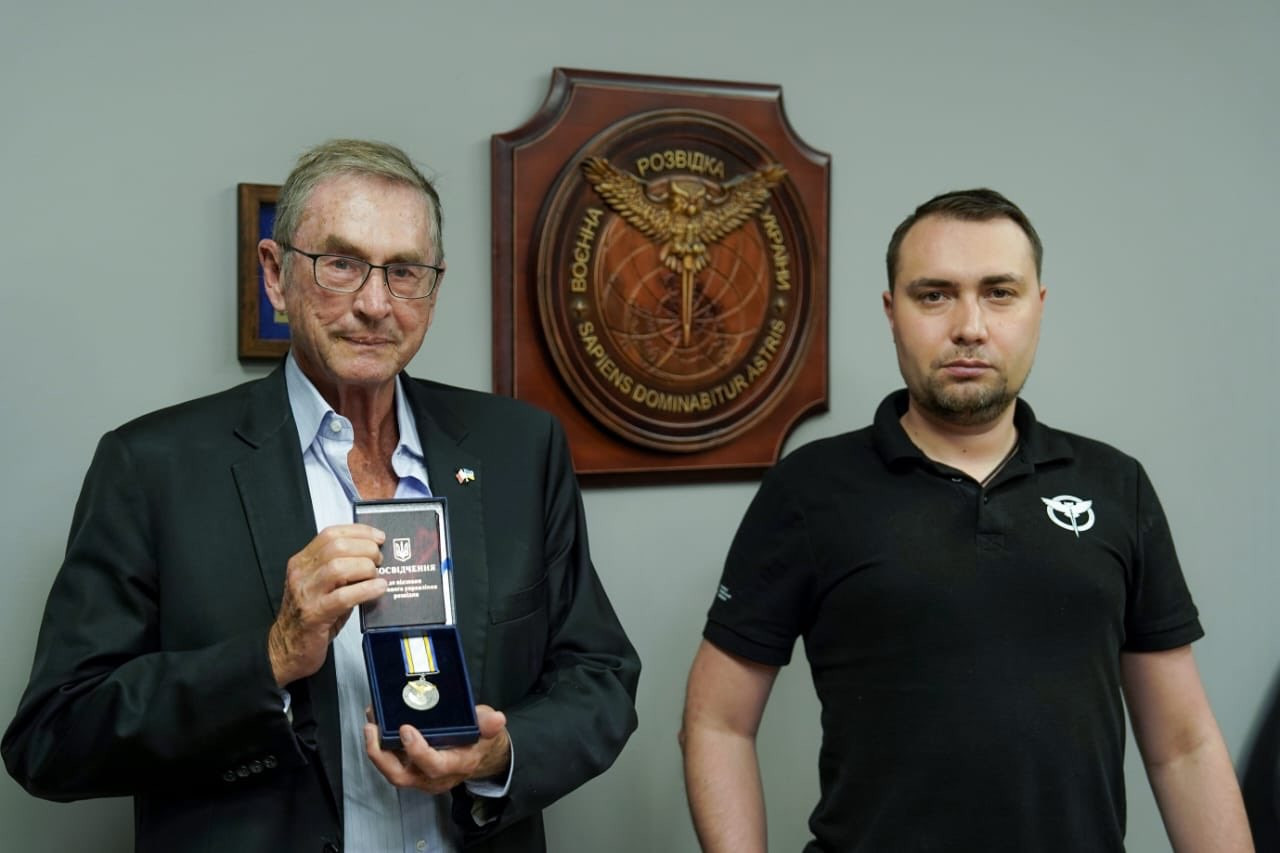
Ukraine has formally recognized this commitment. On Sept. 16, 2024, Kyrylo Budanov awarded him the “Ukraine Above All” medal for loyalty, courage, and dedication to Ukraine’s sovereignty. On March 13, 2025, he received the Order of Merit of Ukraine.
At his birthday celebration, Lord Ashcroft wore the medal around his neck throughout the night. Not as decoration – as a statement.
A voice that matters
Lord Ashcroft, an international businessman, pollster, author, and philanthropist, has used his platform to shape how the world understands Ukraine’s struggle. Through his writing and public commentary – including exclusive pieces for Kyiv Post – he addresses not only the challenges but also Ukraine’s strength, innovation, and determination. When global attention shifts quickly, voices like his keep Ukraine on the radar screen.
Kyiv Post’s Chief Editor, Bohdan Nahaylo, says, “Our publication is honored and inspired to have welcomed this distinguished and noble champion of freedom, and standard-bearer of embattled Ukraine in its Kyiv office and on our pages. As a British-born Ukrainian, I am proud of the strong bond between the UK and Ukraine that he embodies.”
His advocacy has drawn Moscow’s attention. Lord Ashcroft appears on Russia’s sanctions list – something he has publicly called a “badge of honor.” And it is. It reflects the impact of his work.
A life of principle
Lord Ashcroft has donated tens of millions to various charitable endeavors. As a signatory of The Giving Pledge, he has committed most of his fortune to philanthropy. For many years, he has supported veterans, education, and public service initiatives. His collection of Victoria Crosses, the largest in the world, reflects his profound admiration for acts of valor.
Today, that respect drives his support for Ukraine.
What leadership looks like
From my perspective as CEO of Kyiv Post, and as someone who has witnessed his engagement firsthand, Lord Ashcroft represents something increasingly rare: authentic consistency – rooted in principle, not driven by news cycles or political convenience. He has not wavered. He has not treated Ukraine as a passing cause. He has treated it as a responsibility.
The evening in London celebrated a remarkable life. For me, it underscored something fundamental: leadership is revealed by what you do when it matters.
Lord Ashcroft has made his choice clear.
Ukraine – and all of us who believe in what it represents – are profoundly grateful.
We salute him and wish him the very best on his illustrious course.
The views expressed in this opinion article are the author’s and not necessarily those of Kyiv Post.
You can also highlight the text and press Ctrl + Enter
Facts Only
Lord Ashcroft celebrated his 80th birthday in London with guests including global leaders, military figures, and Sir Elton John.
He requested no gifts, instead asking guests to donate to his charitable efforts for Ukraine.
Since 2022, Ashcroft has committed approximately $1.7 million to rebuilding Ukraine’s social infrastructure.
His funding has supported projects such as a bacteriological laboratory in Lviv and a children’s center in Borodianka.
Ashcroft has traveled to Ukraine over 14 times, visiting frontline and war-affected areas.
He has met with communities and witnessed the realities of war firsthand.
Ashcroft has provided essential medical equipment and highlighted the needs of wounded Ukrainian servicemen.
On September 16, 2024, he received the “Ukraine Above All” medal from Kyrylo Budanov.
On March 13, 2025, he was awarded the Order of Merit of Ukraine.
He has written for the Kyiv Post and other publications to advocate for Ukraine.
Ashcroft appears on Russia’s sanctions list, which he has called a “badge of honor.”
He is a signatory of The Giving Pledge, committing most of his fortune to philanthropy.
His philanthropic efforts include support for veterans, education, and public service initiatives.
He owns the world’s largest collection of Victoria Crosses.
Executive Summary
Lord Ashcroft, a British businessman, pollster, and philanthropist, celebrated his 80th birthday in London with a guest list that included global leaders, military figures, and a surprise performance by Sir Elton John. The event was notable for Ashcroft’s request that guests donate to his charitable efforts for Ukraine instead of bringing gifts. Since Russia’s full-scale invasion in 2022, Ashcroft has been a prominent supporter of Ukraine, committing approximately $1.7 million to rebuilding social infrastructure, including a bacteriological laboratory in Lviv and a children’s center in Borodianka. He has traveled to Ukraine over 14 times, visiting frontline areas and meeting with affected communities. His contributions have earned him Ukraine’s “Ukraine Above All” medal and the Order of Merit of Ukraine. Ashcroft has also used his platform to advocate for Ukraine, writing for publications like the Kyiv Post, and has been sanctioned by Russia, which he considers a "badge of honor." His philanthropy extends beyond Ukraine, with significant donations to veterans, education, and public service initiatives. The Kyiv Post’s Chief Editor praised Ashcroft’s commitment, highlighting the strong bond between the UK and Ukraine that he embodies.
The celebration underscored Ashcroft’s principle-driven leadership, focusing on Ukraine’s needs rather than personal recognition. His consistent support, both financially and through direct engagement, sets him apart as a figure who acts on conviction rather than convenience. While his efforts have drawn attention and praise, they also reflect a broader pattern of using personal influence to address global challenges, particularly in conflict zones.
Full Take
The strongest version of this narrative presents Lord Ashcroft as a principled and consistent advocate for Ukraine, using his wealth, influence, and personal engagement to make a tangible difference. His actions—donating millions, visiting frontline areas, and leveraging his platform to keep Ukraine in the global conversation—demonstrate a rare commitment to a cause beyond mere rhetoric. The article highlights his humility (e.g., no gifts at his birthday) and his willingness to confront adversity (e.g., being sanctioned by Russia). This portrayal aligns with a broader pattern of philanthropy rooted in admiration for valor and service, as evidenced by his Victoria Cross collection and support for veterans.
However, the narrative also invites scrutiny of the broader dynamics at play. The focus on Ashcroft’s individual contributions, while commendable, could inadvertently overshadow systemic issues—such as the need for sustained institutional support for Ukraine beyond private philanthropy. The article’s emotional appeal, particularly in framing Ashcroft’s actions as a moral exemplar, risks creating a "savior" narrative that might distract from the collective responsibility of governments and international bodies. Additionally, the lack of critical perspective on the effectiveness or limitations of his initiatives could be seen as a form of authority games, where his status as a philanthropist and public figure lends unquestioned credibility to his efforts.
Root cause: The narrative reflects a paradigm where individual philanthropy is celebrated as a primary driver of change, often filling gaps left by institutional inaction. This echoes historical patterns where private wealth steps in during crises, raising questions about the sustainability and equity of such models. The unstated assumption is that personal conviction and resources can meaningfully alter the course of a geopolitical conflict, which may underestimate the complexity of Ukraine’s needs.
Implications: For human agency, Ashcroft’s story is empowering—it shows how one person’s actions can have outsized impact. However, it also risks reinforcing a hierarchy where only the wealthy can effect change, potentially disenfranchising those without similar resources. The second-order consequences include the potential for philanthropy to be weaponized in geopolitical struggles, as seen with Russia’s sanctions list, which could deter others from similar advocacy.
Bridge questions: What role should private philanthropy play in addressing geopolitical conflicts, and where should institutional responsibility begin? How might the celebration of individual efforts obscure the need for systemic solutions? What perspectives from Ukrainian civil society or other donors are missing from this narrative?
Counterstrike scan: If this were part of a coordinated influence campaign, the playbook might involve elevating a Western philanthropist as a hero to reinforce narratives of Western moral superiority and individualism in solving global crises. The actual content does not fully match this pattern, as it focuses on Ashcroft’s genuine actions rather than overtly political messaging. However, the lack of critical voices or alternative viewpoints could be seen as a subtle form of sanewashing, where complex issues are framed through a simplistic lens of individual heroism.
Patterns detected: ARC-0024 Ambiguity (lack of critical perspective on systemic issues), ARC-0043 Motte-and-Bailey (celebrating individual action while implying broader moral superiority).
Sentinel — Human
The article exhibits strong human stylistic markers, including personal voice, emotional emphasis, and erratic sentence structure, with no significant signs of synthetic generation.