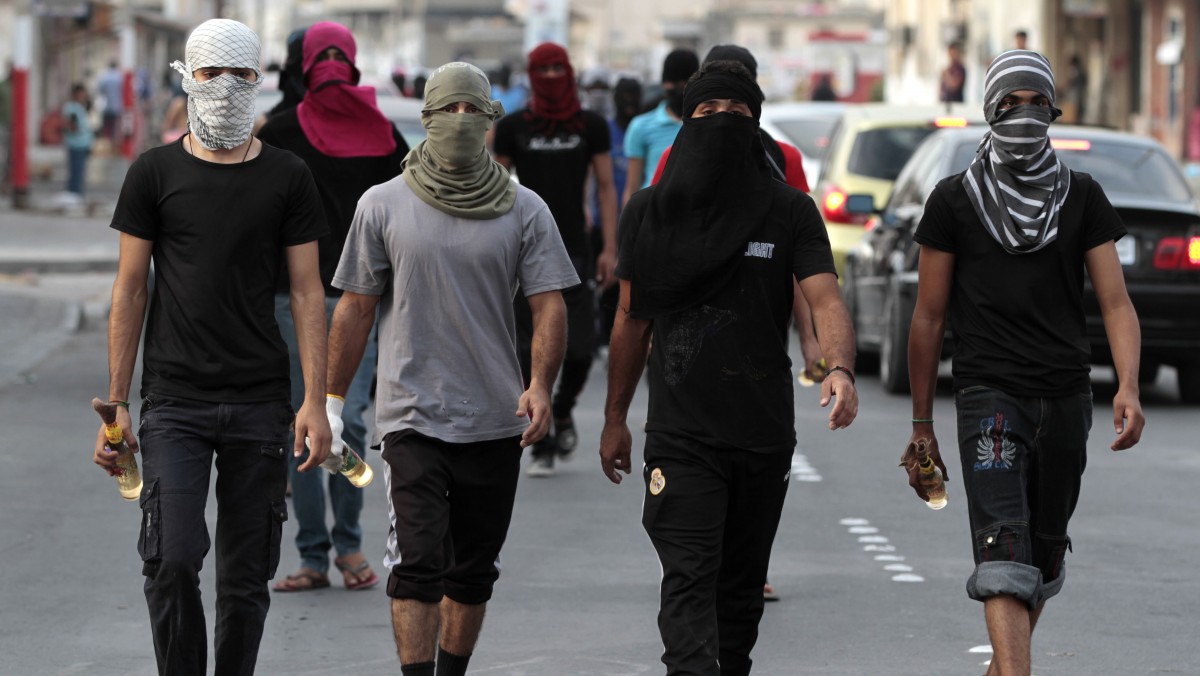
Since February 28, following the Israeli-US war of aggression against Iran, the Islamic Republic has targeted vital US military infrastructure bases in Persian Gulf nations, the worst hit being Bahrain. Simultaneously, the assassination of Ayatollah Seyyed Ali Khamenei has revived the predominantly Shia island’s 2011 revolutionary fervor.
With round the clock missile and drone strikes, civil unrest, damage to vital infrastructure and even rumors that its leader has fled, chaos has characterized the state of affairs in Bahrain. According to reports, the sudden devastation inflicted on Gulf economies have led to contestations from their leaderships, who claim to have not been sufficiently notified of the US-Israeli assault.
The first wave of Iranian retaliatory strikes targeted the Naval Support Activity (NSA) Bahrain base, striking it directly and inflicting damage to the headquarters for the US Naval Forces Central Command (NAVCENT). Locations belonging to the 5th Fleet were specifically targeted, resulting in large fires burning for hours.
Around twenty-four hours following the initiation of the conflict, the Islamic Republic of Iran officially announced the death of its leader, Ayatollah Khamenei. This development would subsequently impact Bahrain over any other Gulf nation, as its citizenry are predominantly Shia Muslims, who are ruled by the Sunni King, Hamad bin Isa al-Khalifa, who was installed by the British.
For many Shia Muslims, Ayatollah Khamenei was their equivalent to what the Pope represents to Catholic Christians. The Bahraini Royal family, having normalized ties with Israel and who have relied on neighboring Gulf nations to violently put down protests and revolts, were immediately put in hot water by the use of their country to aid in the war effort against Iran.
As a result, Bahrainis began staging protests across the country for around four days.
This was until neighboring Saudi Arabia began deploying the Unified Military Command [formerly called the Peninsula Shield Forces] to crack down upon the brewing uprising. The details concerning potential further protests have since been scarce.
⚡️#BREAKING Exclusive: Peninsula Shield Forces seen in Bahrain.
They just entered from Saudi. pic.twitter.com/LhQ7KBqW6e
— War Monitor (@WarMonitors) March 2, 2026
Alongside the crackdown on protesters has also come a wave of arrests against individuals sharing videos of Iranian munitions impacting sites across the country. Washington-based pro-war think tank, the Foundation for Defense of Democracies (FDD), said that the identities of those celebrating Iran’s strikes on US facilities have been reported to the Saudi-led security forces.
The deployment of the Unified Military Command was viewed as a historic development, not seen since the 2011 Bahraini Revolution, when the Saudi-led forces violently suppressed the revolt.
Amidst what appears to be a media blackout in regard to the protests over the past days, conflicting reports have emerged as to whether they are still ongoing or were quelled. Despite King Khalifa delivering a speech on March 8, speculation has continued to spread online that he may have departed the country for Saudi Arabia.
A source from the Bahraini diaspora, describing himself as a member of the opposition and who chose not to be named, told MintPress News that there was a campaign to paint dissent as disloyalty to the country in a bid to justify a broad crackdown:
“They want to portray us as traitors when we are the ones who have been advocating for the removal of the US navy from our country for the very reason we all see today. Look at what has happened now. Are we safer or has our nation’s security increased because of this collaboration? No.”
Tensions over the presence of US bases in Bahrain dates back to 1975 when the Royal Family disbanded the country’s Legislative Assembly, partly due to its opposition to the US Navy’s presence on the island. The move led to 25-years of rule by decree.
In 1981, the Islamic Front for the Liberation of Bahrain would attempt a military coup to transform the nation into an Islamic Republic. Then, between 1994 and 2000, Bahraini forces belonging primarily to Left wing factions led revolts and were critical of US presence inside the Kingdom. As recently as 2024, sizable protests continued to be held against the US Fifth Fleet.
Iran Dismantles US Military Bases
In a desperate bid to censor further documentation of the damage inflicted by Iranian missiles and drones, the Bahraini authorities are pursuing a legal campaign targeting what they call “high betrayal” for filming the ongoing retaliatory strikes. Bahrain’s Public Prosecution seeks to implement the “death penalty” and are operating on the basis that they will pursue violators “without the slightest mercy”.
Manama claims, without evidence, to have intercepted hundreds of Iranian drones and missiles. An announcement that appears to be contested by the video and satellite imagery, confirming the devastating accuracy of Iran’s attacks, particularly on US military facilities, but also on hotels that Tehran claims are hosting US service members.\
Two sources speaking to the Military Times, stated that Trump administration officials had even conceded during a private meeting on Capitol Hill that Iran’s drones were proving more difficult to counter than the Pentagon had anticipated. “They were ill-prepared,” one of the sources stated.
By March 4 alone, satellite imagery released by Planet Labs, revealed extensive damage to the US’s Fifth Fleet headquarters in Manama, the destruction of several large buildings and complexes, in addition to the obliteration of two satellite communications terminals.
According to reports, the Juffair base has been to a great extent put out of service and the area was evacuated early on during the conflict. Iran also claimed to have destroyed much of a US airbase in the Sheikh Issa area, including through strikes on fuel tankers at the base.
The Islamic Revolutionary Guard Corps (IRGC) also reportedly targeted the Israeli Embassy in Bahrain. In retaliation to later US strikes from Bahraini territory, which destroyed a water desalination facility on Iran’s Qeshm Island, the Iranian military announced it had struck back at the US base in Juffair from which it came. The IRGC claims to have destroyed the US’s radars in Bahrain and degraded its surveillance systems.
Following an Iranian drone attack on US forces in Bahrain, a BAPCO oil refinery was additionally struck and damaged, leading to the company declaring majeure, a measure taken to release a company from contractual obligations.
During an Iranian wave of attacks on US military facilities and personnel in Bahrain, civilian homes were struck by a munition that injured around 30 people. Initially, Manama blamed an Iranian drone strike, however, footage later emerged showing a misfired air defense munition striking civilian infrastructure, contesting the Kingdom’s official account.
https://x.com/MintPressNews/status/2031080658676674804
A video circulating from Bahrain appears to contradict claims from U.S. Central Command, which denied that a Patriot interceptor malfunctioned during an attempted interception earlier today.
CENTCOM says reports from Russian and Iranian media suggesting a U.S. Patriot missile… pic.twitter.com/ZKjwCxhrtH
— MintPress News (@MintPressNews) March 9, 2026
As satellite imagery has made it impossible to cover up the extent of the damage caused to US military facilities, a leading commercial satellite imaging company, Planet Labs, has even put a pause on its release of images of the region. The reasons cited were that it could aid in Iranian “battle damage assessment”.
These attempts to censor the extent of the damage caused by Iran’s ballistic missiles and loitering munitions, is not likely to succeed however, as Chinese satellite imaging companies have also been releasing evidence and are not likely to bow to external pressure.
There is also evidence that US forces have had to rely more heavily on sub-bases outside its main military facilities due to the attacks, which appear to also have come under fire. US service members are also known to have sought refuge in hotels, which have additionally come under fire, likely as an attempt to force military personnel to withdraw from the country.
Although the destruction has undoubtedly been overwhelming, in order to put military bases out of service, sustained attacks are necessary, which is why there are no indications that the Iranian military’s waves of attacks will cease.
Facts Only
Iran launched retaliatory strikes against U.S. military bases in Bahrain and other Persian Gulf nations starting February 28, 2026.
The Naval Support Activity (NSA) Bahrain base, headquarters of the U.S. Fifth Fleet, was directly hit, causing large fires and extensive damage.
Ayatollah Seyyed Ali Khamenei, Iran’s Supreme Leader, was assassinated, triggering protests in Bahrain, where the majority-Shia population is ruled by a Sunni monarchy.
Bahraini protests lasted approximately four days before Saudi Arabia deployed the Unified Military Command (formerly Peninsula Shield Forces) to suppress the uprising.
Bahraini authorities have arrested individuals filming Iranian strikes, labeling them as acts of "high betrayal" and threatening the death penalty.
Satellite imagery from Planet Labs confirmed damage to the U.S. Fifth Fleet headquarters in Manama, including destroyed buildings and communications terminals.
Iran claimed to have destroyed U.S. radar systems in Bahrain and targeted the Israeli Embassy in Manama.
A BAPCO oil refinery in Bahrain was damaged by an Iranian strike, leading the company to declare force majeure.
Civilian homes in Bahrain were struck by a munition, injuring around 30 people; initial claims blamed Iran, but footage later suggested a misfired air defense missile.
U.S. Central Command denied reports of a Patriot missile malfunction, though conflicting footage circulated online.
Planet Labs paused the release of satellite images of the region, citing concerns about aiding Iranian battle damage assessment.
Chinese satellite imaging companies have continued releasing evidence of the strikes, countering Bahraini and U.S. claims of intercepted missiles.
Reports suggest U.S. forces have relocated to sub-bases and hotels, some of which have also been targeted by Iranian strikes.
King Hamad bin Isa al-Khalifa of Bahrain delivered a speech on March 8, but speculation persists that he may have fled to Saudi Arabia.
The U.S. and Bahrain have imposed media blackouts, with conflicting reports on the status of protests and the extent of damage.
Executive Summary
Since February 28, 2026, Iran has launched retaliatory strikes against U.S. military infrastructure in Bahrain and other Persian Gulf nations, following what is described as a U.S.-Israeli war of aggression. The Naval Support Activity (NSA) Bahrain base, home to the U.S. Fifth Fleet, sustained significant damage, with fires burning for hours and satellite imagery confirming destruction to key facilities. Concurrently, the assassination of Iran’s Supreme Leader, Ayatollah Khamenei, triggered widespread protests in Bahrain, where the majority-Shia population has long opposed the Sunni monarchy and U.S. military presence. The Bahraini government, backed by Saudi-led Peninsula Shield Forces, has cracked down on dissent, arresting those documenting Iranian strikes and labeling protesters as traitors. Reports suggest King Hamad bin Isa al-Khalifa may have fled to Saudi Arabia, though this remains unconfirmed. Iran’s attacks have also targeted civilian infrastructure, including an oil refinery, and U.S. personnel sheltering in hotels. While Bahrain claims to have intercepted hundreds of Iranian drones and missiles, independent satellite imagery and footage contradict these assertions, revealing extensive damage to military and civilian sites. The conflict has exposed deep-seated tensions over foreign military bases, sectarian rule, and regional alliances, with no clear end in sight.
The situation remains fluid, with conflicting reports on the status of protests, the extent of damage, and the whereabouts of Bahrain’s leadership. The U.S. and its Gulf allies appear unprepared for the scale of Iran’s drone and missile capabilities, while Iran’s sustained attacks suggest a strategy to render U.S. bases inoperable. The media environment is heavily controlled, with Bahrain imposing censorship and threatening severe penalties for those documenting the strikes. Meanwhile, alternative sources, including Chinese satellite imagery, continue to provide evidence of the conflict’s impact, undermining official narratives.
Full Take
The strongest version of this narrative presents a coherent account of escalating conflict between Iran and U.S.-Gulf allies, framed by historical grievances and sectarian tensions. The article effectively highlights the strategic and symbolic significance of Bahrain—a majority-Shia nation ruled by a Sunni monarchy hosting critical U.S. military assets—as a flashpoint. It credits Iran with precise and devastating strikes, undermining U.S. military capabilities while exposing the fragility of Gulf alliances. The inclusion of satellite imagery, eyewitness accounts, and contradictory official statements strengthens the case for a coordinated Iranian campaign and a heavy-handed Gulf response. The piece also underscores the human cost, from civilian casualties to censorship and repression, adding moral weight to its critique of U.S. and Gulf policies.
However, the narrative leans into patterns of emotional exploitation and distortion. The framing of the conflict as a "U.S.-Israeli war of aggression against Iran" without contextualizing Iran’s own regional actions (e.g., proxy warfare, nuclear ambitions) risks oversimplification. The emphasis on Bahraini protests as a spontaneous uprising ignores the complex dynamics of Gulf politics, where external actors often manipulate sectarian divides. The article’s reliance on unnamed sources and social media footage, while valuable, also opens the door to potential misinformation or selective framing. The portrayal of U.S. and Gulf leaders as uniformly incompetent or deceitful may appeal to anti-imperialist sentiments but could obscure nuanced strategic miscalculations on all sides.
At its core, this narrative reflects a paradigm of anti-hegemonic resistance, where Iran’s actions are cast as defensive retaliation against U.S. dominance. The unstated assumption is that Gulf monarchies are illegitimate puppets of Western power, a framing that resonates with certain audiences but elides the authoritarian nature of Iran’s own regime. Historically, this echoes Cold War-era proxy conflicts, where local grievances become battlegrounds for larger geopolitical struggles. The implications for human agency are stark: Bahraini civilians face repression, U.S. personnel are vulnerable, and regional stability is further eroded. The primary beneficiaries appear to be hardliners in Iran and the U.S., who gain from escalation, while ordinary citizens bear the costs.
Key questions emerge: How much of this conflict is driven by genuine popular grievance versus state-sponsored manipulation? What evidence would shift the assessment of Iran’s strategic goals—from defensive retaliation to offensive expansionism? And how might alternative media sources, like Chinese satellite imagery, reshape the information battlefield in ways that challenge Western narratives without simply replacing them with others?
If this were part of a coordinated influence campaign, the playbook would likely involve amplifying anti-U.S. sentiment, exploiting sectarian divides, and leveraging visual evidence to undermine official denials. The actual content aligns partially with this pattern—particularly in its selective framing of U.S. failures and Iranian successes—but stops short of outright fabrication. The inclusion of dissenting voices (e.g., Bahraini opposition members) and independent verification (satellite imagery) suggests a more complex motive than pure propaganda. Still, the absence of Iranian perspectives on civilian casualties or the risks of escalation leaves room for skepticism.
Patterns detected: ARC-0024 Ambiguity (selective framing of U.S. actions without equivalent scrutiny of Iran), ARC-0043 Motte-and-Bailey (portraying protests as organic while downplaying external influence), ARC-0012 Emotional Exploitation (leveraging sectarian and anti-imperialist sentiment).
Sentinel — Human
The article exhibits strong human signals, including stylistic idiosyncrasies, specific sourcing, and historical depth, with minimal stylometric or coherence red flags. While some structural repetition exists, it aligns with journalistic conventions rather than AI generation.